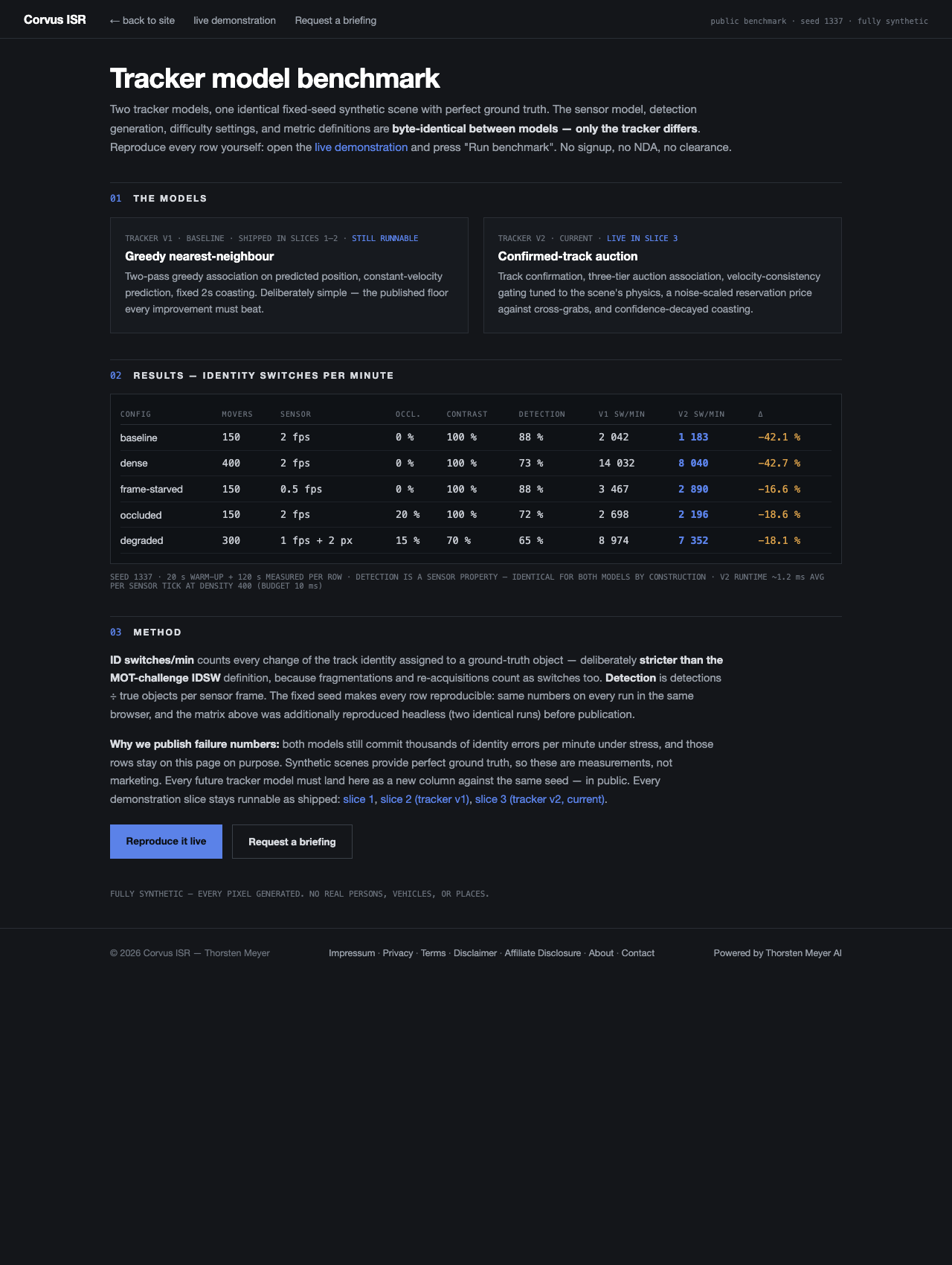
At Corvus ISR, transparency in tracking performance is paramount. They recently released a PUBLIC TRACKER BENCHMARK that rigorously compares two models on a synthetic scene with perfect ground truth. This approach ensures the evaluation is based solely on the models’ capabilities, free from real-world noise or ambiguity.

Prime made for students and young adults
- Fast, free delivery for dorm and study essentials
- Prime Video and Amazon Music included
- Member-only deals
The benchmark pits the baseline model, v1 “greedy nearest-neighbour,” against the more advanced v2 “confirmed-track auction.” The v1 employs a simple two-pass greedy association with constant-velocity prediction and fixed 2s coasting, serving as an industry-standard floor. In contrast, v2 incorporates sophisticated features like three-tier auction association, velocity-consistency gating, noise-scaled reservation prices, and confidence-decayed coasting, representing the latest in tracking technology.
Results reveal meaningful improvements: under a standard scenario with 150 movers at 2 fps, ID switches per minute drop from 2,042 to 1,183, a 42.1% reduction. Similar trends appear with higher densities—14,032 down to 8,040, a 42.7% decrease. Stress tests with degraded conditions like lower frame rates, occlusions, and noise show less dramatic but consistent improvements, illustrating the robustness of v2’s methods.
Why publish such detailed failure data? Because in synthetic scenes with perfect ground truth, every ID switch — including re-acquisitions and fragmentations — is a measurable, honest indicator of model performance. This level of transparency goes beyond marketing hype, emphasizing measurement over mere success stories. Vendors who only showcase successes risk obscuring the true challenges in tracking under stress.
From an engineering perspective, v2 achieves real-time performance, averaging approximately 1.2 milliseconds per sensor tick at the highest density tested (400 movers), with a worst-case of around 5ms. This efficiency ensures it can run live in a browser environment, and anyone can reproduce these results by opening the live demo and pressing “Run benchmark”—no sign-up or NDA required.
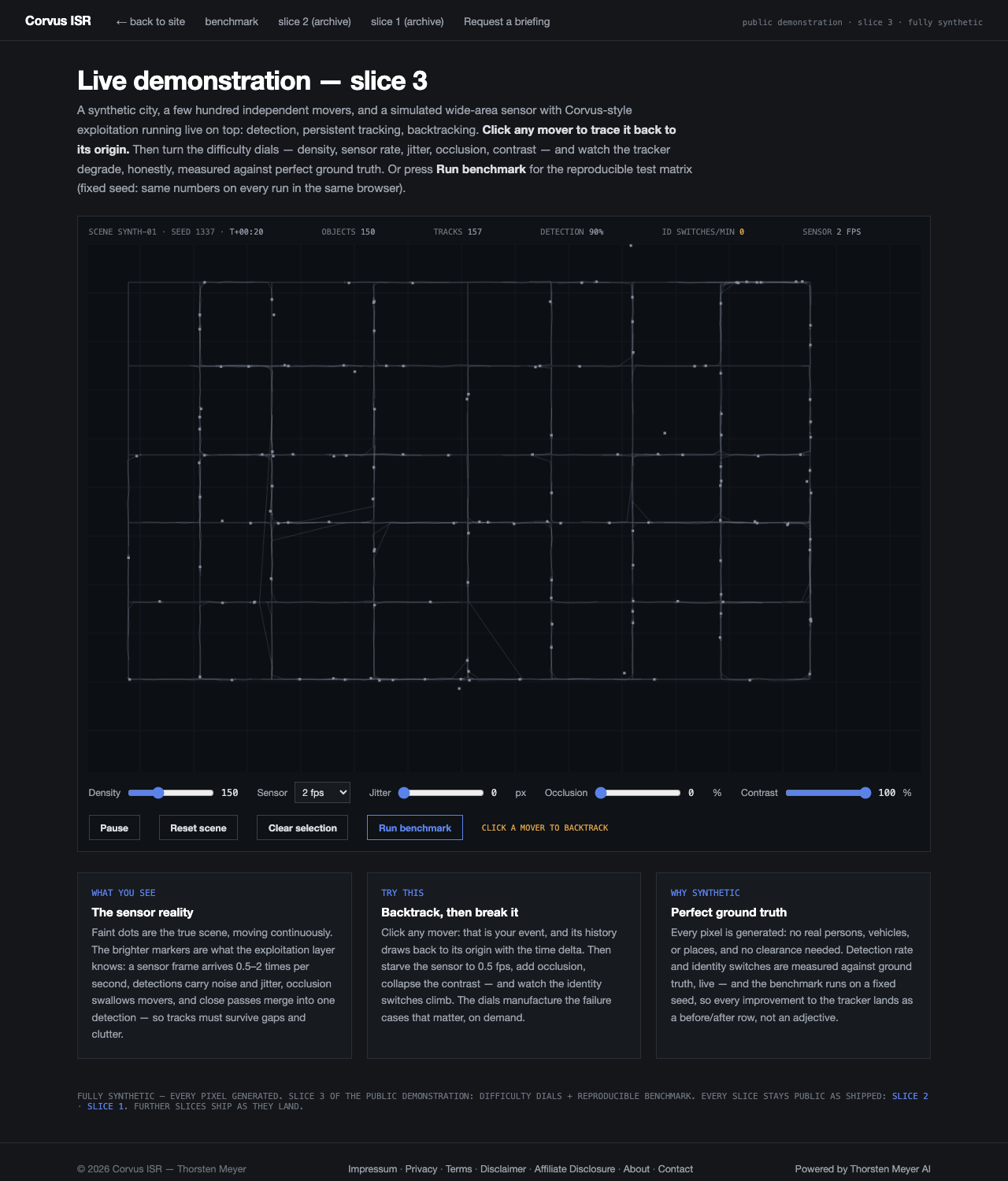
It’s important to underline that this entire evaluation is fully synthetic, with every pixel generated and no real-world data involved. The ground truth is perfect, and the published numbers serve as a critical metric for future tracker development. Every new model will be compared against this benchmark, ensuring a transparent and scientific approach to performance assessment. Curious minds are encouraged to explore the benchmark themselves and see the results firsthand.
real-time object tracking software
As an affiliate, we earn on qualifying purchases.
As an affiliate, we earn on qualifying purchases.
synthetic scene tracking benchmark
As an affiliate, we earn on qualifying purchases.
As an affiliate, we earn on qualifying purchases.
As an affiliate, we earn on qualifying purchases.
As an affiliate, we earn on qualifying purchases.
Halloween Picks
halloween
As an affiliate, we earn on qualifying purchases.