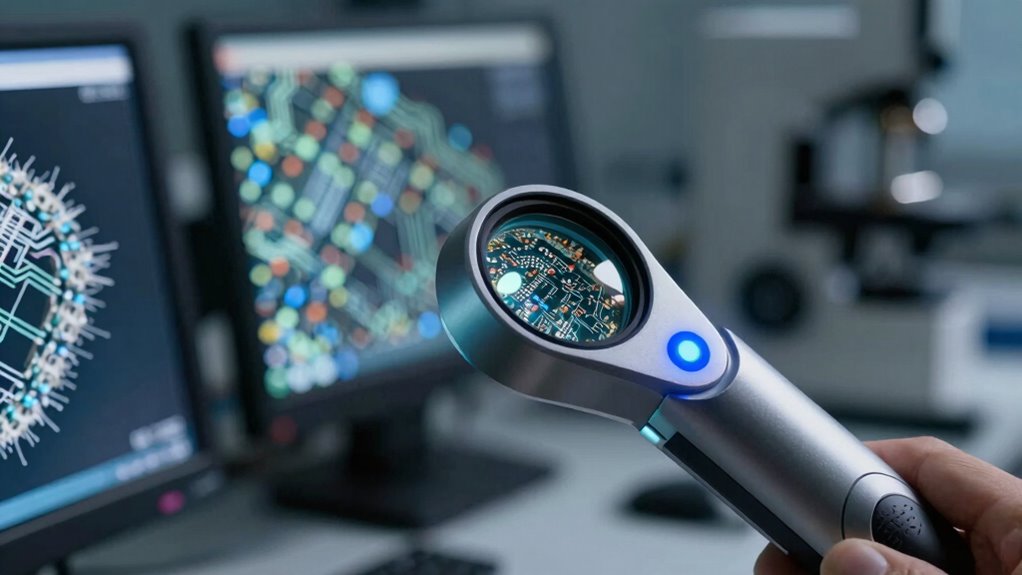

Digital magnification tools use advanced image processing and optical algorithms to enhance images at high zoom levels. They analyze pixels in real time, adjusting contrast, sharpness, and brightness to prevent blurriness or pixelation. These tools also use sophisticated interpolation techniques to fill in missing details smoothly and correct distortions, ensuring clarity. By combining these technologies seamlessly, they turn raw data into sharp, detailed visuals. Keep exploring to discover the full mechanisms behind this impressive technology.

Prime made for students and young adults
- Fast, free delivery for dorm and study essentials
- Prime Video and Amazon Music included
- Member-only deals
Key Takeaways
- Digital magnification tools utilize advanced image processing algorithms to enhance image clarity during zooming.
- Optical algorithms simulate real-world lens behavior to correct distortions and improve visual fidelity.
- Real-time analysis adjusts contrast, sharpness, and brightness to maintain detail at high magnification levels.
- Interpolation techniques fill in missing image information smoothly, preventing pixelation or blurriness.
- Seamless integration of image processing and optical models ensures sharp, detailed visuals during digital zooming.
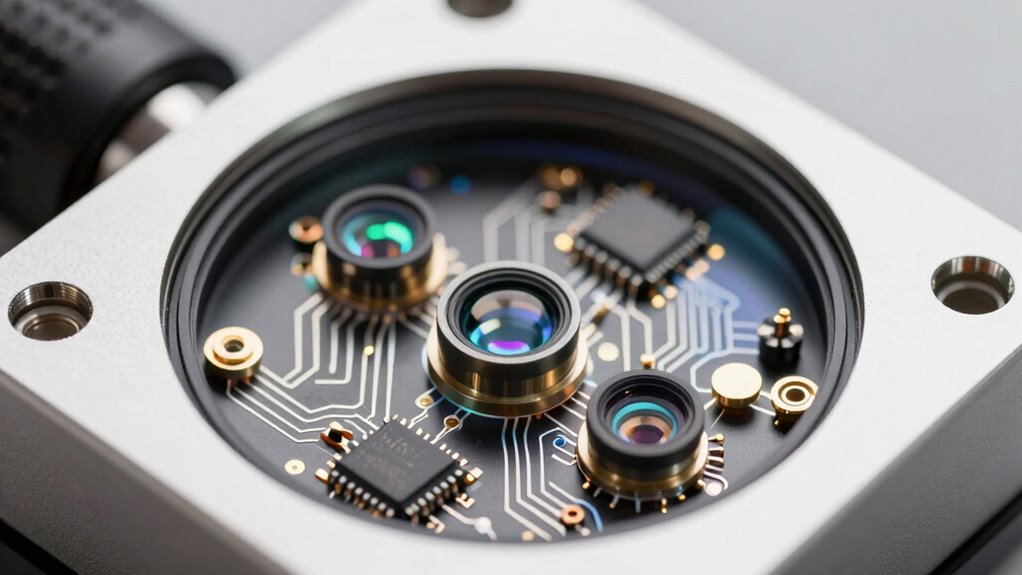
Digital magnification tools have become indispensable for enhancing vision and improving accessibility, but many users don’t realize the complex technology working behind the scenes. At their core, these tools rely heavily on sophisticated image processing techniques and optical algorithms to deliver clear, enlarged images. When you activate a magnification feature, it’s not just about zooming in; it’s about intelligently manipulating visual data to make details more visible without sacrificing quality. This process involves analyzing the original image, recognizing important features, and then enhancing or reconstructing those features to guarantee sharpness and clarity at higher magnifications.
Image processing plays a pivotal role here. It involves algorithms that analyze the pixels of the image in real-time, adjusting contrast, brightness, and sharpness to optimize visibility. These adjustments are essential because simply enlarging an image often results in pixelation or blurriness. Instead, the software uses advanced techniques to interpolate missing information, filling in gaps smoothly and seamlessly. This guarantees that when you zoom in, the image remains crisp and detailed, allowing you to see fine lines, small text, or intricate patterns clearly. The processing algorithms continuously adapt, providing a dynamic, user-friendly experience that feels natural, even at high levels of magnification. Additionally, real-time analysis ensures that adjustments happen instantly, maintaining the quality of the image during interaction. Incorporating advanced image processing techniques further enhances the accuracy of these adjustments, ensuring optimal clarity at all levels of zoom. The integration of mathematical models helps simulate optical systems, improving the overall effectiveness of the magnification.
Optical algorithms are another key component, working behind the scenes to refine how images are enlarged and displayed. These algorithms utilize mathematical models to simulate optical systems, compensating for distortions and aberrations that naturally occur in lenses or digital displays. By doing so, they enhance the perceived quality of the magnified image, making it appear more like what you’d see through a high-quality optical device. They also help in reducing noise or artifacts that can emerge during digital zooming, ensuring that the enlarged image remains as true to the original as possible. Furthermore, these algorithms often incorporate distortion correction to improve visual fidelity at higher magnifications, ensuring a seamless viewing experience.
Together, image processing and optical algorithms form a seamless system that transforms raw visual data into accessible, easily interpretable images. You might not see these processes, but they’re working tirelessly to guarantee you get the best possible view, whether you’re reading fine print, viewing detailed diagrams, or exploring artwork. Without these complex technological foundations, digital magnification tools wouldn’t offer the clarity and reliability that users depend on every day. Instead, they rely on a finely tuned combination of software and mathematical models to bring the world into sharper focus for you.
As an affiliate, we earn on qualifying purchases.
Frequently Asked Questions
How Do Digital Magnification Tools Improve Image Clarity?
Digital magnification tools improve image clarity by enhancing image resolution through advanced algorithms, which sharpen details and reduce blurriness. They utilize optical enhancement techniques to refine image quality, making features more distinct. By intelligently processing the image, these tools allow you to see finer details that might be missed with standard zoom. As a result, you gain clearer, more detailed visuals, making your observations more accurate and insightful.
What Are the Limitations of Current Magnification Technology?
Imagine trying to examine a tiny artifact, only to see fuzzy details despite high zoom. Current magnification tech faces optical limitations and hardware constraints, which hinder clarity at extreme levels. These limitations mean you can’t always achieve perfect detail, especially when hardware can’t process ultra-high resolutions or reduce noise effectively. As a result, you’ll often encounter image distortion or graininess, preventing you from seeing every detail clearly.
Can Digital Magnification Tools Be Used for Medical Diagnostics?
Yes, digital magnification tools are increasingly used in medical imaging to enhance diagnostic accuracy. They allow you to examine details in scans or images more closely, helping identify abnormalities that might be missed otherwise. While they don’t replace traditional methods, they serve as valuable aids for doctors, improving precision in diagnosis. Just remember, the effectiveness depends on the quality of the imaging and the tool’s resolution.
How Do Software Algorithms Enhance Magnified Images?
Software algorithms enhance magnified images by improving image resolution and clarity. They analyze pixel data, filling in gaps with predicted details to create sharper visuals. Through algorithm optimization, these tools reduce noise and distortions, making images clearer even at high magnifications. You benefit from more accurate, detailed views, which are essential for applications like medical diagnostics, where precision can impact diagnoses and treatment decisions.
What Future Advancements Are Expected in Digital Magnification?
In the future, you can expect digital magnification to become even more powerful with quantum computing, enabling ultra-precise image processing and real-time enhancements. Augmented reality will seamlessly overlay magnified details onto your environment, making inspection and learning more intuitive. These advancements will make images clearer, faster, and more interactive, transforming how you analyze, understand, and interact with tiny details in everyday and professional settings.
high zoom image enhancement software
As an affiliate, we earn on qualifying purchases.
As an affiliate, we earn on qualifying purchases.
Conclusion
You might be surprised to learn that over 70% of visually impaired users rely on digital magnification tools daily, transforming their ability to read and see clearly. These tools harness advanced algorithms and high-resolution displays, making everyday tasks more accessible. As technology continues to evolve, so does your potential to overcome visual challenges. Embrace these innovative solutions, and you’ll discover a world of clarity and independence you never thought possible.
optical distortion correction device
As an affiliate, we earn on qualifying purchases.
As an affiliate, we earn on qualifying purchases.
real-time image processing magnifier
As an affiliate, we earn on qualifying purchases.
As an affiliate, we earn on qualifying purchases.
Halloween Picks
halloween
As an affiliate, we earn on qualifying purchases.