
📊 Full opportunity report: Can An IEP Negotiation Simulator Change Parent Meetings? on IdeaNavigator AI — validation score, market gap, and execution plan.

Prime made for students and young adults
- Fast, free delivery for dorm and study essentials
- Prime Video and Amazon Music included
- Member-only deals
TL;DR
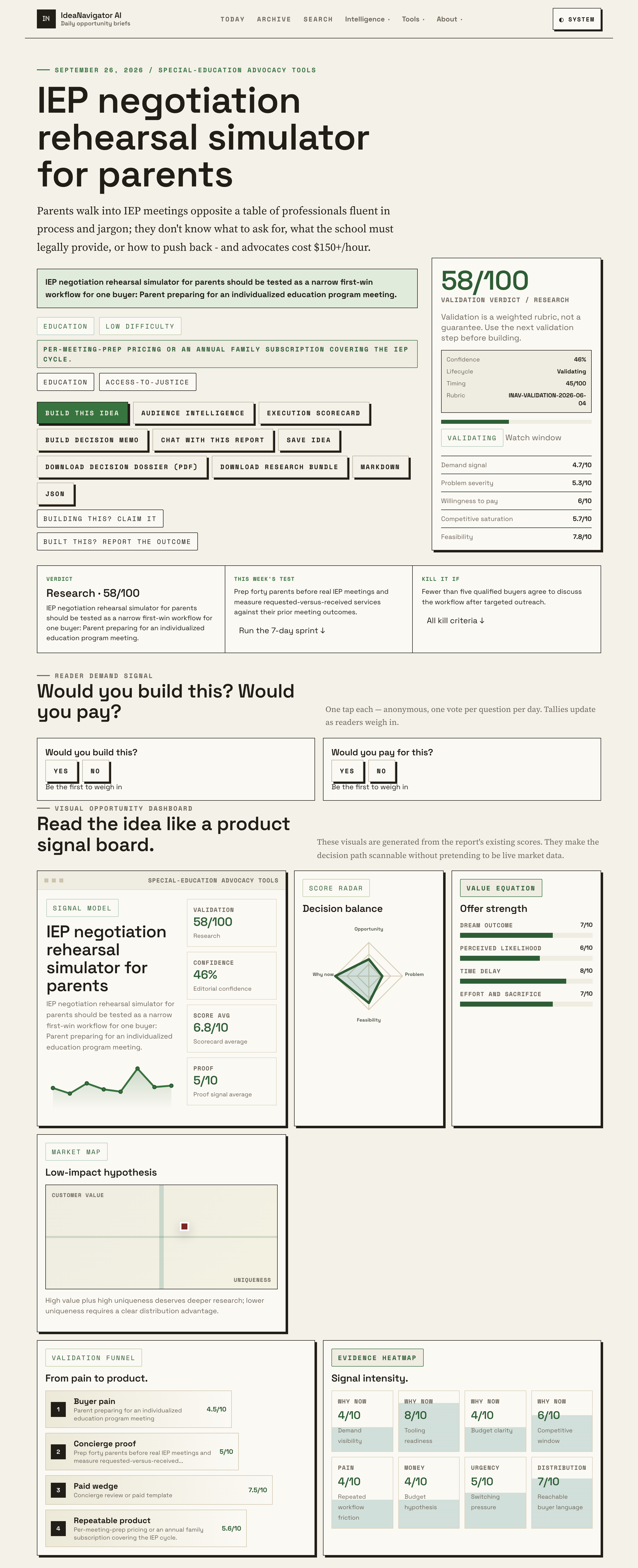
A proposal describes an AI simulator that would help parents prepare for individualized education program meetings by reviewing documents, explaining rights and rehearsing conversations. The concept has not been shown to improve services or meeting outcomes; its suggested first test would involve 40 parents.
IdeaNavigator AI’s proposal describes an AI-powered rehearsal simulator to help parents prepare for individualized education program (IEP) meetings, where families discuss support for a student with a disability. According to the proposal, the tool would review a child’s existing education documents, help a parent prepare requests and simulate school staff responses. The proposal reports no product launch or evidence of improved outcomes.
The proposed tool is aimed at one specific user: a parent preparing for an IEP meeting. Under the proposal, a parent would upload the current IEP and evaluation reports. The simulator would then explain relevant information in plain language, produce a list of possible requests with legal grounding and let the parent rehearse a meeting through role-play that includes realistic pushback.
The proposal presents rehearsal as a way to help parents hold their positions during discussions with school professionals. It says parents may face an unfamiliar process and terminology, while private advocates can cost $150 or more per hour. The proposal provides no survey, pricing study or comparison of advocacy costs to support those figures.
Two potential payment models are suggested: per-meeting preparation or an annual family subscription covering the IEP cycle. To test demand and usefulness, IdeaNavigator AI recommends preparing 40 parents before actual meetings and comparing requested services with services received, as well as with each family’s previous meeting outcomes. The proposal does not report a completed test.
Testing Support Before IEP Meetings
The proposal says a rehearsal tool could give parents a lower-cost way to organize questions and practice explaining what they want before meeting with a school team. It also suggests the tool could help families understand the documents they have. These are potential benefits identified in the proposal; it provides no evidence that role-play changes meeting decisions or increases the services a student receives.
The proposed comparison between requests and services received could provide an initial measure of whether families obtain what they seek. However, that measure alone would not show that the simulator caused any change. A student’s needs, school resources, family circumstances and the details of each meeting may all affect the outcome. Comparing results with a family’s prior meeting could offer context, but would not establish what would have happened without the tool.
The proposal identifies the accuracy of legal explanations as a product consideration. It does not describe how the tool would check its legal explanations, handle incomplete records or direct families to qualified help when a case calls for it.
A Narrow Proposed First Test
IdeaNavigator AI frames the concept as a focused first product for one buyer and one point in the IEP process, rather than as a general education assistant. The proposed sequence is document review, plain-language explanation, a grounded request list and meeting practice. This scope could make it easier to test whether parents find the preparation useful than a broader tool with multiple audiences and tasks.
IdeaNavigator AI offers two reasons for pursuing the concept: it says large language model role-play has become capable enough for realistic practice, and points to rising special-education identification rates alongside tighter district resources. The proposal supplies no dates, statistics, studies or specific districts to document those trends. They are presented as the rationale for the idea, not as findings established by the proposed product.
The proposed 40-parent trial is a validation plan, not a reported pilot. It would place the tool in real preparation situations and compare parents’ requests with the services received and their previous outcomes. The outline does not specify how participants would be recruited, how results would be recorded, or what level of change would count as success.
Accuracy and Results Remain Open
No simulator, completed trial or outcome data are described in IdeaNavigator AI’s proposal. It is unclear whether a product is being built, who would operate it, when it might become available or how families would pay for it. The proposed per-meeting and annual subscription models remain options, not announced prices.
The proposal does not explain how the tool would protect sensitive student records uploaded by families, verify the legal grounding of its recommendations or account for differences across jurisdictions. It also does not say whether special-education professionals or attorneys would review outputs, or how the system would respond when records conflict or do not provide enough information.
Even if a 40-parent test takes place, its results would need careful interpretation. The outline does not define a comparison method or explain how it would distinguish the simulator’s contribution from other factors shaping a meeting. The proposal provides no basis to conclude that the tool reduces the need for advocates, makes meetings less adversarial or improves educational services.
A Forty-Family Validation Plan
IdeaNavigator AI proposes preparing 40 parents for real IEP meetings and tracking what services they request and receive, then comparing those outcomes with each parent’s earlier meetings. The proposal presents this as a way to assess the workflow in practice and determine whether the measures can be collected.
The proposal gives no timeline, recruitment plan or results. It also does not explain how the tool would check legal guidance, protect uploaded records or define a meaningful outcome for families or districts to assess its practical value.
Key Questions
What would the proposed IEP simulator do?
According to IdeaNavigator AI’s proposal, it would review a parent’s current IEP and evaluation reports, explain them in plain language, suggest requests with legal grounding and provide role-play practice for the meeting.
Is the simulator available now?
IdeaNavigator AI’s proposal does not report a launched product, availability date or completed pilot. It describes a concept and a suggested test.
How would the proposal test whether it helps?
IdeaNavigator AI suggests preparing 40 parents before actual meetings and comparing requested services with services received and with their previous meeting outcomes. The proposal reports no test results.
Would the simulator replace a special-education advocate?
The proposal does not establish that it would. It presents lower-cost preparation as an opportunity, but provides no evidence that the tool could replace an advocate or address every family’s needs.
Source: IdeaNavigator AI
Fall Picks
fall essentials
As an affiliate, we earn on qualifying purchases.