📊 Full opportunity report: What Should TRT Patients Track Alongside Their Lab Results? on IdeaNavigator AI — validation score, market gap, and execution plan.

Prime made for students and young adults
- Fast, free delivery for dorm and study essentials
- Prime Video and Amazon Music included
- Member-only deals
TL;DR
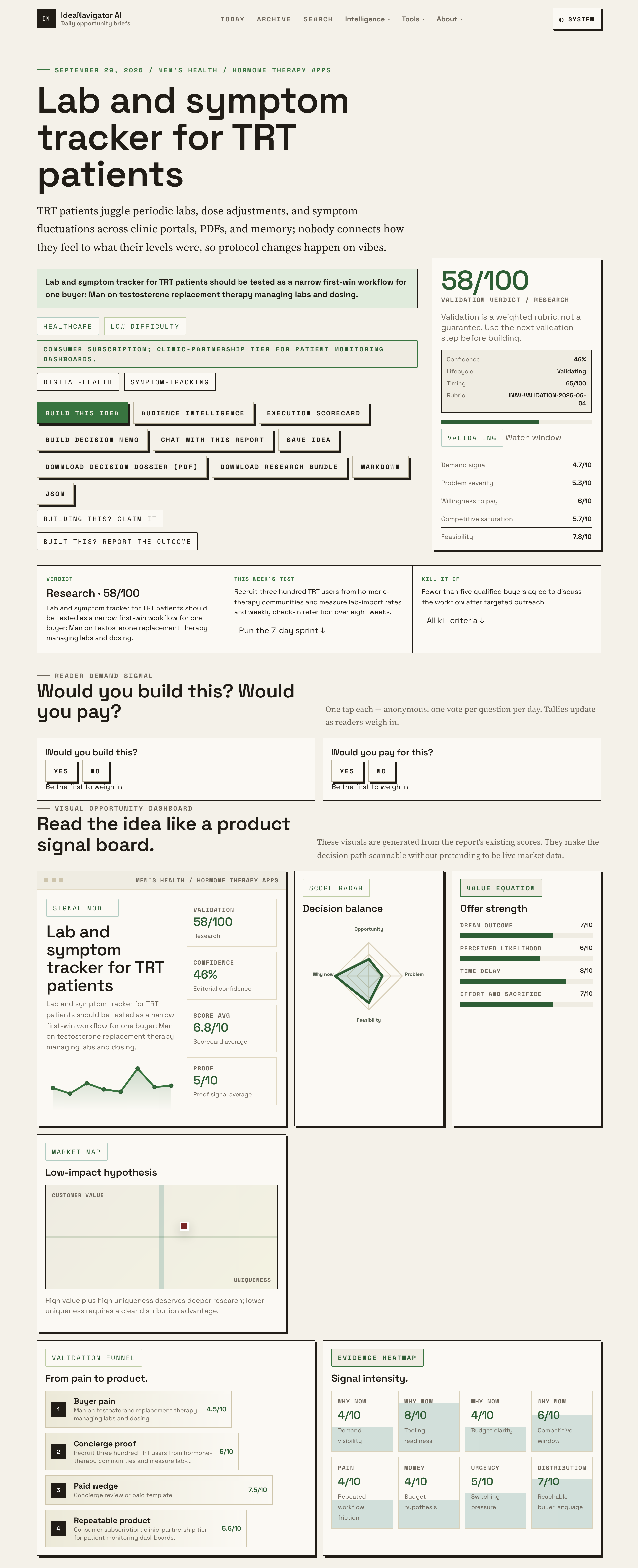
IdeaNavigator AI has outlined a proposed app for men on testosterone replacement therapy that would connect lab results and dose changes with daily symptom reports. The concept is at the proposal stage: no product launch, clinical evaluation, user results or clinic partnerships are reported.
IdeaNavigator AI has proposed a lab and symptom tracker for men on testosterone replacement therapy (TRT), designed to bring lab results, dose changes and daily symptom check-ins together. The idea describes a possible product and an eight-week validation plan; it does not report that an app has launched or that the proposed approach has been tested. These details come from the concept published on IdeaNavigator AI.
According to IdeaNavigator AI’s proposal, the app would let patients import lab PDFs, chart hormone panel results over time and record dose changes alongside daily symptoms. The concept also proposes trend summaries for clinic visits and flags for results outside target ranges. It does not identify a specific set of hormone tests, define target ranges or explain how the app would handle differences in a patient’s treatment plan.
IdeaNavigator AI frames the problem as fragmented patient records: people may encounter lab results in clinic portals and PDFs while tracking dose adjustments and changing symptoms separately, including from memory. The proposal’s premise is that a shared timeline could help patients and clinicians review how reported symptoms relate in time to laboratory results and treatment changes. That is the intended use described in the proposal, not a demonstrated clinical benefit.
For validation, IdeaNavigator AI suggests recruiting 300 TRT users through hormone-therapy communities and measuring lab-import rates and weekly check-in retention over eight weeks. The proposal provides no recruitment details, completed study, retention figures or thresholds for deciding whether the concept succeeds. It also outlines a potential business model combining a consumer subscription with a clinic-partnership tier offering patient-monitoring dashboards.
The proposal addresses a practical coordination problem: treatment involves periodic blood tests, prescribed dosing and patients’ reports of how they feel, while information may sit in separate places. A timeline that puts those records side by side could give patients a more organized account to bring to appointments. For clinicians, a concise history might help structure a discussion about symptoms and treatment changes.
That potential depends on accurate records and clinical interpretation. A flagged result cannot by itself establish that a dose should change or explain a symptom. IdeaNavigator AI’s proposal does not say how alerts would be reviewed, what safeguards would prevent patients from treating them as instructions, or how a clinic dashboard would fit into existing care. Those details matter because the app would handle health information and present it in a treatment setting.
The concept also describes a potential business opportunity in men’s health and hormone-therapy apps, but gives no market-size estimate or evidence of willingness to pay. Its suggested subscription and clinic tiers are business hypotheses. The proposed retention study could indicate whether users keep logging information for two months, but it would not alone establish improved health outcomes or clinician adoption.
How the Proposed Tracker Works
IdeaNavigator AI frames the idea around one user group: men managing TRT labs and dosing. Rather than proposing a general health record, it centers on a sequence of hormone panels, treatment adjustments and symptom check-ins. Its proposed first version would combine those elements and prepare a summary for a clinic visit.
IdeaNavigator AI says rising TRT prescriptions and telehealth clinics have created a larger population of patients managing care across providers. The proposal offers no prescription counts, dates, geographic scope or supporting data for that market claim, so the scale and timing of the trend cannot be assessed from the information provided. It also does not name a clinic, product team or development partner.
The next step described in the proposal is a user test, not a clinical trial. Its proposed measures—PDF import activity and weekly check-in retention over eight weeks—focus on whether people use the basic workflow. They do not test whether the charts or summaries are medically accurate, whether clinicians find them useful, or whether the app changes treatment decisions.
Testing and Safety Questions
IdeaNavigator AI does not state whether the app exists as a working product or whether user recruitment has begun. No results from the suggested 300-person test are available. The proposal also leaves unclear how lab PDFs would be read and checked for errors, how the app would set or personalize target ranges, and what would happen when results fall outside them.
The proposal does not describe privacy protections, data storage, consent, access controls or the process for sharing records with clinics. It also leaves open whether clinicians would review flagged values or summaries, how conflicting records from different providers would be handled, and whether the product would be offered only to adults under medical supervision. These issues would need answers before readers could judge the product’s safety, reliability or fit with clinical practice.
Finally, the proposed eight-week measures would reveal use patterns, not prove that the tracker improves care. IdeaNavigator AI presents no evidence about clinical outcomes, accuracy, user demand, subscription pricing or clinic interest. Those claims remain unestablished.
The Proposed Eight-Week Test
IdeaNavigator AI identifies recruitment of 300 TRT users from hormone-therapy communities as the next milestone in the concept, followed by eight weeks of tracking lab imports and weekly check-ins. It has not reported a start date, enrollment process or findings. Any update would need to clarify whether the test took place and what its measures showed, while distinguishing user engagement from evidence of clinical benefit.
If development proceeds, the proposal leaves practical questions for a later product description: which lab documents can be imported, how dose changes are recorded, how summaries are checked, and what the alerts mean for patients and clinicians. For now, the development is a product concept with a proposed validation plan, not a confirmed service or evaluated medical tool.
Source: IdeaNavigator AI
Key Questions
Has the TRT lab and symptom tracker launched?
No launch is reported. IdeaNavigator AI’s available description presents a product concept and a proposed test, without confirming that an app is available.
What would the proposed app track?
According to IdeaNavigator AI’s concept, it would combine imported lab PDFs, dose changes and daily symptom check-ins, then chart results over time and prepare summaries for clinic visits.
Has the tracker been shown to improve TRT care?
No outcome evidence is reported. The eight-week test proposed by IdeaNavigator AI would measure lab-import rates and weekly check-in retention, not establish clinical benefit.
What is the proposed test?
IdeaNavigator AI proposes recruiting 300 TRT users from hormone-therapy communities and tracking app engagement over eight weeks. The timing and results are unknown.
Source: IdeaNavigator AI
Fall Picks
fall essentials
As an affiliate, we earn on qualifying purchases.