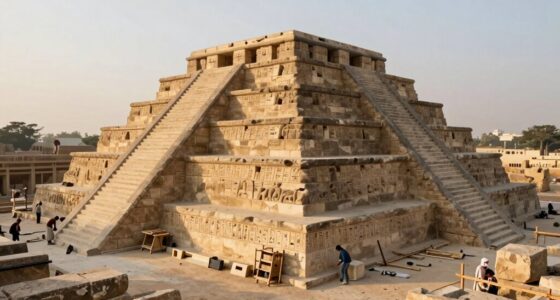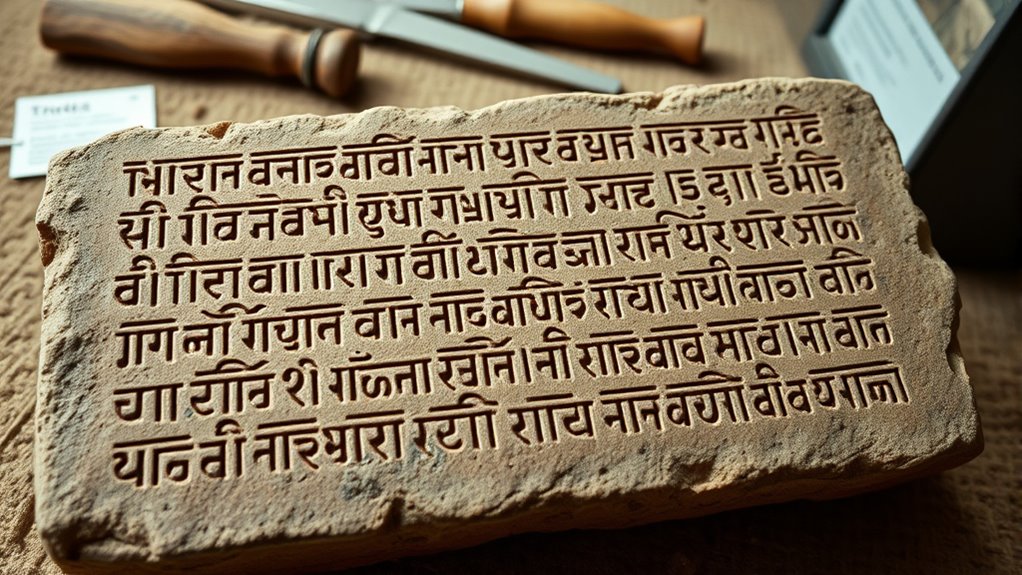

AI is making promising progress in deciphering the Indus script by analyzing vast datasets of symbols, patterns, and their context on artifacts. It helps identify recurring motifs, possible linguistic links, and connections to trade and social activities. While the script remains largely mysterious, AI’s capabilities could soon uncover its secrets, offering insights into ancient society. To uncover how these breakthroughs might change our understanding, keep exploring this fascinating development further.
Key Takeaways
- AI rapidly analyzes extensive Indus inscriptions, identifying patterns that humans may overlook for potential translation clues.
- Pattern recognition techniques help correlate symbols with trade practices, offering insights into their possible meanings.
- Machine learning models can detect language-like structures, advancing the possibility of deciphering the script’s phonetic or semantic content.
- AI’s ability to map symbol distributions aids understanding of social and economic contexts, supporting translation efforts.
- Overall, AI accelerates progress toward deciphering the Indus script, bringing us closer to understanding its language and purpose.
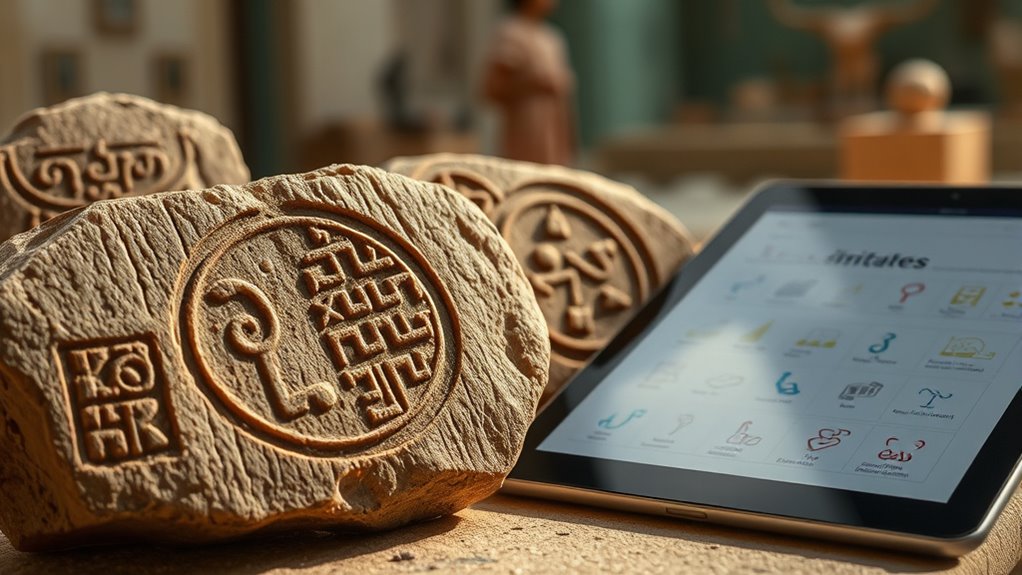
Have you ever wondered if artificial intelligence can unseal the mysteries of the ancient Indus Script? For centuries, this undeciphered writing system has puzzled archaeologists and linguists alike. It appears on seals, pottery, and artifacts from the Indus Valley Civilization, but no one has cracked its code. Now, with advancements in AI, there’s renewed hope that we might finally understand what this script was trying to convey. The key could lie in analyzing patterns, symbols, and contexts that human researchers have struggled to interpret. AI’s ability to process massive datasets at lightning speed gives it an edge in decipherment efforts, especially when it comes to complex, symbol-rich scripts like that of the Indus.
One promising avenue involves examining the role of the Indus Script in ancient trade. Traders of the time likely used these symbols to mark goods, convey ownership, or facilitate exchanges across regions. If AI can identify recurring motifs and their associations with specific items, it might reveal underlying meanings tied to commerce and exchange networks. This approach could help us understand how trade influenced the script’s development and usage, offering clues to its purpose. By analyzing the spatial distribution of symbols on seals and artifacts, AI models can map trade routes and interactions, shedding light on the economic life of the Indus Valley. This, in turn, could guide scholars towards a successful script decipherment by connecting symbols with known trade practices.
Using machine learning algorithms trained on existing data, researchers are now attempting to recognize patterns that might resemble language structures or symbolic systems. These algorithms sift through thousands of inscriptions, looking for repetitions, variations, and correlations that could indicate phonetic or semantic values. While we don’t yet have a Rosetta Stone for the Indus Script, AI-driven pattern recognition offers a new angle that humans alone might overlook. As more data becomes available, AI can refine its models, increasing the chances of uncovering the script’s underlying logic. Additionally, advances in pattern recognition technology further enhance AI’s capacity to analyze complex symbols and uncover potential linguistic structures. If successful, this breakthrough could unseal insights into the social, religious, and economic aspects of the Indus civilization.
Ultimately, AI’s contribution to the script decipherment isn’t just about translating symbols—it’s about opening a window into a forgotten world. By integrating AI analysis with archaeological context, we stand a better chance of unraveling the purpose and meaning behind these ancient symbols. The prospect of finally understanding the Indus Script excites many because it connects us more deeply to our shared human past. If AI can crack this mystery, it would mark a monumental step forward in deciphering ancient trade networks and revealing the stories of a civilization long gone.

Paekole AI Translation Earbuds, Real-Time Two-Way Translator in 198+ Languages, Audifonos Traductores Inglés Español, 3-in-1 Translating Headphones for Travel, Business & Learning
🌍 AI REAL-TIME TRANSLATOR & 198 LANGUAGES: Break language barriers instantly. These two-way translation earbuds support 198 languages…
As an affiliate, we earn on qualifying purchases.
As an affiliate, we earn on qualifying purchases.
Frequently Asked Questions
Has Any AI Successfully Deciphered Ancient Scripts Before?
You might wonder if AI has ever cracked ancient scripts before. While AI hasn’t fully deciphered major scripts like the Indus Script, it has made progress with cryptogram puzzles using advanced language pattern recognition. AI tools analyze patterns and context, helping humans decode some ancient texts. However, complete translation remains challenging, so no AI has yet succeeded in fully deciphering complex scripts independently.
What Challenges Does the Indus Script Pose for AI Translation?
You might think AI can crack any code, but the Indus script proves otherwise. Its linguistic ambiguity and script complexity make translation a nightmare. Despite AI’s advances, it struggles with the lack of a clear Rosetta Stone and consistent symbols. Ironically, technology’s progress highlights just how much we still don’t understand about this ancient puzzle, leaving us guessing and AI still on the sidelines of true decipherment.
Are There Any Existing AI Models Specifically Designed for Ancient Language Analysis?
You’ll find that existing AI models for ancient language analysis mainly rely on machine learning and linguistic models. These models help identify patterns and similarities with known languages, but they’re often limited due to scarce data. While some efforts focus on deciphering ancient scripts, no specialized AI fully understands or translates them yet. Advances continue, but translating complex scripts like the Indus remains a significant challenge for AI technology.
Could AI Help in Dating the Origins of the Indus Script More Accurately?
While it’s tempting to hope for a quick breakthrough, AI’s role in refining linguistic dating and archaeological correlation is more about gradual progress. You might see AI analyze patterns or artifacts to suggest possible timelines, helping researchers narrow down the script’s origins. However, this process still requires careful interpretation and validation, meaning AI can assist, but it doesn’t replace expert judgment in accurately dating the Indus script’s beginnings.
How Might AI Impact Our Understanding of Indus Valley Civilization?
You might find that AI markedly impacts your understanding of the Indus Valley Civilization by revealing trade networks and societal structure. AI analyzes archaeological data, uncovering patterns and connections previously overlooked. This helps you visualize how communities interacted and organized themselves, offering new insights into their economy, social hierarchy, and cultural practices. Ultimately, AI deepens your comprehension of the civilization’s complexity, enriching your historical perspective and guiding future research efforts.
ancient script deciphering software
As an affiliate, we earn on qualifying purchases.
As an affiliate, we earn on qualifying purchases.
Conclusion
You might think AI will easily unfasten the mysteries of the Indus script, but the truth is, it’s not that simple. While AI can analyze patterns and suggest translations, it can’t confirm their accuracy without proven context. The theory that AI will finally decode the script is promising, but it’s still just a tool, not a miracle. Until we find more definitive clues, AI remains a helpful assistant, not the ultimate answer to this ancient puzzle.
INDUS VALLEY CIVILIZATION: Tracing the Origins, Achievements, and Enduring Legacy of an Ancient South Asian World of Cities, Trade, and Culture
As an affiliate, we earn on qualifying purchases.
As an affiliate, we earn on qualifying purchases.

Machine Learning for Archaeological Applications in R (Elements in Current Archaeological Tools and Techniques)
As an affiliate, we earn on qualifying purchases.
As an affiliate, we earn on qualifying purchases.