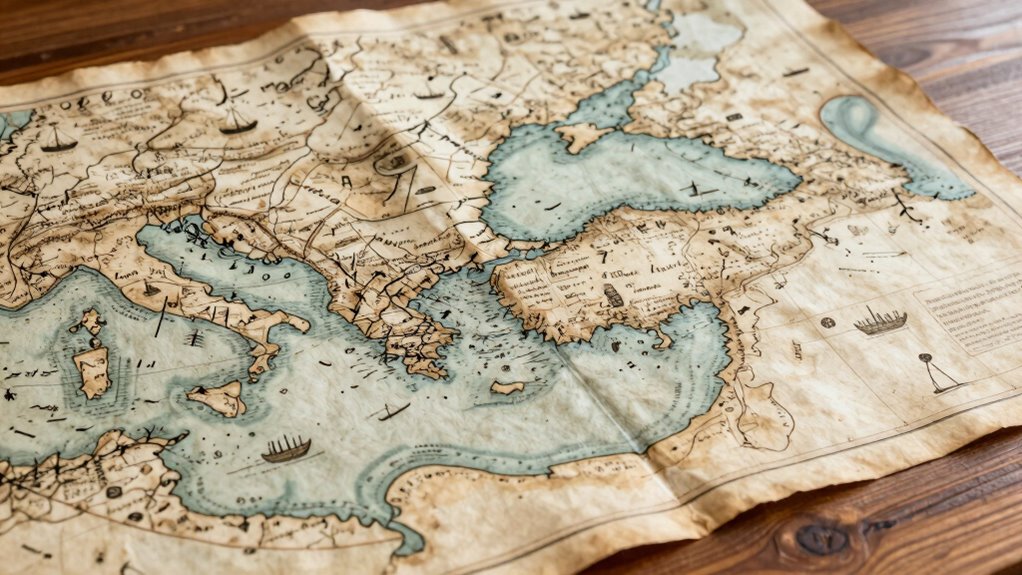

Theories about the Sea Peoples suggest they were a loose confederation of groups from the Aegean, Anatolia, or central Mediterranean who disrupted trade and civilizations during the Late Bronze Age collapse. Archaeological evidence like pottery, city ruins, and inscriptions support different origins, with most experts leaning toward a diverse, migrated coalition rather than a single nation. If you explore further, you’ll uncover the intriguing details behind these ancient maritime raiders and their lasting impact.
Key Takeaways
- Theories suggest the Sea Peoples were a confederation of displaced groups from the Aegean and eastern Mediterranean.
- Archaeological evidence indicates their origin through pottery styles, trade disruptions, and destruction layers at ancient sites.
- Linguistic and cultural artifacts point to diverse origins, supporting a coalition of multiple distinct groups.
- Their raids and invasions contributed to the collapse of major civilizations like Egypt and the Hittites.
- Most scholars view them as a complex network of maritime groups whose disruptions triggered the Late Bronze Age collapse.
Top picks for "peopl mystery theory"
Open Amazon search results for this keyword.
As an affiliate, we earn on qualifying purchases.
Who Were the Sea Peoples? Origins and Identity
Who exactly were the Sea Peoples, and where did they come from? You might wonder if they were just raiders or something more complex. Historians believe they were a confederation of groups that disrupted established trade networks, impacting entire civilizations. They likely originated from regions around the Aegean, Anatolia, or even the central Mediterranean, but their exact origins remain uncertain. What’s intriguing is how they maintained diplomatic contacts with some states, possibly recruiting or forming alliances before attacking. These interactions suggest they weren’t solely destructive but also engaged in political and economic exchanges. The confederation of groups behind the Sea Peoples may have had diverse motives, including economic gain and territorial expansion. Their origins and motives continue to puzzle experts, but their influence on ancient history is undeniable. Understanding their background helps piece together the broader puzzle of late Bronze Age collapse.
Were the Sea Peoples Aegean or Anatolian Migrants? What Does the Evidence Say?

Determining whether the Sea Peoples originated from the Aegean or Anatolian regions remains a complex challenge for historians. Evidence suggests an Aegean migration, as many of their artifacts and pottery styles resemble those from the late Bronze Age Aegean civilizations. However, signs of Anatolian influence are also present, including similarities in weaponry and potential linguistic links. Some scholars argue that the Sea Peoples could have been a mix of groups from both regions, driven by socio-economic pressures or climate changes. The lack of definitive inscriptions or clear archaeological links makes it difficult to conclusively assign their origins. Overall, current evidence leans toward a stronger Aegean connection, but Anatolian ties cannot be entirely discounted. The true story likely involves a complex interplay of influences from both regions.
Did the Sea Peoples Form a Confederation or Consist of Multiple Groups?
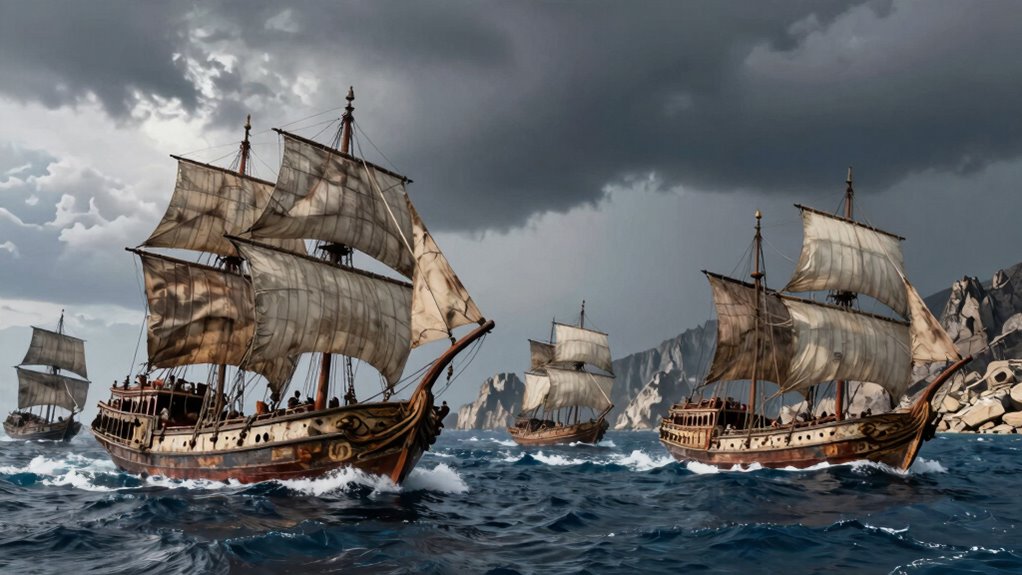
Did the Sea Peoples operate as a unified confederation or consist of multiple distinct groups? This question drives many confederation theories, which suggest they may have been a loosely connected alliance rather than a single entity. Evidence from different archaeological sites and textual sources points to the likelihood of multiple groups working together for common goals. Some scholars argue the Sea Peoples were a confederation of diverse groups, each with its own identity, coordinating attacks and migrations. Others believe they might have been a collection of independent, unrelated groups acting separately but with similar motives. The current consensus leans toward a multi-group coalition, but definitive proof remains elusive, leaving this aspect of their organization open to interpretation. Additionally, the varying types of piercings and cultural practices observed in artifacts may reflect the diverse origins of these groups. The diverse origins and cultural expressions support the idea of a multifaceted coalition rather than a single unified force. Furthermore, analyzing archaeological evidence from multiple sites enhances our understanding of the possible interactions and shared strategies among these groups. Recent studies on cultural diversity among artifacts reinforce the notion that these groups maintained distinct identities while cooperating. The presence of linguistic differences in inscriptions and records further suggests a complex network of separate communities working in tandem.
What Archaeological Finds Support Different Theories About the Sea Peoples?
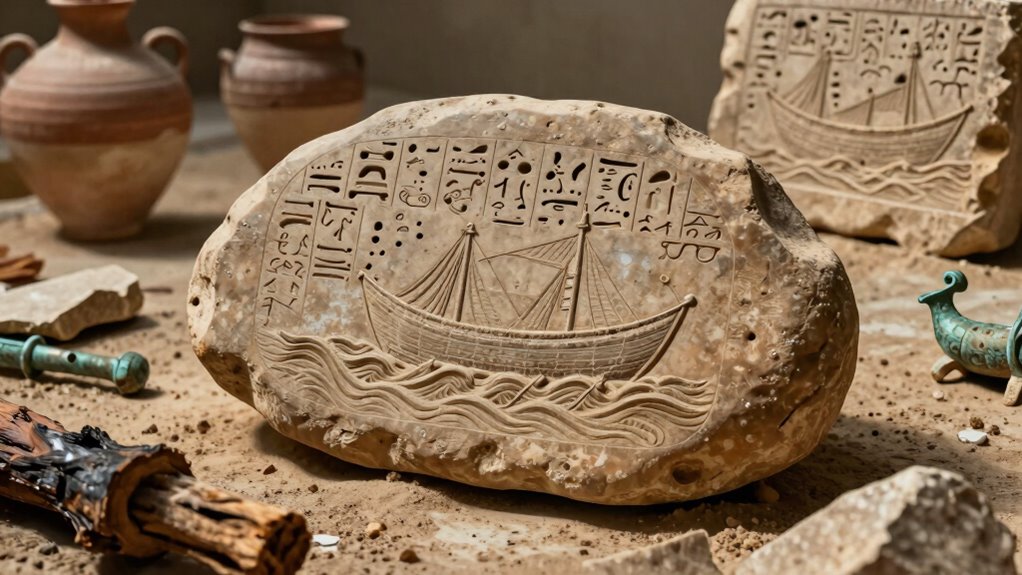
Archaeological finds like ancient pottery and city ruins offer clues about who the Sea Peoples might have been. Maritime art and inscriptions also provide insights into their origins and movements. Examining these artifacts helps you understand the different theories about their identity and role in history. Additionally, recent discoveries and analyses continue to shed light on their possible connections to broader airless paint sprayers, advancing our understanding of this enigmatic group. For example, the analysis of material composition of pottery shards can reveal trade networks and cultural influences related to the Sea Peoples. Moreover, the study of archaeological context helps contextualize their role within broader ancient Mediterranean societies, highlighting how archaeological methodology enhances our interpretations of these findings.
Ancient Pottery Evidence
Have ancient pottery shards ever revealed clues about the origins and movements of the Sea Peoples? Pottery analysis plays a vital role in understanding their migration patterns. By examining styles, materials, and manufacturing techniques, archaeologists can trace cultural connections across regions. Artifact distribution also provides valuable insights; for instance, clusters of similar pottery found across different sites suggest coordinated movements or trade. Some pottery types resemble those from the Aegean or Anatolia, supporting theories that the Sea Peoples originated from these areas. Conversely, unique local styles hint that they might have been a confederation of different groups. Additionally, recent advances in sustainable fabric analysis have allowed researchers to study ancient textiles and pottery residues, offering further clues about trade and cultural exchanges. Techniques such as residue analysis have even identified traces of food and dyes, enriching our understanding of their daily lives. Moreover, the development of advanced dating techniques has helped establish more precise chronological frameworks for these artifacts. The use of ceramic compositional analysis techniques provides detailed information about the clay sources, helping to pinpoint specific geographic origins of the pottery. Furthermore, the integration of geochemical sourcing methods has enhanced the accuracy of identifying artifact provenance. Overall, pottery evidence helps piece together the puzzle, offering tangible links to the possible origins and routes of these mysterious maritime groups.
Fortifications and City Ruins
Pottery shards provide valuable insights into the origins of the Sea Peoples, but their movements and motivations are also revealed through the fortifications and city ruins they left behind. Fortification analysis shows abrupt changes in defensive structures, indicating sudden invasions or migrations. City ruin patterns reveal destruction layers consistent with targeted attacks or widespread upheaval. For example, some sites display massive fortification walls suddenly abandoned or damaged, supporting theories of violent incursions. Others show signs of systematic destruction, suggesting coordinated efforts. The following table summarizes key archaeological features:
| Site | Fortification Analysis | City Ruin Patterns |
|---|---|---|
| A | Sudden wall collapses | Burned layers, collapse debris |
| B | Reinforced defenses pre-invasion | Disorganized ruins |
| C | Abandoned structures | Evidence of sieges |
These findings help piece together the Sea Peoples’ disruptive impact. Additionally, fortification modifications at various sites underscore the dynamic nature of their invasions and the evolving defensive strategies employed by local populations. Recognizing these modifications highlights the importance of archaeological evidence in understanding historical events.
Maritime Art and Inscriptions
Maritime art and inscriptions offer critical clues that help scholars evaluate different theories about the Sea Peoples. Through inscriptions analysis, you can uncover references to ships, battles, and origins that hint at their identity. These clues often appear in ancient reliefs, pottery, and wall carvings, revealing maritime activities and interactions. Consider these key points: 1. Maritime art depicting ships with unique designs suggests specific cultural origins. 2. Inscriptions mentioning “foreign lands” or “sea raiders” point to their movements and impact. 3. Iconography and symbols in inscriptions help associate the Sea Peoples with particular regions or groups. Additionally, analyzing archaeological finds such as shipwrecks and port structures can provide further insights into their maritime capabilities and routes. The discovery of ancient shipwrecks with distinct construction styles can also help identify the technological advancements and trade networks of these groups.
Did the Sea Peoples Cause the Collapse of Egypt and the Hittite Empire?
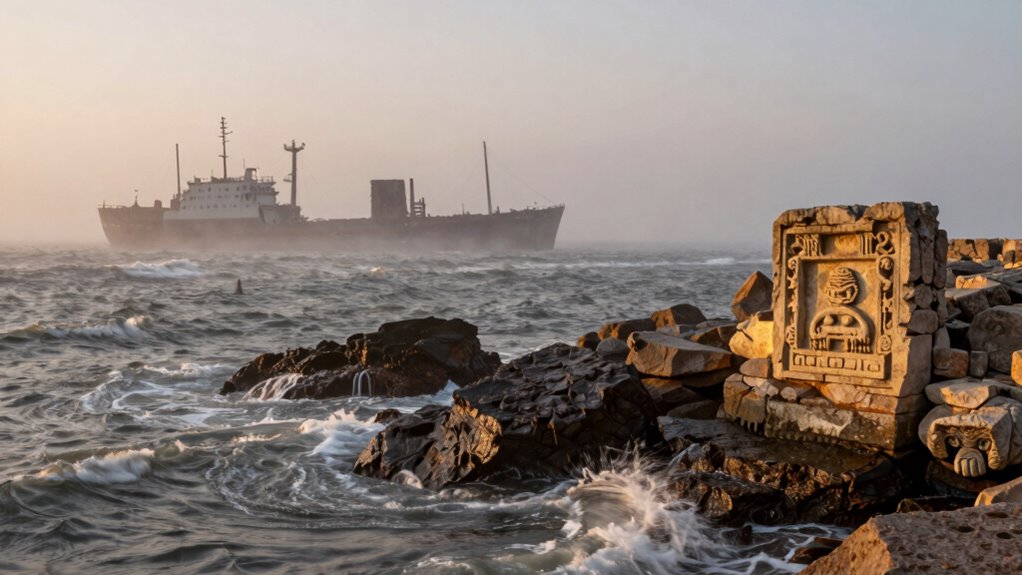
Did the Sea Peoples truly cause the collapse of Egypt and the Hittite Empire? Historians debate whether myth vs. reality explains their impact, or if cultural diffusion played a larger role. Theories suggest they may have hastened decline, but not caused it alone. To understand their influence, consider this:
| Factors Influencing Collapse | Evidence | Impact |
|---|---|---|
| Invasion | Destruction layers | Disruption |
| Internal Strife | Political unrest | Weakening |
| External Pressures | New trade routes | Shift in power |
| Cultural Diffusion | Art, technology | Cultural blending |
| Myth vs. Reality | Historical records | Perception vs. fact |
Theories vary, but the truth likely involves complex interactions, not just a simple invasion. Additionally, archaeological evidence plays a crucial role in uncovering the true extent of their impact, helping to differentiate between myth and fact. Researchers also examine historical records to better understand the events and assess the accuracy of ancient accounts. Moreover, studying material culture provides further insights into the extent of cultural diffusion during this period.
Which Theory About the Sea Peoples Is Most Widely Accepted and Why?

Most scholars agree that the most accepted theory is that the Sea Peoples were a confederation of displaced groups from the eastern Mediterranean. You’ll find this supported by archaeological finds, linguistic clues, and cultural similarities across regions. These pieces of evidence help explain their widespread impact and why this explanation remains the dominant view. Additionally, the presence of advanced maritime technology among these groups suggests they were capable of significant naval movements, further reinforcing this theory.
Archaeological Evidence Supporting
Archaeological evidence largely supports the theory that the Sea Peoples were a confederation of displaced groups who migrated from the Aegean and eastern Mediterranean regions, rather than a single, unified invading force. You can see this through disrupted trade networks found in ancient records, indicating widespread movement and upheaval. Additionally, linguistic analysis of inscriptions and artifacts shows a mix of languages, confirming diverse origins. Here are three key points:
- Altered trade routes suggest large-scale migration and economic disruption.
- Varied pottery styles and weaponry reflect multiple cultural influences, not a single civilization.
- Inscriptions mentioning different groups reinforce the idea of a confederation rather than a unified army.
Together, this evidence paints a picture of a fragmented, displaced peoples’ movement across the Mediterranean.
Linguistic and Cultural Clues
Linguistic and cultural clues play a significant role in shaping the prevailing theory about the Sea Peoples. By analyzing ancient texts and artifacts, scholars suggest these groups might have originated from regions connected by trade routes, influencing their language and customs. Many believe their mythical origins hint at stories passed through generations, blending myth with historical truth. The table below highlights key linguistic and cultural indicators:
| Evidence Type | Significance |
|---|---|
| Language similarities | Connects Sea Peoples to specific regions |
| Mythical origins | Reflects shared stories and cultural roots |
| Trade route influences | Shows interactions with ancient civilizations |
| Religious practices | Indicates cultural exchanges |
| Art and artifacts | Reveal cultural identities and origins |
These clues support the idea that the Sea Peoples had diverse, interconnected backgrounds shaped by trade and myth.
Historical Consistency and Impact
Scholars widely accept the theory that the Sea Peoples were a confederation of displaced maritime groups who caused significant upheaval during the late Bronze Age. Their raids led to widespread trade disruptions, destabilizing regional economies and weakening established powers. This chaos facilitated cultural diffusion, as different groups interacted and exchanged ideas amid the turmoil. Understanding their impact involves three key points:
- Trade disruptions prompted shifts in regional alliances and economic practices.
- Cultural diffusion introduced new technologies and beliefs, reshaping civilizations.
- The upheaval contributed to the collapse of major Late Bronze Age civilizations, marking a pivotal transition.
This theory aligns with archaeological evidence and historical records, making it the most widely accepted explanation for the Sea Peoples’ enduring influence on history.
Frequently Asked Questions
How Do Scholars Differentiate Between the Various Groups Within the Sea Peoples?
You differentiate between the Sea Peoples groups by examining linguistic analysis and archaeological evidence. Linguistic analysis helps identify distinct languages or dialects in inscriptions and artifacts, revealing cultural differences. Archaeological evidence, like unique weapon styles, settlement patterns, or pottery, also highlights variations among groups. By combining these methods, scholars can classify and understand the diverse origins and identities of the Sea Peoples, even when their origins remain somewhat mysterious.
What Role Did Climate Change Play in the Sea Peoples’ Migrations?
Climate shifts likely triggered the Sea Peoples’ migrations by causing resource scarcity and disrupting their traditional livelihoods. As temperatures changed and rainfall patterns became unpredictable, you’d find that food and water sources dwindled, pushing these groups to seek new lands. This environmental pressure may have fueled their movements across the Mediterranean, making climate change a significant factor in their displacement and subsequent conflicts with established civilizations.
Are There Modern Groups Believed to Be Descended From the Sea Peoples?
You might wonder if modern groups descend from the Sea Peoples. Genetic traces suggest some Mediterranean populations share ancient DNA, hinting at continuity. However, cultural continuity is harder to prove, as civilizations evolved and absorbed others. While no specific group claims direct descent, these genetic links imply that descendants of the Sea Peoples could exist today, blending into broader regional communities over millennia.
How Reliable Are the Ancient Sources Describing the Sea Peoples’ Invasions?
Ancient sources about the Sea Peoples‘ invasions are quite unreliable, as they often blend mythical origins with historical events. You should know that archaeological evidence is limited and open to interpretation, making it hard to fully confirm their accounts. While some inscriptions mention the Sea Peoples, the lack of concrete evidence means you should treat these descriptions cautiously, recognizing they may be influenced by myth and bias rather than factual accuracy.
Could the Sea Peoples’ Movements Be Linked to Broader Geopolitical Shifts?
Like a domino effect, the Sea Peoples’ movements can be linked to broader geopolitical shifts. You see, trade disruptions and a power vacuum in the Eastern Mediterranean likely pushed these groups to migrate, seeking stability. These upheavals weren’t isolated; they reflected larger regional changes that prompted the Sea Peoples to act. Their invasions probably responded to these shifting dynamics, making their movements part of a bigger story of political and economic transformation.
Conclusion
As you explore the Sea Peoples mystery, you’ll see that around 1200 BCE, their raids impacted over 20 ancient civilizations, including Egypt and the Hittite Empire. This staggering statistic highlights how a potentially small group of migrants or confederation could have reshaped history. While debates continue, most scholars lean toward them being Aegean migrants who formed a loose confederation, making their story one of the most intriguing puzzles in ancient history.