📊 Full opportunity report: What Kid-Facing Vendors Need To Know About Consent Management on IdeaNavigator AI — validation score, market gap, and execution plan.

Prime made for students and young adults
- Fast, free delivery for dorm and study essentials
- Prime Video and Amazon Music included
- Member-only deals
TL;DR
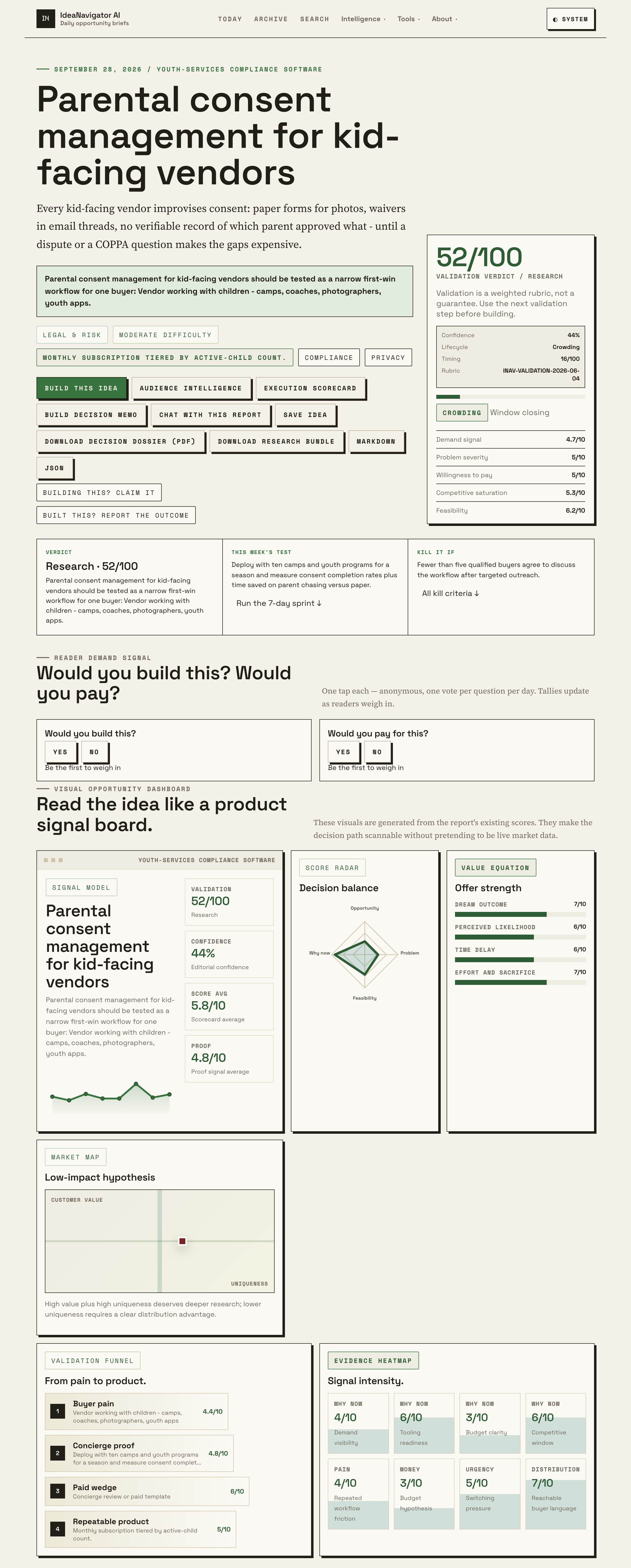
An IdeaNavigator AI proposal outlines a consent management product for camps, coaches, photographers and youth apps. It recommends testing phone-based parental consent flows with ten youth programs for one season; no launch, pilot results or customer data are reported.
IdeaNavigator AI’s proposal describes a parental consent management product for camps, coaches, photographers and youth apps, and suggests a pilot involving ten youth programs for one season. The proposal says vendors may currently manage permissions through paper forms and email. It does not report a product launch, participating customers or pilot results.
In its proposal, IdeaNavigator AI says the product would let vendors create branded consent flows for parents to complete on their phones. Suggested permission types include photo use, data collection, medical information and liability. The proposal also calls for identity checks suited to the risk of each permission, a consent record for each child, expiry tracking and an export for audits.
IdeaNavigator AI describes the problem as fragmented recordkeeping: a vendor may have a photo form on paper, a waiver in an email thread and no readily verifiable record of which parent approved which use. The proposal argues those gaps can become costly during a dispute or a question about compliance. It gives no specific examples of disputes, enforcement cases or measured losses.
The proposal suggests a monthly subscription priced by active-child count. To test the idea, it recommends deploying the product with ten camps or youth programs for a season and comparing consent completion rates and staff follow-up time with paper processes. It supplies no pricing, product specifications, pilot partners or results.
A Record for Every Permission
IdeaNavigator AI’s proposal says permission records can affect whether vendors working with children can use a photograph, collect information or act on a medical disclosure. It argues that a single organized record could help staff find what a parent approved and whether that permission has expired, as well as respond to questions from families or review their practices.
The proposal’s commercial case rests on replacing several informal processes with one workflow. If vendors spend substantial time chasing forms or struggle to locate approvals, a service that reduces that work may have practical value. However, IdeaNavigator AI provides no measured time savings, completion rates, customer demand or evidence vendors would pay a monthly fee. Its suggested season-long pilot is intended to test those points.
The proposal also cites legal compliance as part of the opportunity, but it does not establish that a particular product would meet any specific legal requirement. Consent records can support administration; appropriate disclosures, verification steps and retention periods may depend on a vendor’s activities and applicable rules. Buyers would need to evaluate those details before relying on a tool.
How Vendors Handle Consent
IdeaNavigator AI’s proposal focuses on businesses and programs that interact with children, including camps, coaches, photographers and youth apps. These organizations may seek different permissions for different purposes, such as using a child’s image or collecting personal information. The proposal groups these needs into one product concept and calls for records that distinguish permissions by child and track expiry.
The proposal cites COPPA updates, state laws and parent challenges to photo and data use as reasons vendors may be paying more attention to defensible records. It does not identify particular legal changes, jurisdictions, enforcement actions or survey evidence. These points are therefore the proposal’s stated rationale, not a detailed account of current law or a quantified trend.
IdeaNavigator AI recommends testing a workflow with one buyer group before treating youth-services compliance software as a broader market. It says a pilot with ten programs over a season could assess whether parents complete forms, whether staff spend less time pursuing responses and whether the records suit day-to-day operations. The proposal does not say that this test has begun.
Demand and Compliance Still Untested
IdeaNavigator AI’s supplied proposal does not confirm a product or pilot. It does not say whether a vendor is building the service, whether any camps or youth programs have agreed to participate, or when a test might take place. It reports no results on consent completion, follow-up time, customer retention or willingness to pay.
The proposal describes identity checks only as appropriate to each risk tier. It does not detail the specific checks, how the service would handle sensitive records, or how vendors would set expiration and retention rules. It also does not explain how the product would address differing legal obligations across locations or types of data. These remain product and compliance questions for a pilot and any later implementation.
A Seasonal Pilot Would Test Use
IdeaNavigator AI proposes a season-long test with ten camps or youth programs. It suggests measuring how often parents complete consent flows and how much staff time the product saves on follow-up compared with paper. Those measures could help assess whether the workflow addresses a recurring operational problem.
The proposal gives no schedule, pilot enrollment process or decision criteria. It also leaves open how participating programs would handle different consent types, how identity checks would work, what records vendors could export and how subscription pricing would relate to active-child counts. Until results are reported, the product’s usability, demand and business case remain prospective.
Source: IdeaNavigator AI proposal, “Parental Consent Platform”
Key Questions
Has a parental consent product launched?
No launch is reported. The IdeaNavigator AI material describes a product proposal and a possible pilot, not an available service.
Who is the proposed product for?
IdeaNavigator AI’s proposal targets vendors working with children, including camps, coaches, photographers and youth apps.
What would the product manage?
The proposal describes phone-based flows for permissions such as photo use, data collection, medical information and liability, with per-child records, expiry tracking and audit exports.
How would the idea be tested?
IdeaNavigator AI recommends a season-long pilot with ten camps or youth programs, measuring completion rates and staff time spent following up with parents compared with paper.
Source: IdeaNavigator AI
Fall Picks
fall essentials
As an affiliate, we earn on qualifying purchases.