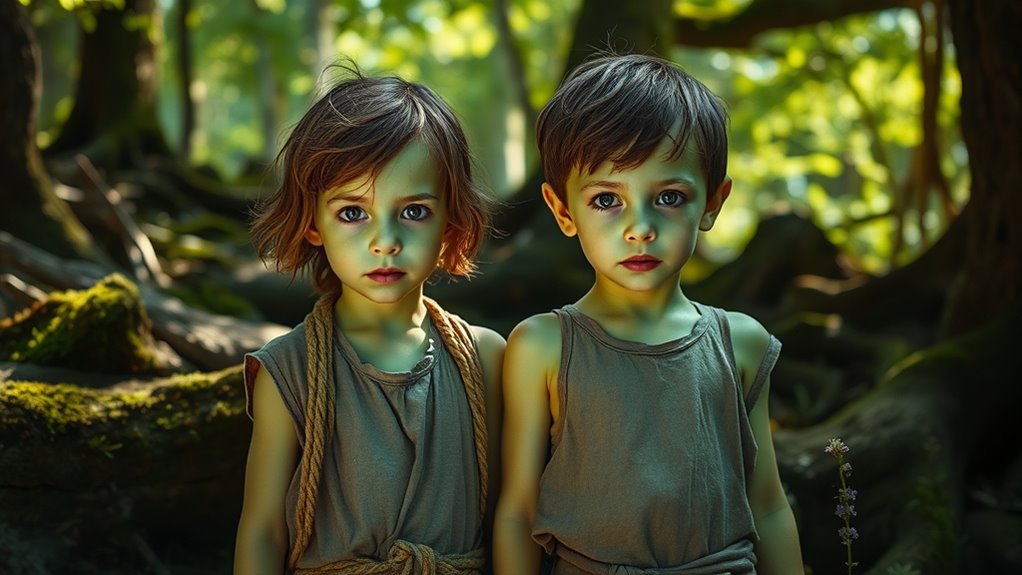

The Green Children of Woolpit blend medieval folklore with scientific explanations, showing how mysterious events can be understood through both myth and genetics. You might see them as fairy children or wonder if a rare genetic condition caused their green skin and strange language. These stories reveal how people in the past interpreted the unknown, but modern science offers plausible answers. If you want to uncover more about how folklore meets genetics, there’s plenty more to explore.

Prime made for students and young adults
- Fast, free delivery for dorm and study essentials
- Prime Video and Amazon Music included
- Member-only deals
Key Takeaways
- The legend blends medieval folklore with possible explanations involving rare genetic conditions causing green skin.
- Folklore depicts the children as supernatural or otherworldly beings, while modern science suggests a genetic or environmental origin.
- Genetic anomalies like hypochromic conditions could account for the green pigmentation seen in the children.
- The story illustrates how cultural interpretation of unexplained phenomena often merges myth with emerging scientific understanding.
- Scientific insights provide plausible explanations that bridge the mystical elements of the legend with biological possibilities.
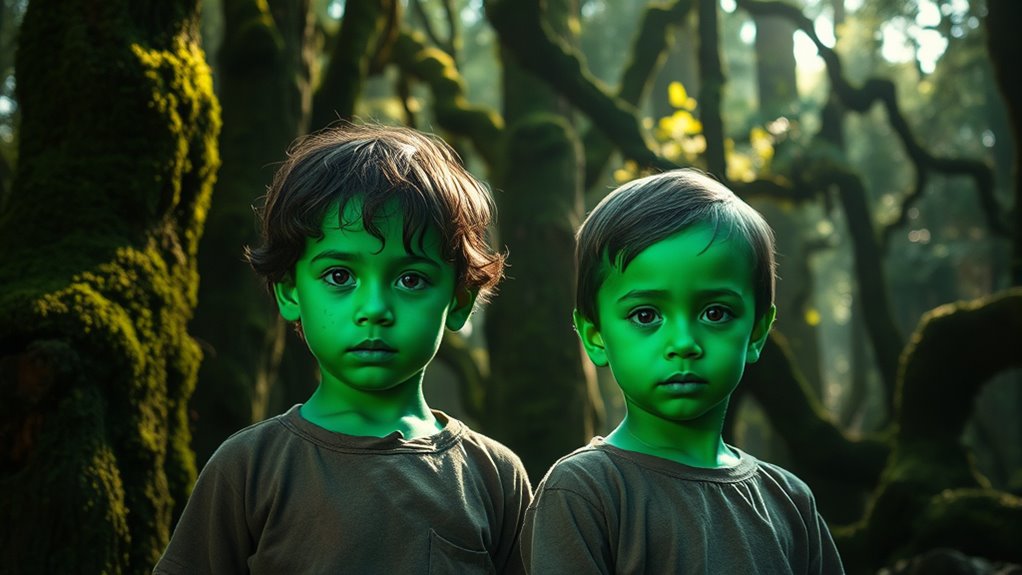
The Green Children of Woolpit are among England’s most mysterious legends, capturing imaginations for centuries. As you explore their story, you’ll find yourself immersed in a blend of medieval folklore and the intriguing possibilities of genetic anomalies. These children, discovered in the 12th century village of Woolpit, appeared suddenly, their skin a vivid shade of green. They spoke an unknown language and seemed unaware of their origins, sparking curiosity and speculation that still lingers today. Their story has become a captivating puzzle, inviting you to explore both myth and science.
In medieval folklore, tales like the green children often served as allegories or moral lessons. They reflect a time when the natural world was shrouded in mystery, and unexplained phenomena were seen as signs from the supernatural or divine. The children’s unusual appearance and behavior fit neatly into this context, making them subjects of local legend and religious interpretation. Some believed they were fairy or elf children, symbols of supernatural forces at play. Others thought they might be from a different realm altogether, their green hue marking them as otherworldly beings. These stories were passed down through generations, shaping local beliefs and adding layers of myth to the already enigmatic account.
However, modern science offers a different perspective. Some researchers suggest that the children’s green skin might have resulted from a rare genetic anomaly, such as a condition that affects skin pigmentation. The possibility of genetic anomalies provides a rational explanation that aligns with our understanding of biology, especially considering the child’s symptoms and the limited medical knowledge available at the time. It’s conceivable that they suffered from a condition that caused abnormal skin coloration, possibly exacerbated by environmental factors or nutritional deficiencies. Advances in medical science have enabled us to better understand such rare conditions, offering plausible explanations rooted in genetics that can account for their unusual appearance. This scientific angle doesn’t diminish the mystery but instead offers a plausible explanation rooted in genetics, bridging the gap between folklore and reality.
As you consider both viewpoints, you may realize that the story of the green children embodies the human desire to understand the inexplicable. Whether as a product of medieval imagination or a rare genetic condition, their legend endures because it taps into universal questions about identity, origin, and the unknown. The tale continues to enchant because it blurs the lines between myth and science, inviting you to ponder how our ancestors made sense of strange phenomena and how modern knowledge can provide new insights. Ultimately, the green children of Woolpit remain a fascinating example of how folklore and genetics intertwine, forever enriching the story of one of England’s most enduring legends.
Popular right now

Dyson V8 Cyclone Cordless Vacuum

eufy E25 Robot Vacuum and Mop Combo with HydroJet Roller Mop

KitchenAid Artisan 5-Qt Tilt-Head Stand Mixer, Cardamom
As an affiliate, we earn on qualifying purchases.
Frequently Asked Questions
Are There Any Modern Sightings Similar to the Woolpit Children?
You’re curious if modern sightings resemble the Woolpit children. Recent reports sometimes mention unusual children with strange appearances or behaviors, sparking curiosity. While these stories often lack verification, they echo the mystery of Woolpit’s green children. You should remain skeptical, but it’s intriguing how folklore persists in modern sightings. Keep an eye on local reports and investigations, as some may have roots in unexplained phenomena or cultural stories.
What Are the Latest Genetic Studies Related to Green Pigmentation?
Genetic mutations play a key role in pigmentation research, helping scientists understand unusual skin colors like green. Recent studies explore how specific gene variations can cause atypical pigmentation, shedding light on rare conditions and potential evolutionary traits. You might find that advances in genetic analysis reveal new insights into pigmentation, enabling better diagnosis and treatment. Ongoing research continues to deepen our understanding of how genetics influence skin and eye color variations, including rare pigmentation anomalies.
Could Environmental Factors Explain the Children’s Unusual Appearance?
You might think environmental factors can’t cause such unusual appearances, but biological adaptations often respond to environmental influences. While genetics play a key role, exposure to specific elements or conditions could lead to pigmentation changes. For example, certain environmental influences might trigger biological adaptations that result in greenish skin or hair. So, yes, environmental factors could potentially explain the children’s unusual appearance, highlighting how environment and biology interact in unexpected ways.
How Do Different Cultures Interpret the Woolpit Legend?
You might notice that different cultures interpret the Woolpit legend through diverse cultural variations and mythological interpretations. Some view the green children as symbols of otherworldly beings or divine messengers, while others see them as reflection of local fears or natural phenomena. These interpretations reveal how folklore adapts to cultural beliefs, emphasizing spiritual or supernatural themes unique to each society, which enriches the story’s meaning across different regions.
Is There Any Scientific Evidence Supporting the Folklore’s Origins?
You might find it interesting that scientific evidence supporting the folklore’s origins is limited, yet some believe coincidences hint at genetic anomalies or environmental explanations. While there’s no concrete proof, genetic anomalies could explain their green skin or unusual features, and environmental factors might have influenced their condition. Though intriguing, these ideas remain speculative, and the story’s true origins continue to spark curiosity rather than definitive scientific validation.
Conclusion
As you reflect on the green children of Woolpit, you see how folklore and genetics intertwine like threads in a tapestry. Their story, mysterious as a shadow at dusk, invites you to contemplate both myth and science. Just as rivers carve valleys over time, legends shape our understanding of the past. Ultimately, their tale reminds you that sometimes, truth and imagination dance together, creating a story as captivating as a song that lingers long after it’s finished.