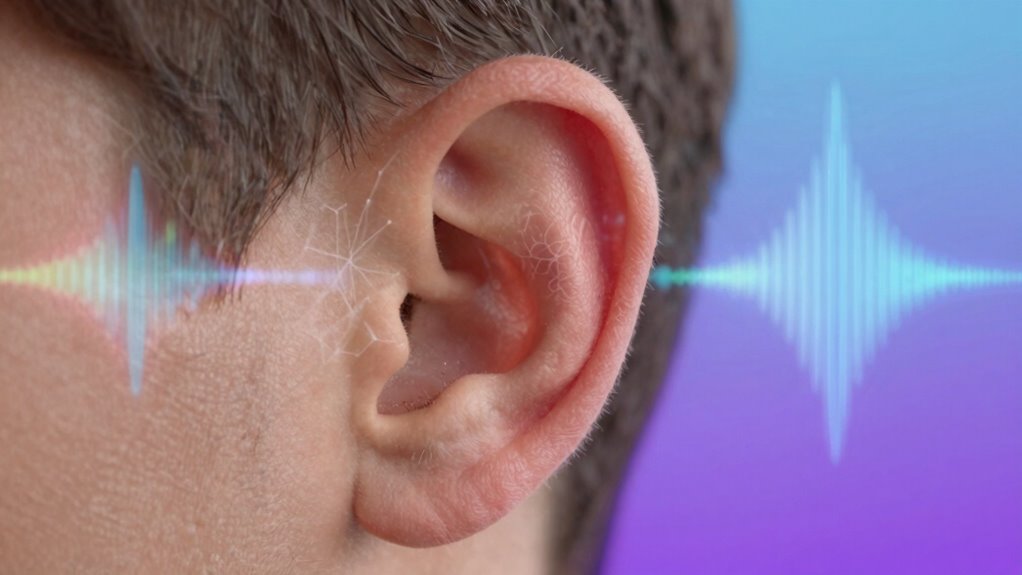

You tend to mishear or missee things because your brain processes incomplete or ambiguous sensory signals in real time, often filling in gaps based on expectations and prior knowledge. Background noise, fast speech, distractions, and fatigue overload your auditory processing system, making errors more likely. Your perceptions are shaped by what you anticipate, leading to automatic corrections or misinterpretations. Understanding how your brain manages this information reveals why mistakes happen—if you’re curious, you’ll uncover more behind these perceptual quirks.

Prime made for students and young adults
- Fast, free delivery for dorm and study essentials
- Prime Video and Amazon Music included
- Member-only deals
Key Takeaways
- Background noise, fast speech, and unclear pronunciation overload auditory processing, leading to mishearing.
- Cognitive distractions, fatigue, and multitasking reduce the brain’s ability to accurately interpret sounds and visuals.
- Expectations and prior knowledge fill in gaps, sometimes causing misperceptions of ambiguous signals.
- The brain tends to fill in missing sensory details, which can result in incorrect perceptions when signals are incomplete.
- Limited cognitive resources increase the likelihood of errors in noisy or complex environments.
Have you ever wondered why you sometimes mishear or missee words, even when you’re confident you understood? It’s a common experience, and the answer lies in how your brain processes sensory information. Your auditory processing system plays a vital role in decoding sounds, but it’s not always perfect. When you listen, your brain filters and interprets a vast amount of auditory data in real time. Sometimes, background noise, fast speech, or unclear pronunciation can overload this system, leading to misinterpretations. It’s not that you’re not paying attention; rather, your brain is doing its best to make sense of incomplete or ambiguous signals.
Cognitive interference is another key factor. Your brain constantly juggles multiple streams of information, and when something interferes—like distractions, fatigue, or multitasking—it can disrupt the smooth flow of processing auditory or visual stimuli. For example, if you’re trying to focus on a conversation in a noisy café, your brain may struggle to distinguish the speaker’s words from the background noise. This interference can cause you to mishear words or even see something differently than what’s actually there. It’s a natural consequence of your brain prioritizing and managing limited cognitive resources. When these resources are taxed, errors become more likely.
Furthermore, your expectations and prior knowledge influence what you perceive. If your mind expects to hear or see something specific, it can fill in gaps or interpret ambiguous stimuli in a way that aligns with your assumptions. This cognitive bias can lead to mishearing or misseeing, especially in situations where the signals are weak or unclear. For instance, if you’re reading a message and the text is slightly blurry, your brain might automatically correct it based on context or familiarity, which sometimes results in an incorrect perception. Additionally, understanding how your sensory processing system functions highlights why sometimes your brain may fill in missing details, especially when sensory information is incomplete or ambiguous. Recognizing these sensory processing mechanisms can help you better understand why your perceptions may sometimes be inaccurate.
As an affiliate, we earn on qualifying purchases.
Frequently Asked Questions
Can Age Affect How Often People Mishear or Missee Things?
Yes, age can affect how often you mishear or missee things. As you grow older, auditory processing can slow down, making it harder to distinguish sounds accurately. Additionally, cognitive decline may impair your ability to interpret what you hear or see, leading to more misunderstandings. These changes can increase the likelihood of mishearing or misseeing, especially in noisy environments or complex situations, highlighting how aging impacts sensory and cognitive functions.
Do Cultural Differences Influence Mishearing and Misreading?
Research shows that up to 60% of miscommunications stem from cultural differences. You’ll find that cultural context and language nuances profoundly influence mishearing and misreading. When you’re exposed to different languages or customs, subtle meanings can be lost or misunderstood, leading to errors. You need to be aware that these differences shape how you interpret messages, making cultural awareness essential for clearer communication across diverse groups.
How Does Multitasking Impact Auditory and Visual Perception Accuracy?
When you multitask, divided attention causes sensory overload, which reduces your perception accuracy. Your brain struggles to process auditory and visual information simultaneously, leading to misunderstandings or missed details. This divided attention hampers your ability to focus on one task, increasing the likelihood of mishearing or misreading. To improve perception accuracy, you should minimize multitasking, especially in situations requiring careful listening or reading.
Are There Specific Conditions That Increase Susceptibility to Mishearing?
Like a modern-day detective lost in a foggy maze, you’re more susceptible to mishearing when you’re tired, stressed, or distracted. Conditions like noisy environments or rapid conversations heighten the chances of falling for auditory illusions or visual misinterpretations. When your focus wanes, your brain struggles to distinguish real sounds from illusions, making you more prone to miscommunication. Staying alert and minimizing distractions helps protect you from these perceptual pitfalls.
Can Training Improve Accuracy in Perceiving Spoken and Written Language?
Yes, training can improve your accuracy in speech perception, both spoken and written. Through cognitive training, you can enhance your ability to process sounds, differentiate similar words, and interpret context more effectively. Regular practice with targeted exercises sharpens your listening skills and visual language recognition. Over time, these improvements boost your overall comprehension, making you less prone to mishearing or misreading, and help you become a more attentive and accurate communicator.
As an affiliate, we earn on qualifying purchases.
Conclusion
Next time your words slip through your mind’s cracks or your eyes play tricks on you, remember it’s just your brain’s way of dancing to a complex tune. Like a seasoned artist blending colors, your mind interprets signals, sometimes adding a splash of confusion. So, when mishearing or misseeing happens, don’t fret—it’s just your brain’s quirky way of turning the ordinary into a fascinating mosaic of perception. Embrace the mystery; it keeps life beautifully unpredictable.
As an affiliate, we earn on qualifying purchases.
As an affiliate, we earn on qualifying purchases.
Halloween Picks
halloween
As an affiliate, we earn on qualifying purchases.