
🔍 Read the full analysis: AI And The Changing Work Of Farmers on ThorstenMeyerAI.com

Prime made for students and young adults
- Fast, free delivery for dorm and study essentials
- Prime Video and Amazon Music included
- Member-only deals
TL;DR
Farm technology is automating tasks such as tractor steering and dairy milking, but adoption is uneven and labor-intensive strawberry picking remains difficult to mechanize. USDA figures show 22% of U.S. farms used at least one precision-farming practice in 2025, while 398,258 H-2A temporary farm jobs were certified that fiscal year. The source does not establish that AI alone is driving these changes.
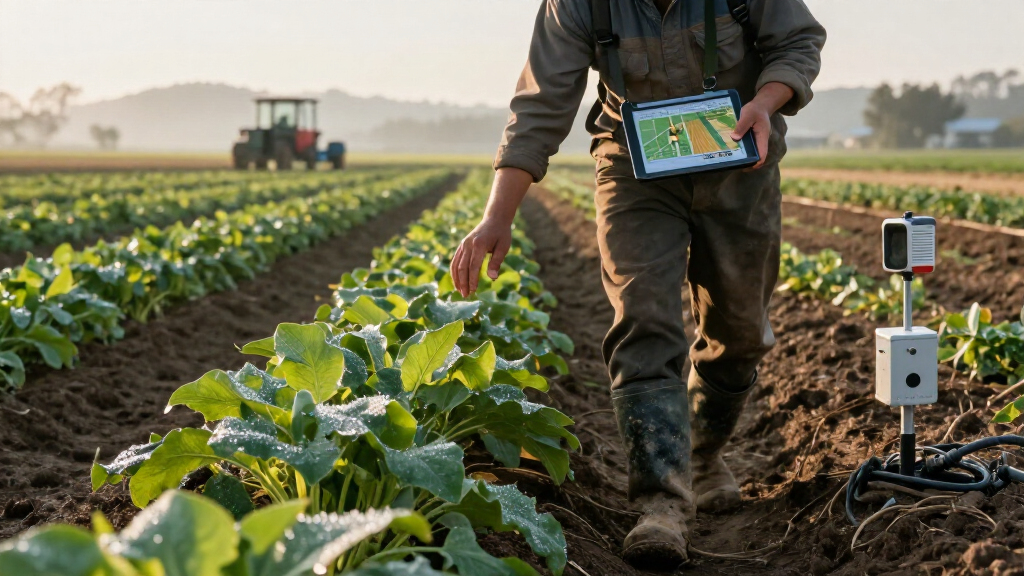
Farm automation is advancing unevenly: satellite-guided tractors are common across many acres of major U.S. crops, and robots milk some dairy herds, but people still pick most soft fruit by hand. A report published November 29, 2026, by ThorstenMeyerAI.com traces the shift and points to a divide between large farms that can adopt precision tools and smaller operations that may not.
U.S. Department of Agriculture data cited in the report show guidance systems were used on more than half of the acres planted to corn, soybeans, winter wheat and cotton in the most recent crop-year observations listed. Auto-steer use on U.S. corn acres rose from 5.3% in 2001 to 58% in 2016. Those are acreage measures, not the share of farms using the technology.
Farm-level adoption is lower. USDA statistics show 22% of U.S. farms used at least one precision-farming practice in 2025, down from 27% in 2023. The category includes a range of tools, such as GPS guidance, yield monitors, soil mapping, drones, electronic tagging, precision feeding and robotic milking. In 2016, 73% of the largest corn farms in the cited size group used guidance, compared with 10% of the smallest.
In Germany, the federal statistics office counted 8,800 dairy farms using automatic milking systems in 2023, or 19% of all dairy farms. Meanwhile, strawberry harvesting remains a difficult task to automate. A 2024 University of California cost study cited by the report found harvesting accounted for about two-thirds of costs for organic strawberries. The report says commercial strawberry robots are now operating on table-top systems, rather than harvesting fruit in soil-grown fields.
Infographic 01 · Precision farming
Most acres, not most farms
Satellite steering took over most of America’s big crop fields, but only about one US farm in five uses any precision farming. The big farms adopt first.
US corn · share of planted acres with auto-steer (ERS, ARMS)
Guidance systems by 2019 · share of planted acres (ERS)
US farms using any precision agriculture practice · share of farms (NASS)
US corn farms using guidance, 2016 · by farm size (ERS)
Germany, 2023 · dairy farms with milking robots (Destatis)
Acre shares (ERS, by crop and survey year) and farm shares (NASS) are different measures and not directly comparable. Before 2018, ERS “guidance” means auto-steer without lightbars. NASS counts GPS guidance, yield monitoring, soil mapping, variable rate, drones, electronic tagging, precision feeding and robotic milking.
Sources: USDA ERS, EIB-248 (2023); USDA ERS, Amber Waves (April 2023); USDA NASS, Technology Use (August 2025); Destatis press release 204 (23 May 2024).
Powered by Thorsten Meyer AI
Automation Reaches Some Farm Tasks
The figures show that “farm automation” is not a single change affecting every farm or job in the same way. Machines can take over repeatable, structured tasks, such as guiding a tractor along a field or attaching milking cups in a controlled barn. Picking soft fruit requires locating ripe produce among leaves and handling it without damage, a harder problem for machines.
That distinction matters to workers and farm owners. Automation may reduce the need for people to perform certain tasks, but the source does not measure job losses caused by these tools or show that AI is responsible for all adoption. It instead describes a mix of satellite positioning, sensors, robotics and other precision technologies. The distribution of adoption also matters: large farms can apply equipment across more acres, while smaller farms may face different costs and returns.
Labor demand remains a significant part of the picture. The report gives 398,258 H-2A temporary farm jobs certified in U.S. fiscal year 2025, compared with just over 48,000 in fiscal 2005. These are certified jobs, not a direct count of individual workers or evidence that all farm labor is increasing. The numbers do, however, underline that mechanization has not removed the need for seasonal agricultural labor.
Popular right now

Roborock F25 BX Cordless Wet/Dry Vacuum Cleaner

Sony WH-1000XM4C Wireless Noise-Cancelling Headphones, Black

Bose QuietComfort Wireless Noise-Cancelling Headphones, Sandstone
As an affiliate, we earn on qualifying purchases.
From GPS Guidance to Milking Robots
The report places the current changes within a longer shift toward farm machinery and digital tools. USDA’s Economic Research Service dates commercial yield monitors to 1993 and variable-rate technology to 1995. Yield monitors record output across sections of a field; variable-rate equipment can change how much seed or fertilizer is applied from one location to another.
GPS accuracy also helped make guidance systems practical. On May 1, 2000, the U.S. government ended Selective Availability, which had intentionally degraded the civilian GPS signal. Auto-steering spread quickly across some crop acreage afterward, although the adoption pattern favored larger farms. The source attributes this pattern to possible scale benefits identified by USDA researchers, not to a universal advantage for every farm.
Dairy automation developed along a separate path. Dutch company Lely says it installed a prototype milking robot on two farms in 1992 and launched the system commercially in 1995. In robotic milking, sensors and a robotic arm handle the connection of milking cups when a cow enters the system. That is a more controlled setting than a field of ripe fruit, where crops vary in position and readiness.
“Most acres, not most farms.”
— Thorsten Meyer, ThorstenMeyerAI.com report
How Much Work Will Change?
The figures describe technology use and labor certifications, but they do not show how many jobs automation has eliminated, created or changed. Nor do they isolate the effect of AI from GPS, sensors, conventional automation and other equipment. The article’s title refers to AI, but its evidence covers a broader set of technologies.
The source also does not provide a current, comparable adoption rate for strawberry-picking robots across farms, or evidence that table-top systems can be transferred economically to soil-grown fields. A cited 2014 review of 50 harvesting robots reported an average success rate of 66% and 33 seconds per fruit, and said none was on the market at the time. Those historical figures should not be read as a measure of today’s commercial performance.
Finally, the reported USDA farm-adoption rate fell from 27% in 2023 to 22% in 2025, but the material does not explain the reason for that decline. The figures also cover different technologies and do not say whether farms stopped using tools, changed their reporting, or adopted other systems.
Watch Adoption Beyond Large Farms
The next useful indicators will be updated USDA farm and acreage data showing whether precision-tool use rises beyond large operations, as well as new evidence on the cost and reliability of fruit-harvesting robots in working fields. Further reporting would also be needed to connect specific technologies with changes in hiring, hours or farm wages.
For now, the clearest picture is task by task: guidance systems are established across many crop acres, robotic milking is used on a share of dairy farms, and seasonal workers remain part of U.S. agriculture. Whether AI changes that balance substantially will depend on performance, cost, farm size and the kind of crop being handled.
Key Questions
Are most farms already using precision agriculture?
No. The USDA figures cited in the report say 22% of U.S. farms used at least one precision-farming practice in 2025. A larger share of acreage in several major crops used guidance systems, partly because larger farms adopt these tools more often.
Which farm tasks are being automated?
The report describes tractor guidance, variable-rate applications and robotic milking among the tasks supported by automation or precision systems. It does not establish that every example uses AI.
Why is strawberry picking still difficult to automate?
Harvesting requires identifying ripe fruit among leaves and picking it without damaging it. A cited 2024 cost study found harvesting represented about two-thirds of costs for organic strawberries; the report says commercial robots currently work on table-top systems rather than in soil-grown fields.
Does the report show that farm automation is reducing jobs?
No. It presents technology-adoption figures and the number of H-2A jobs certified, but does not measure job losses or establish a causal link between automation and employment changes.
Source: ThorstenMeyerAI.com