
TL;DR

Prime made for students and young adults
- Fast, free delivery for dorm and study essentials
- Prime Video and Amazon Music included
- Member-only deals
Physicists led by Northwestern University’s Gerald Gabrielse trapped and studied a single positron, the antimatter counterpart of an electron, for a month using electromagnetic fields in an ultracold vacuum. The result reported in Physical Review Letters sets up future measurements of the positron’s magnetic moment; the team has not yet reported that comparison or found an explanation for the universe’s matter excess.
Physicists led by Gerald Gabrielse of Northwestern University reported that they confined and studied a single positron for a month, using electromagnetic fields rather than physical walls to keep the antimatter particle from contacting ordinary matter. The result, published in Physical Review Letters, gives researchers a way to study the particle’s quantum states and prepare for a precise comparison with the electron.
The team produced positrons from the radioactive isotope sodium-22, which decays and emits the antimatter counterpart of an electron. To slow the particles, researchers sent them through a thin piece of cold tungsten. Interactions in the tungsten reduce their energy, though each collision carries a chance that a positron will annihilate with matter. Particles that emerge are then guided onward by electromagnetic fields.
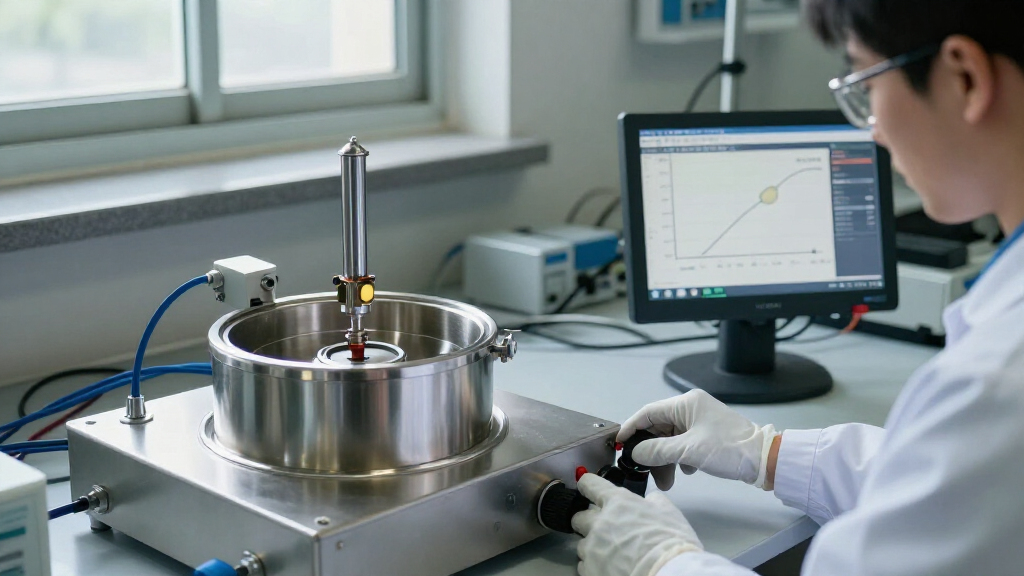
The surviving positrons entered a vacuum cooled to three-tenths of a degree above absolute zero. An electric field confined them at the top and bottom, while a magnetic field constrained them at the sides. The researchers isolated one positron and kept it available for study for a month. The report says the approach could allow confinement for longer, potentially indefinitely, but does not describe that as an achieved duration.
The next scientific aim is to measure the positron’s magnetic moment, a property describing the strength and orientation of its magnetic field. The measurement involves determining energy differences associated with flipping the particle’s spin and moving it from its lowest-energy state to its first excited state. The team has not yet reported the positron result in the source material.
A Test of Electron–Positron Symmetry
Keeping one positron trapped for an extended period gives physicists time to make delicate measurements without the particle immediately annihilating on contact with ordinary matter. The advance is a research capability, not evidence that the positron and electron differ: the central comparison still needs to be performed.
Gabrielse’s group has measured the electron’s magnetic moment using a similar trap, reaching a precision of one part in 10 trillion, according to the report. A comparably precise positron measurement would test a prediction of the Standard Model: that the two particles’ magnetic moments are exactly opposite. Any difference would need careful confirmation and interpretation, but could point to physics not captured by that prediction.
The question has wider significance because the observable universe is made mostly of matter. Physicists think the Big Bang produced matter and antimatter in roughly equal amounts, after which most of both annihilated. Why a small excess of matter remained is unresolved. A positron–electron comparison is one of several tests of matter–antimatter symmetry; this trapping result enables such work but does not itself explain the imbalance.
Popular right now

Dyson Big Ball Multi Floor Canister Vacuum, Yellow

Dyson V8 Cyclone Cordless Vacuum

eufy E25 Robot Vacuum and Mop Combo with HydroJet Roller Mop
As an affiliate, we earn on qualifying purchases.
How the Positron Trap Works
Antimatter particles share the mass of their matter counterparts but have opposite electric charge. When a positron meets an electron, the pair can annihilate, making ordinary containers unsuitable for holding antimatter. Gabrielse described the basic constraint this way: “If you want to hold on to antimatter, you have to hold it in a container without walls.”
The team’s method addresses that problem in stages: radioactive sodium-22 supplies positrons, tungsten slows them, electromagnetic fields steer them, and a carefully cooled vacuum confines the selected particle. Each stage matters because the positron must lose energy and reach the trap without annihilating. The reported month-long isolation means researchers can investigate a single particle over an extended period rather than relying only on brief encounters.
The planned magnetic-moment test concerns a fundamental symmetry expectation. Theoretical physicist Roni Harnik of Fermilab, who was not involved in the work, described the symmetry by imagining particles replaced by antiparticles, left and right reversed, and time run backward. He said basic theories predict that physics remains the same under those transformations. The positron measurement would test one specific aspect of that broader expectation.
““The big challenge is to persuade these positrons to slow down and then capture them.””
— Gerald Gabrielse, Northwestern University physicist and project leader
The Magnetic-Moment Result Is Pending
The reported achievement is the month-long confinement and study of a single positron. The source material gives no measured positron magnetic moment, no comparison result against the electron, and no evidence that the two values differ. It also does not supply the paper’s publication date beyond saying the report appeared on Wednesday.
It remains unknown whether the eventual comparison will find the exact opposite values predicted by the Standard Model or a measurable discrepancy. Even a difference would not, on its own, establish why the universe contains more matter than antimatter; researchers would need to verify the result and determine how it fits with other tests. The claim that the technique could support indefinite confinement is a possibility described in the report, not a demonstrated duration.
The Planned Positron Measurement
The team intends to use the trap to measure the positron’s magnetic moment by determining the energy required to reverse its spin and the energy needed to move it from its ground state to its first excited state. Researchers can then compare the result with the electron measurement made using a similar setup.
The key next milestone is a reported positron value with its precision and comparison basis. Until that measurement is available, the month-long trapping result should be understood as an experimental advance that makes a test possible—not as a resolution of the matter–antimatter imbalance.
Key Questions
What antimatter particle did the researchers trap?
They trapped a positron, the antimatter counterpart of the electron. It has the same mass as an electron but an opposite electric charge.
How did the team keep the positron from touching matter?
Researchers confined it in a vacuum using electric and magnetic fields, rather than placing it in a container with physical walls. They first slowed positrons in cold tungsten and guided surviving particles into the trap.
Did the researchers find that positrons and electrons behave differently?
No such finding is reported. The team plans to measure the positron’s magnetic moment and compare it with the electron’s; the source material does not provide the positron measurement or establish a difference.
Why does the magnetic-moment comparison matter?
The Standard Model predicts that the electron and positron have exactly opposite magnetic moments. A confirmed difference could point to physics beyond that prediction and may inform research into why matter is more abundant than antimatter.
Source: hn