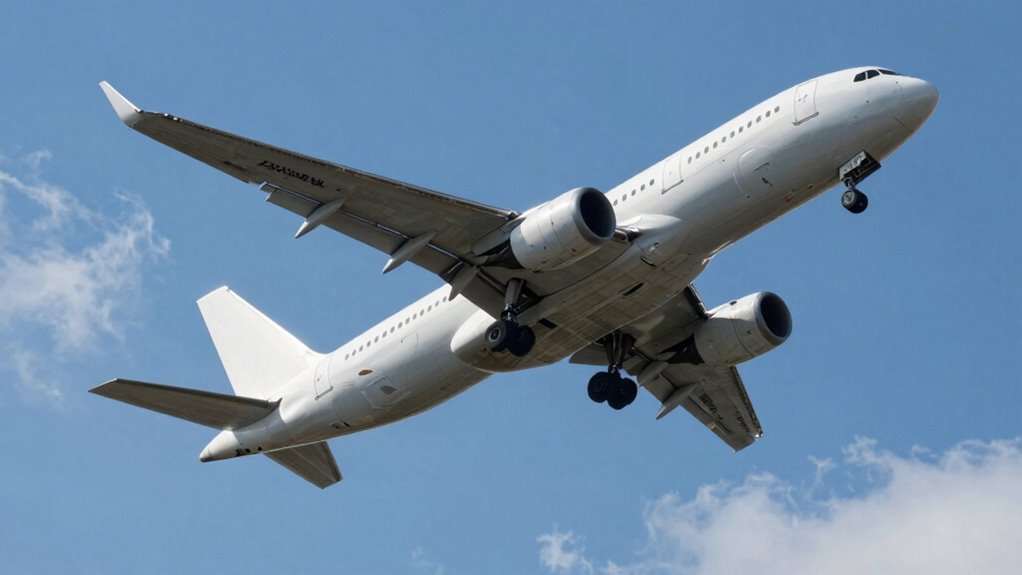

You might think magic keeps airplanes up, but it’s actually science at work. When the plane moves forward, the shape of the wings forces air to move faster over the top, lowering pressure there thanks to the Bernoulli principle. At the same time, airflow deflects downward, pushing the wings up via Newton’s third law. Adjusting the angle of attack and engine thrust helps maintain this balance. Want to discover more about how all these forces work together?

Prime made for students and young adults
- Fast, free delivery for dorm and study essentials
- Prime Video and Amazon Music included
- Member-only deals
Key Takeaways
- Airplanes stay up because of lift, created by pressure differences between the upper and lower wing surfaces.
- Faster airflow over the curved top surface lowers pressure, generating upward force.
- The wing’s shape (airfoil) directs airflow to maximize lift via Bernoulli’s principle.
- Newton’s third law states wings deflect air downward, producing an equal upward lift force.
- Engines provide thrust, maintaining airflow and pressure differences necessary for sustained lift.
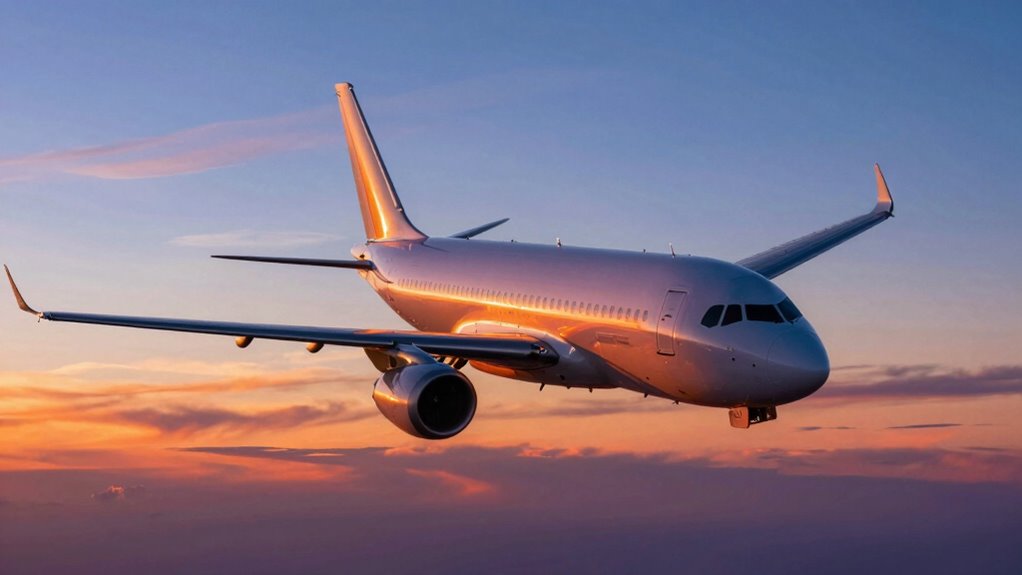
When you watch an airplane soar through the sky, it might seem like magic, but in reality, it’s all about physics working behind the scenes. The key to staying up in the air is lift generation, which involves a fascinating interplay of forces and principles. One of the most important concepts here is the Bernoulli principle, which explains how differences in air pressure help lift the aircraft. As the airplane moves forward, air flows faster over the curved upper surface of the wing and slower underneath. Because faster-moving air creates lower pressure, the pressure on top of the wing drops compared to the bottom. This pressure difference generates an upward force—lift—that counters gravity and keeps the plane aloft.
Your understanding of lift begins with recognizing that wings are specially shaped to maximize this effect. The curved upper surface, called an airfoil, guides air to move faster over the top, while the flatter bottom allows air to pass underneath more slowly. The Bernoulli principle states that when the speed of a fluid increases, its pressure decreases. So, the faster airflow over the top of the wing results in lower pressure there, while the pressure underneath remains higher. This pressure difference pushes the wing upward, creating lift.
But lift isn’t just about the Bernoulli principle. Newton’s third law also plays a role—air deflects downward as it passes over the wing, and in response, the wing pushes upward. This action-reaction pair complements the pressure-based lift generated by the Bernoulli effect. As you might imagine, the angle at which the wing meets the oncoming air, known as the angle of attack, influences how much lift is produced. Increasing this angle increases the pressure difference, but if it gets too steep, it can cause turbulence and stall the wing.
Your airplane’s engines provide the necessary thrust to keep it moving forward, ensuring the airflow over the wings remains steady and consistent. Without this forward motion, the pressure differences and lift would diminish, causing the plane to descend. So, the entire system relies on a delicate balance: engines keep you moving, wings shape the air to create pressure differences, and the Bernoulli principle explains how those differences generate the lift that keeps you in the sky. Additionally, understanding the pressure differences involved helps clarify how pilots control lift and manage flight stability.
Furthermore, pilots adjust the angle of attack to optimize lift during different phases of flight, demonstrating how understanding these principles is essential for safe flying. Recognizing the relationship between pressure and airflow is fundamental for understanding how wings function and how pilots can adjust their techniques to maintain safe and efficient flight. This understanding of aerodynamic principles is crucial for designing safer aircraft and improving flight performance. In addition, advancements in aerodynamic design have led to more efficient wings that generate greater lift with less effort, contributing to fuel savings and better flight stability.
Popular right now

TCL 85 Designer Series QD-Mini LED TV (Model 85A400U) with Google Smart TV

Vitamix Propel Series 750 Professional-Grade Blender, 4 Programs, Black

Breville Bambino Espresso Machine, Brushed Stainless Steel
As an affiliate, we earn on qualifying purchases.
Frequently Asked Questions
How Do Airplane Wings Generate Lift at Different Speeds?
You generate lift at different speeds by adjusting your wing’s angle and maintaining thrust optimization. As speed increases, aerodynamic drag decreases, helping produce more lift. When you accelerate, your engines provide more thrust, overcoming drag and increasing airflow over the wings. This enhances lift even at lower speeds. Conversely, at slower speeds, pilots may need to increase wing angle (angle of attack) to generate sufficient lift, balancing drag and thrust for safe flight.
What Role Does Airplane Weight Distribution Play in Flight Stability?
Think of your airplane’s weight distribution like a tightrope walker balancing on a wire. The center of gravity must be carefully positioned to *guarantee* flight stability. Proper load balancing keeps the aircraft level and responsive, preventing unwanted pitching or rolling. If weight isn’t evenly distributed, the plane becomes unstable, making control difficult. So, maintaining *ideal* weight distribution is essential for smooth, safe flight, just like a tightrope walker maintaining perfect balance.
How Do Weather Conditions Affect the Physics of Flight?
Weather conditions greatly impact aircraft aerodynamics and flight physics. When atmospheric pressure drops at high altitudes, it affects lift generation, making it harder to stay aloft. Wind, turbulence, and storms can cause unpredictable airflow, challenging your aircraft’s stability and control. You need to adjust your speed and altitude to counteract these effects. Understanding how weather influences aerodynamics helps you navigate safely through changing atmospheric pressures and airflow conditions.
Why Do Some Airplanes Have Winglets?
You’ll notice some airplanes have winglets to reduce wingtip vortices, which are swirling air currents created by differences in air pressure. These vortices increase aerodynamic drag, making the plane less efficient. By adding winglets, you decrease this drag, improving fuel efficiency and stability. Fundamentally, winglets help the plane glide more smoothly, saving fuel and reducing turbulence for passengers.
How Does Turbulence Impact the Physics of Airplane Flight?
Turbulence disrupts your airplane’s smooth flight by causing sudden changes in speed and direction, often linked to atmospheric pressure variations and jet streams. When you encounter turbulence, you’re experiencing shifts in air currents that affect the plane’s stability. These fluctuations happen because the aircraft moves through areas of differing atmospheric pressure or crosses jet streams, which are fast-moving air currents high in the atmosphere, impacting the flight’s smoothness and requiring pilots to adjust accordingly.
Conclusion
So, next time you watch a plane soar through the sky, remember it’s a masterful dance of physics, a whisper of science holding it aloft. Like a skilled magician, it defies the ordinary, turning air into a gentle giant lifting it higher. Airplanes aren’t just machines; they’re flying poetry, a breathtaking harmony of forces that keeps you floating above the clouds. And in that moment, you’re part of the incredible physics that make flight possible.