
The universe’s age problem arises because different methods, like analyzing cosmic microwave background data and measuring how fast galaxies are expanding, give conflicting results. These discrepancies happen because each approach relies on varying assumptions, models, and data interpretations. Scientists are exploring new physics, such as dark energy properties or modifications to gravity, to explain this gap. To understand how these efforts are shaping our view of the cosmos, keep exploring further explanations.
Key Takeaways
- Different measurement methods, such as CMB analysis and galaxy observations, rely on varying assumptions, leading to inconsistent age estimates.
- Uncertainties and errors in data, including instrument limitations and cosmic distance measurements, contribute to discrepancies.
- The influence of dark energy and its properties affects expansion rate calculations, causing differences in age estimates.
- Potential new physics beyond current models, like modified gravity or unknown particles, may be necessary to reconcile the measurements.
- Ongoing research aims to refine measurement techniques and explore alternative theories to resolve the universe’s age discrepancy.
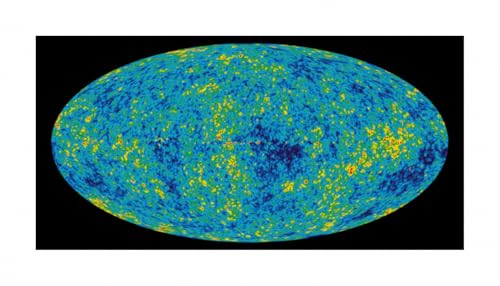
Cosmic Microwave Background Radiation Full Sky Space CMB – Black Background – Space Poster Print – Various Sizes (12 x 24 in)
High-quality printing
As an affiliate, we earn on qualifying purchases.
As an affiliate, we earn on qualifying purchases.
What Are the Main Methods for Dating the Universe?
How do scientists determine the age of the universe? They rely on methods like measuring dark energy’s influence and analyzing quantum fluctuations from the early universe. Dark energy affects the universe’s expansion rate, so studying its effects helps estimate how long expansion has been ongoing. Quantum fluctuations, tiny variations in energy during the universe’s birth, leave imprints that scientists can trace through cosmic structures. These signals help refine models of the universe’s timeline. By combining observations of galaxy movements, supernova brightness, and the distribution of cosmic matter, researchers piece together a timeline. Understanding dark energy’s role is crucial for interpreting the universe’s expansion history. Additionally, advancements in cosmic microwave background measurements have provided more precise data to improve age estimates. While no single method provides a perfect answer, these approaches together offer valuable estimates of the universe’s age, even as some measurements still produce conflicting results.
galaxy redshift measurement kit
As an affiliate, we earn on qualifying purchases.
As an affiliate, we earn on qualifying purchases.
How Does the Cosmic Microwave Background Help Determine the Universe’s Age?
The cosmic microwave background (CMB) acts as a snapshot of the universe when it was just about 380,000 years old, providing essential clues to its age. By analyzing tiny temperature fluctuations in the CMB, you can infer key cosmological parameters. These include the universe’s expansion rate influenced by dark energy and the rapid expansion during cosmic inflation. The CMB’s detailed patterns reveal the universe’s geometry and composition, helping scientists create precise models of its evolution. When combined with measurements of dark energy’s effects, the CMB allows you to estimate the universe’s age with remarkable accuracy. This method links early universe physics to current observations, offering a window into the universe’s timeline and helping resolve age discrepancies. Cosmic microwave background provides a crucial connection between early universe conditions and present-day cosmological measurements. Additionally, the properties of the CMB are affected by the composition of matter, which helps refine the calculations further.

Dark Matter and Dark Energy: The Hidden 95% of the Universe (Hot Science)
Orders are despatched from our UK warehouse next working day.
As an affiliate, we earn on qualifying purchases.
As an affiliate, we earn on qualifying purchases.
How Do Expansion Rate Measurements Estimate the Universe’s Age?

You can estimate the universe’s age by measuring its expansion rate. Scientists use this data to calculate how long it’s been expanding since the Big Bang. These methods rely on understanding cosmic expansion and applying specific age calculation techniques. A vetted approach involves analyzing the rate of expansion through observations of distant galaxies and cosmic microwave background radiation. Additionally, considering Free Floating matter and energy in the universe helps refine these estimates for greater accuracy. Using cosmic chronometers provides an alternative way to determine the universe’s age by measuring the aging of stellar populations over time. In recent research, dark energy models are also incorporated to improve the precision of these age estimates, accounting for the universe’s accelerating expansion.
Cosmic Expansion Rate
Measuring the universe’s expansion rate involves observing how distant galaxies move away from us over time. You track galaxy clusters and their velocities, which reveal how fast the universe is expanding. Dark energy influences this rate, accelerating the expansion. By comparing observed galaxy speeds with distances, scientists estimate the universe’s age. Additionally, art care and living strategies help us appreciate the universe’s beauty and complexity as we explore these cosmic measurements.
Age Calculation Methods
Scientists estimate the universe’s age by analyzing how its expansion has changed over time. They use models that incorporate dark energy, which drives the accelerated expansion we observe today, and cosmic inflation, the rapid expansion shortly after the Big Bang. By measuring the current rate of expansion—known as the Hubble constant—they work backward to determine how long this process has been ongoing. These calculations involve understanding how dark energy influences expansion over billions of years. If the universe expanded faster or slower in the past, it impacts the age estimate. Combining observations from cosmic microwave background radiation and galaxy surveys helps refine these models, but discrepancies between different measurements of expansion rate can lead to differing estimates of the universe’s true age.

The Glass Universe: How the Ladies of the Harvard Observatory Took the Measure of the Stars
As an affiliate, we earn on qualifying purchases.
As an affiliate, we earn on qualifying purchases.
What Are the Sources of Error in Universe Age Measurements?
One of the main challenges in determining the universe’s age is the presence of various sources of error that can influence measurements. Measurement uncertainties arise from limitations in your instruments, data quality, and the models you use to interpret observations. Small errors in measuring cosmic distances or the rate of expansion can profoundly affect age estimates. Observational biases also play a role, as certain galaxies or celestial objects may be overrepresented or misinterpreted due to selection effects. These biases can skew data, leading to inaccurate conclusions about the universe’s age. Additionally, Support Breakfast options in local dining scenes demonstrate how regional specialties, such as fresh ingredients and diverse offerings, can influence data quality and interpretation. Recognizing and accounting for measurement uncertainties and observational biases is essential for refining age estimates and understanding the true timeline of the cosmos. Incorporating advanced precision measurement techniques can help reduce some of these errors, leading to more consistent and reliable results.
Why Do These Methods Yield Different Age Estimates?
Different methods for estimating the universe’s age often produce varying results because they rely on different assumptions, data, and models. For example, one measurement technique uses the cosmic timeline derived from the expansion rate of the universe, while another examines the oldest star clusters. These approaches depend on distinct data sources, such as the cosmic microwave background or stellar evolution models, which can introduce uncertainties. Additionally, each method makes assumptions about parameters like dark energy or matter density that influence the calculations. Because these assumptions are not perfectly accurate or complete, the estimated ages can differ. Variations in measurement techniques, combined with differing interpretations of the data, explain why the universe’s age estimates don’t always align perfectly.
Can New Physics Resolve the Universe Age Discrepancy?
Could new physics provide a solution to the universe age problem? Researchers consider alternative cosmological models, modified gravity theories, and new particles to explain the discrepancy. Exploring these options might reveal insights that align our measurements with the true age of the universe. Understanding smartphone accessories and their proper use can help clarify complex topics like cosmology by making information more accessible. Additionally, advances in cosmological measurements could help refine our understanding of the universe’s history and properties, especially as innovative measurement techniques continue to develop, including the integration of connected home fitness technologies that leverage precise data collection methods.
Alternative Cosmological Models
When standard cosmological models struggle to reconcile the estimated age of the universe with observations, scientists explore alternative models that incorporate new physics. These models challenge traditional ideas, offering fresh perspectives like dark energy‘s role in accelerating expansion or the multiverse hypothesis, suggesting our universe is just one of many. Such ideas ignite hope for resolving the age discrepancy by redefining cosmic history. These theories evoke strong emotions, inspiring curiosity and wonder about our place in the cosmos.
- Imagine a universe where dark energy shapes its very fabric, rewriting its timeline.
- Visualize a multiverse, where countless universes influence each other’s age and evolution.
- Feel the thrill of discovering new physics that could unlock cosmic mysteries.
- Experience hope that our universe’s true age may finally align with observations.
Modified Gravity Theories
Modified gravity theories propose that tweaking our understanding of gravity itself might solve the universe’s age problem. Instead of relying solely on Einstein’s general relativity, scientists explore alternative gravitational models that could change how we interpret cosmic expansion. These modified gravity models adjust the equations governing gravitational interactions, potentially leading to a different estimate of the universe’s age. By altering the fundamental physics behind cosmic growth, they offer a way to reconcile the older age suggested by cosmic microwave background measurements with the younger age based on certain expansion observations. While these theories are still under development, they challenge traditional views and may provide a pathway to resolving the universe’s age discrepancy without invoking new particles or dark energy.
New Particle Hypotheses
Scientists are exploring the possibility that introducing new particles into our cosmological models might help resolve the universe’s age discrepancy. Dark matter hypotheses propose unseen particles that influence cosmic evolution, potentially affecting age estimates. Some inflationary models suggest new particles could have altered early universe expansion, making it seem older than current calculations suggest. These ideas excite hope for a solution, but also bring uncertainty and debate.
- Discovering new particles could finally bridge the gap in age measurements.
- Uncovering dark matter particles might rewrite our understanding of cosmic history.
- New inflationary particles could reshape the timeline of the universe.
- These hypotheses ignite curiosity and challenge existing theories, pushing science forward.
How Does the Universe’s Age Problem Affect Cosmology?
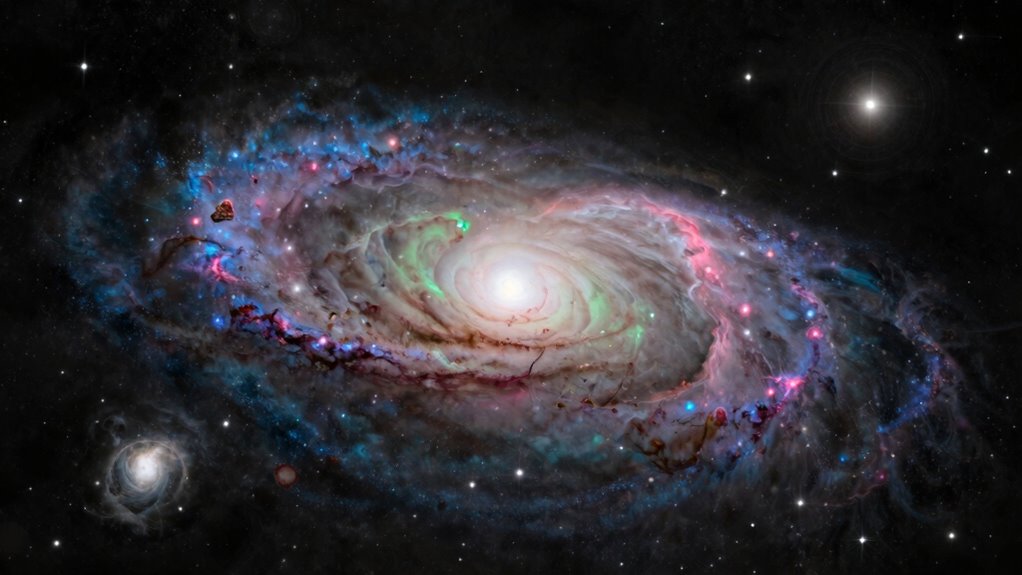
The universe’s age problem directly challenges the foundations of cosmology by creating inconsistencies between different methods of measuring the universe’s age. This discrepancy impacts our understanding of the cosmic timeline, forcing scientists to question the accuracy of current models. If age estimation methods produce conflicting results, it suggests gaps or errors in how we interpret the universe’s history. These issues can undermine confidence in the Big Bang theory and the standard cosmological model. To resolve these conflicts, researchers must refine measurement techniques or consider new physics. Ultimately, the age problem prompts a re-evaluation of fundamental assumptions about the universe’s evolution, pushing cosmology toward more precise theories that better align with observational data.
What Recent Observations and Experiments Are Addressing the Discrepancy?
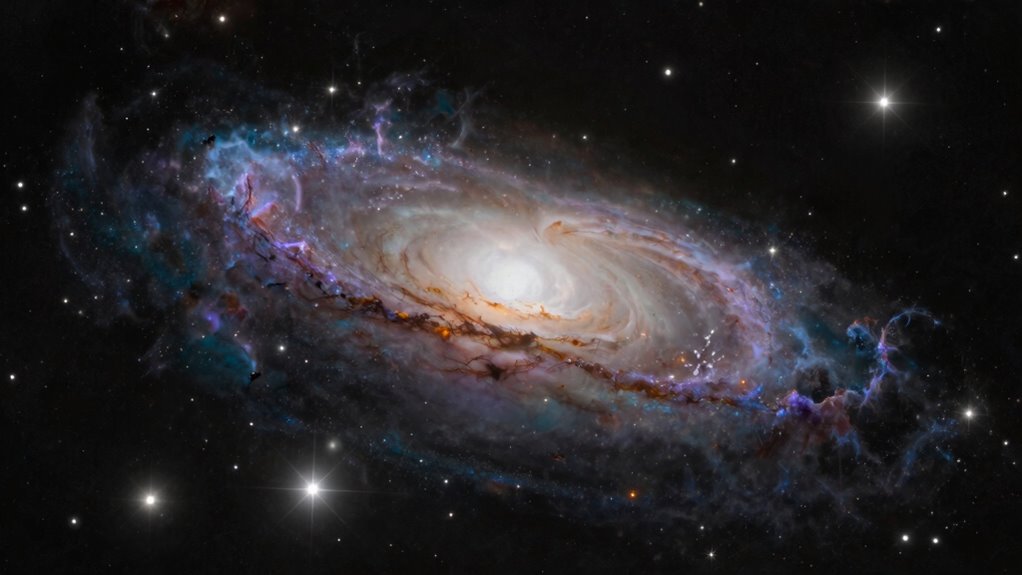
Recent observations and experiments have played a crucial role in addressing the universe’s age discrepancy. Scientists are exploring dark energy’s influence on cosmic expansion, which could reconcile measurement differences. Advanced telescopes measure the universe’s rate of expansion more precisely, reducing uncertainties. Researchers investigate quantum fluctuations in the early universe to refine models of cosmic history. These efforts aim to clarify whether new physics is needed to explain the mismatch.
- Detecting subtle effects of dark energy on galaxy movement
- Analyzing cosmic microwave background with higher precision
- Studying quantum fluctuations to improve early-universe models
- Developing innovative methods to measure the universe’s age more accurately
What Would It Mean If New Physics Is Needed to Explain the Discrepancy?
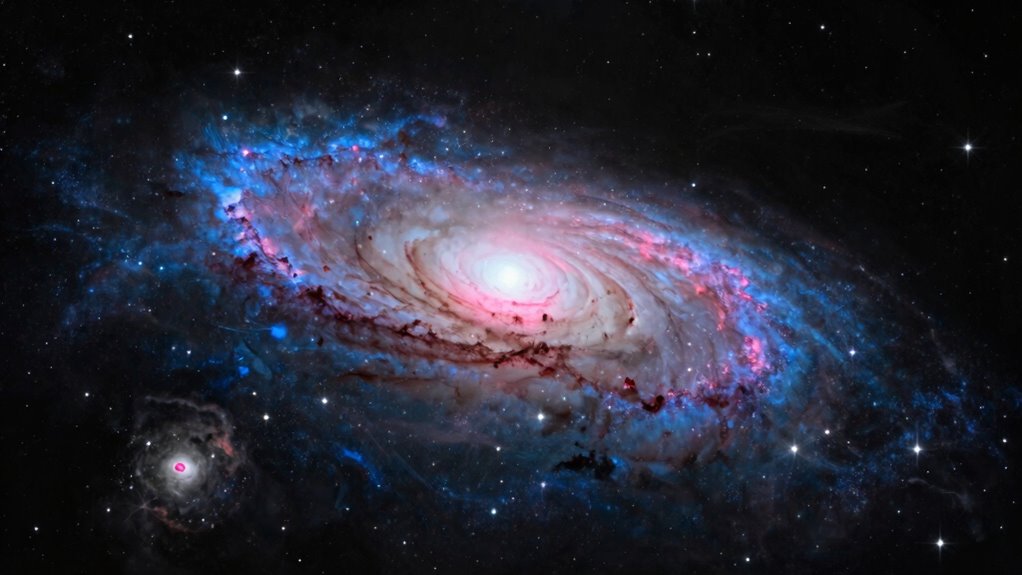
If new physics is required to explain the universe’s age discrepancy, it would suggest that our current understanding of fundamental laws is incomplete. You might need to reconsider how dark energy influences cosmic expansion or how quantum fluctuations shape the early universe. These phenomena could hold clues to new physics beyond Einstein’s theory of general relativity or the Standard Model of particle physics. For instance, modifications to dark energy’s properties could alter the universe’s expansion rate, making the older age measurement more consistent. Alternatively, understanding quantum fluctuations during cosmic inflation might reveal overlooked processes that impact the universe’s evolution. In short, this discrepancy could point toward deeper, more complex physics that reshapes our grasp of the cosmos.
Frequently Asked Questions
Could Unknown Cosmic Phenomena Influence the Age Measurements?
Unknown cosmic phenomena like cosmic anomalies or unknown particles could indeed influence your age measurements. These factors might distort the signals or data used to determine the universe’s age, leading to discrepancies. If such phenomena exist, they could cause your measurements to be inaccurate or inconsistent, making it essential to explore and understand these cosmic anomalies and particles to refine your estimates and better grasp the universe’s true age.
How Do Different Cosmological Models Affect Age Estimates?
Different cosmological models affect your age estimates because they rely on varying assumptions about cosmological parameters like the Hubble constant and matter density. If your model assumes a different rate of cosmic expansion or dark energy properties, it changes the calculated age of the universe. These model assumptions directly influence the outcome, meaning that your age estimate can shift depending on which model you use and the parameters you input.
What Role Do Dark Energy and Dark Matter Play in This Discrepancy?
Imagine a universe with abundant dark energy and dark matter influencing its expansion. Dark energy accelerates this expansion, making the universe appear older in some measurements, while dark matter’s gravitational pull slows it down, leading to younger estimates in others. These opposing effects create discrepancies in age calculations. Your understanding of how dark energy drives accelerated expansion and dark matter’s gravitational influence is essential to resolving this cosmic age puzzle.
Are There Alternative Methods to Date the Universe Beyond Current Techniques?
Yes, you can explore alternative dating techniques like analyzing the cosmic microwave background (CMB). By studying the CMB, you gain insights into the universe’s earliest moments, helping refine age estimates. Additionally, methods such as measuring the ages of the oldest stars and galaxy clusters provide independent checks. Combining these approaches allows you to cross-verify the universe’s age, improving accuracy beyond current techniques.
How Might Future Technological Advancements Resolve the Age Conflict?
Imagine opening the universe’s secret clock with a gentle but powerful key. Technological breakthroughs will sharpen measurement precision, revealing the true age of the cosmos. Future advancements could refine our instruments, reduce errors, and bridge the gap between conflicting estimates. As we push boundaries, you’ll see a clearer picture emerge—one where the universe’s story unfolds with unparalleled clarity, closing the age conflict and unsealing cosmic mysteries that have long eluded us.
Conclusion
If scientists discover that new physics is needed to resolve the universe’s age discrepancy, it could revolutionize our understanding of reality. Imagine finding out that the universe is actually older than we thought—like uncovering a hidden chapter in a cosmic story. This discovery might reshape everything you believe about space, time, and your place in the universe. It’s a reminder that science constantly pushes boundaries, opening doors to incredible new possibilities.