TL;DR

Prime made for students and young adults
- Fast, free delivery for dorm and study essentials
- Prime Video and Amazon Music included
- Member-only deals
NASA says SpaceX’s 35th Commercial Resupply Services mission will carry four investigations to the International Space Station focused on human and plant health. The studies include lab-grown brain models, disease-infected plants, a compact biomarker reader and a final planned round of sampling for antibiotic-resistant bacteria.
NASA says SpaceX’s 35th Commercial Resupply Services mission will carry four health-related investigations to the International Space Station, including studies of human brain tissue, crop disease, astronaut health testing and antibiotic-resistant bacteria. The work is intended to support crew health on extended missions while also producing findings relevant to agriculture and health research on Earth.
One investigation will send lab-grown models of human brain tissue to the station for five weeks. Researchers plan to compare the space-exposed models with identical samples kept on Earth, examining cellular-level effects of a short spaceflight. NASA says the study could improve understanding of how the brain responds to stress and inform approaches to reducing risks during future exploration; the report does not describe a clinical test in astronauts.
A separate experiment will compare plants grown on Earth and in orbit after infection with a disease-causing fungus. The researchers will examine molecular and structural changes to test whether crop diseases develop faster or more severely in microgravity. NASA says the results could inform breeding for disease resistance and help limit yield losses, including in future space-growing systems.
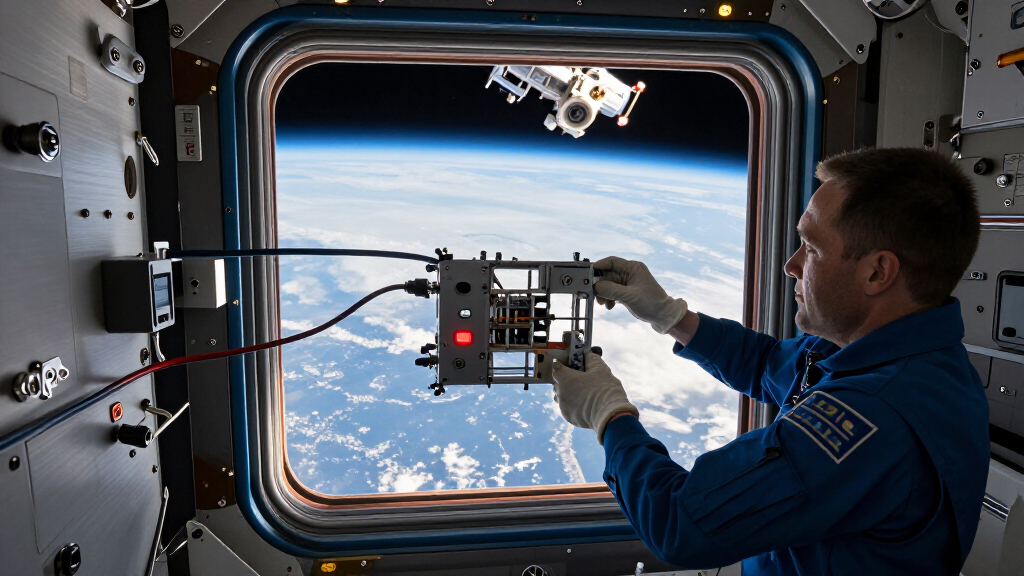
The cargo also includes the first test of a compact microplate reader that reached the station earlier this year. The Commercially Enabled Rapid Space Science experiment will assess whether the device can measure biomarkers such as antibodies, antigens and proteins in samples aboard the station. Another investigation returns for its fourth and final planned stay, with astronauts sampling station surfaces to track drug-resistant organisms and study how resistant bacteria survive and evolve in microgravity.
Preparing Health Research for Deep Space
The investigations address practical limits of crewed missions far from Earth: astronauts need ways to monitor health, manage infection risks and sustain food production when regular resupply or rapid return of samples is difficult. A reader able to measure selected biomarkers in orbit could provide results sooner than shipping samples back to Earth, though the mission’s test is meant to evaluate the device rather than establish that it is ready for routine medical use.
Plant research also has a direct operational dimension. NASA says crops can contribute nutrition and dietary variety, while helping absorb carbon dioxide, produce oxygen and recycle water. Understanding how disease affects plants in microgravity could help inform systems intended for longer missions. On Earth, the crop study may offer evidence relevant to breeding disease-resistant plants, while the bacterial investigation may add to research on antimicrobial resistance.
lab-grown human brain tissue model kit
As an affiliate, we earn on qualifying purchases.
As an affiliate, we earn on qualifying purchases.
Four Investigations, Different Research Questions
The four payloads fall within NASA’s Biological and Physical Sciences division and share a focus on health and biological systems in space, but they use different methods. The brain study compares space-flown tissue models with Earth controls; the plant experiment examines fungal infection; the reader test evaluates rapid sample analysis; and the bacteria project repeatedly monitors surfaces aboard the station.
NASA frames these studies as support for astronaut health during long-duration missions, including future journeys to the Moon and beyond. The CRS-35 flight is a cargo delivery opportunity, not a report of completed results. The supplied NASA report does not identify a launch date, provide named investigators, or state when findings from these experiments will be published.
As an affiliate, we earn on qualifying purchases.
Launch and Results Still Pending
The source report does not give a CRS-35 launch date, so the timing of the experiments’ arrival at the station is not specified here. It also does not provide a detailed launch schedule, investigator names, or projected dates for results. Those details should not be inferred from the mission number or the research descriptions.
The investigations are designed to test questions, not to announce conclusions. It remains unknown what cellular changes the brain models will show, whether fungal disease will differ in orbit, how well the microplate reader will measure its target biomarkers in station conditions, and what the final planned sampling round will reveal about resistant bacteria. NASA describes potential benefits for Earth and future missions, but those applications depend on findings that are not yet reported.
portable bacterial culture testing kit
As an affiliate, we earn on qualifying purchases.
As an affiliate, we earn on qualifying purchases.
Flight Delivery and On-Orbit Testing
The next milestone is the CRS-35 launch and delivery of the research cargo to the space station. After arrival, the investigations will be carried out in orbit: the brain models are scheduled to remain there for five weeks, the plant study will compare space- and Earth-grown samples, the microplate reader will undergo its first station test, and the bacteria project will complete its fourth and final planned stay.
NASA has not supplied dates for the launch or for publication of results in the report. Future updates would be needed to establish the experiments’ outcomes and whether the tested approaches can support astronaut health monitoring or space agriculture.
As an affiliate, we earn on qualifying purchases.
Key Questions
What will SpaceX CRS-35 carry for NASA?
NASA says the mission will carry four investigations to the International Space Station, covering brain tissue, crop disease, biomarker measurement and antibiotic-resistant bacteria.
How long will the brain tissue models stay in space?
The NASA report says the lab-grown brain models will be aboard the station for five weeks, after which researchers can compare them with matching models kept on Earth.
Will the microplate reader diagnose astronauts in orbit?
The mission will test whether the compact reader can detect and measure selected biomarkers in station samples. NASA describes faster health assessment as a research aim; the report does not say the device is already approved for routine diagnosis.
When is CRS-35 scheduled to launch?
The supplied NASA report does not state a launch date. The mission is described as SpaceX’s 35th Commercial Resupply Services flight for NASA.
When will the research results be available?
NASA’s report does not give publication dates. Results will depend on the experiments being conducted and analyzed, and no findings from CRS-35 are reported yet.
Source: primary
Halloween Picks
halloween
As an affiliate, we earn on qualifying purchases.