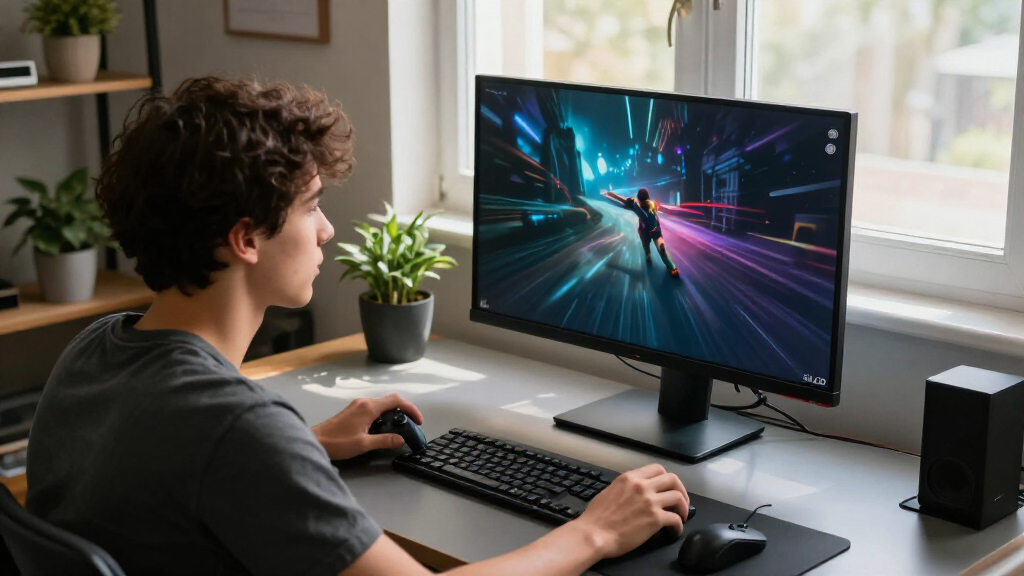

🔍 Read the full analysis: 8 Best OLED Gaming Monitors For Fast, Immersive Play In 2027 on ThorstenMeyerAI.com

Prime made for students and young adults
- Fast, free delivery for dorm and study essentials
- Prime Video and Amazon Music included
- Member-only deals
TL;DR
A buying guide from ThorstenMeyerAI.com ranks eight OLED gaming monitors by intended use, including competitive speed, ultrawide immersion and standard QHD play. Its specifications and rankings are the guide’s claims; independent testing, current pricing and full product details are not included in the supplied material.
ThorstenMeyerAI.com has published a guide to eight OLED gaming monitors, ranking the ASUS ROG Strix XG27ACDNG first for its stated QHD resolution and 360Hz refresh rate, and naming the Alienware AW3425DW its ultrawide option. The guide compares products for different uses, but the supplied material does not provide independent test results, pricing or a publication date, so its rankings should be read as editorial recommendations rather than verified performance findings.
The guide’s central distinction is between speed, screen format and simplicity. It recommends the ASUS XG27ACDNG for competitive gaming, citing its 27-inch QHD QD-OLED panel and stated 360Hz refresh rate. The guide describes that as the highest refresh-rate specification among its eight picks; most of its other 27-inch options are listed at 240Hz.
For players who prefer a wider image, the guide selects the 34.2-inch curved Alienware AW3425DW. Its ultrawide format is presented as an immersion-focused alternative to conventional QHD screens, not as a universal upgrade. The LG 27GX704A-B is highlighted for a 240Hz panel and broad adaptive-sync support. The guide also groups Acer, AOC, ASUS, LG and Samsung models among its 240Hz QHD choices, saying buyers should compare their features and intended use.
The guide identifies the Samsung G5 as a simpler QHD OLED option without the same stated high-refresh emphasis as its 240Hz and 360Hz models. However, the supplied source does not give a full specification table or detailed model names for every pick. The eight selections are therefore covered below by the distinctions the source provides, without adding specifications it does not establish.
The 8 picks
- 1
 Alienware AW3425DW 34.2-inch Curved QD-OLED Gaming MonitorView on Amazon →
- 2
 ASUS ROG Strix XG27ACDNG 26.5-Inch QHD QD-OLED Gaming Monitor, 360HzView on Amazon →
- 3
 ASUS ROG Strix XG27AQDMGR 27-Inch QHD 240Hz OLED Gaming MonitorView on Amazon →
- 4
 Samsung 27-inch Odyssey OLED G6 QD-OLED QHD Gaming Monitor (G61SH)View on Amazon →
- 5
 AOC Q27GAZDV 27-Inch QHD 240Hz QD-OLED Gaming MonitorView on Amazon →
- 6
 LG 27GX704A-B 27-inch Ultragear QHD (2650×1440) OLED Gaming Monitor 240Hz, 0….View on Amazon →
- 7
 Samsung 27-Inch Odyssey OLED G5 QHD Gaming Monitor (G50SF)View on Amazon →
- 8
 Acer Predator 26.5-inch QHD 2560×1440 QD-OLED Gaming Monitor X27U W1View on Amazon →
Choosing Speed, Size and Format
These recommendations matter to shoppers because “OLED gaming monitor” does not describe one uniform experience. A high refresh rate can suit competitive play, while an ultrawide screen may better match games and setups built around immersion. A simpler QHD display may be a better fit for someone who does not need the highest stated refresh rate.
The guide also makes an important practical point: refresh rate is a specification ceiling, not a guarantee that a computer will render every game at that rate. Whether 360Hz offers a useful advantage depends on the games played and the system driving the display. Screen space, ports, adaptive sync, room lighting and OLED care habits can also affect the buying decision. The source does not establish which monitor performs best in measured image quality or value.
Popular right now

KitchenAid Artisan Series 5-Quart Tilt-Head Stand Mixer, Milkshake

Vitamix VX1 Professional-Grade Blender, 64 oz, Black

Apple AirPods Pro 3 Wireless Earbuds with Active Noise Cancellation
As an affiliate, we earn on qualifying purchases.
How the Eight Picks Differ
The list is organized by buyer need rather than by a claim that all eight models compete on identical terms. Its main categories are competitive-speed QHD, general-purpose 240Hz QHD, ultrawide immersion and a less demanding QHD option. Several models share a resolution and refresh-rate class, so the guide says their feature sets and intended use should help separate them.
Its advice also notes that standard 16:9 QHD is a familiar fit for many desks and games, while ultrawide support varies by title and the wider image requires more graphics processing. The source recommends checking device connections and OLED care features, but offers no independent measurements of brightness, reflections, durability or burn-in risk for these specific models.
“The ASUS XG27ACDNG ranks highest for its 360Hz ceiling in a familiar 27-inch QHD format.”
— ThorstenMeyerAI.com guide
Missing Tests and Model Details
The source material does not include independent benchmark results, measured image quality, prices or a confirmed publication date. It also does not identify every one of the eight selections by full model name or supply complete specifications for each, limiting how precisely readers can compare the list. Availability and prices may vary by market and over time.
Claims about the best overall choice and the most suitable option for a particular player are the guide’s editorial judgments. The supplied information does not show how those rankings were tested, nor does it provide model-by-model evidence about brightness, reflection handling, longevity or burn-in protection. Readers should check current manufacturer specifications and independent reviews before purchasing.
Check Current Specs Before Buying
The next step for shoppers is to verify each monitor’s exact model number, current price, connection capabilities and availability. Check that the intended PC or console can use the required resolution and refresh rate over the selected port, and confirm that the games played support an ultrawide aspect ratio if considering the Alienware.
For the guide itself, the supplied material does not state whether an updated list or further testing is planned. Its rankings may need reconsideration as prices, product availability and monitor specifications change.
Key Questions
Which monitor does the guide rank best overall?
It ranks the ASUS ROG Strix XG27ACDNG first, citing its QHD QD-OLED panel and stated 360Hz refresh rate. The source does not provide independent test results to verify that ranking.
Which pick is intended for ultrawide gaming?
The guide names the Alienware AW3425DW, a 34.2-inch curved ultrawide model. It is presented as an immersion-focused option; check whether your games support its wider aspect ratio.
Does a 360Hz monitor mean every game runs at 360 frames per second?
No. The refresh-rate figure describes the monitor’s stated capability, not the frame rate a PC will achieve. Results depend on the game and system hardware.
What details are missing from the supplied guide?
The material does not provide prices, independent measurements or full specifications for all eight models. It also does not establish current availability or a publication date.
What should buyers check before choosing an OLED gaming monitor?
Compare the exact model’s resolution, refresh rate, ports and adaptive-sync support with your PC or console. Consider desk space and game support for ultrawide, and follow the manufacturer’s guidance for OLED care.
Source: ThorstenMeyerAI.com