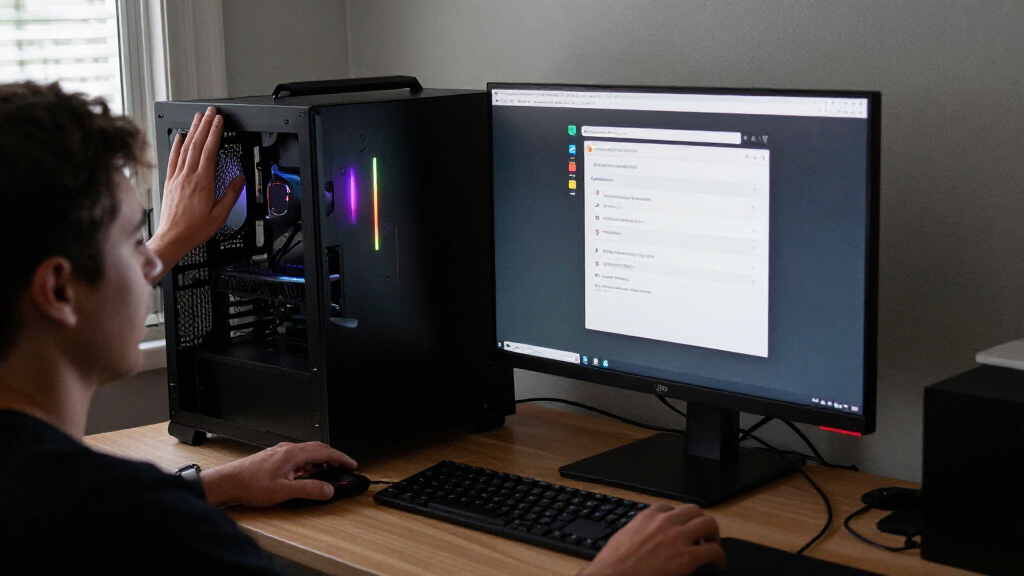
🔍 Read the full analysis: A Gaming PC Can Run “Uncensored” DeepSeek, But Its Controls Raise Questions on ThorstenMeyerAI.com

Prime made for students and young adults
- Fast, free delivery for dorm and study essentials
- Prime Video and Amazon Music included
- Member-only deals
TL;DR
AtomicChat has published a modified DeepSeek-V4.1-Flash-1017 model that it says runs on a single 12GB GPU and recorded no refusals on its JailbreakBench test. Those results are self-reported, and running the model still requires substantial system RAM and storage; the edit also removes refusals across topics, with its effect on political bias untested.
AtomicChat has published a modified version of DeepSeek-V4.1-Flash-1017 that it says can run locally with a 12GB graphics card and declined none of the harmful prompts in its reported safety test. The build combines DeepSeek model weights with separate compression and refusal-removal work, but its benchmark results and technical claims have not been independently verified.
The repository, titled DeepSeek-V4.1-Flash-1017-Uncensored-GSQ-RCO-GGUF, is available under the AtomicChat account on Hugging Face. AtomicChat reports that refusals on the JailbreakBench test dropped from 85.2% to 0.0% while reasoning scores held. The source account says those figures come from the publisher and have not been replicated independently; the result should not be read as proof that the model will comply with every harmful request.
The build combines DeepSeek’s model with compression methods from ISTA-DASLab at the Institute of Science and Technology Austria, plus AtomicChat’s edit to reduce refusals. According to the developers’ own tests, running it requires 46 to 64GB of system RAM, about 250GB of downloads and Strata, a free hobby engine. They report speeds of roughly 5 to 10 tokens per second. The 12GB figure refers to graphics memory, not the computer’s total memory or storage needs.
AtomicChat’s model card says the edit removes refusals across topics rather than keeping some categories of refusal. It also warns that its refusal classifier reads the beginning of an answer, so a later soft refusal may be counted as a response. The publisher says major expert blocks were left unchanged, but outside parties have not checked that claim. The repository was ungated and listed 30,284 downloads in the preceding month on November 3, according to the source.
Infographic 01 · From a paper to a gaming PC
“Uncensored” is two years old. The new part is the size.
How a 2024 research finding, an MIT licence, a compression lab and a hobby engine put a 763-billion-parameter model on one 12 GB graphics card.
- 15 Aug 2023China’s generative AI rules take effectServices must “(u)phold the Core Socialist Values”
- Jun 2024Refusal is “a single direction”Shown across 13 open chat models up to 72B; removing it stops refusals
- Sep 2025US evaluators: censorship sits in the weightsNIST CAISI on older DeepSeek models (R1, R1-0528, V3.1), not V4.1
- 10 Sep 2026DeepSeek-V4.1-Flash released under MITFirst uncensored forks within hours, per Tech Insider
- 17 Oct 2026Update V4.1-Flash-1017Weights on Hugging Face and ModelScope; no safety statement
- 24 Oct 2026A free hobby engine adds the modelStrata 0.2.4: one 12 GB GPU, the rest streamed from RAM and SSD
- 3 Nov 202612,613 models tagged “abliterated”Hugging Face tag filter; several V4.1-Flash builds on page one
Hardware figures from the Strata release notes and the ISTA-DASLab model card (publisher figures). “Consumer hardware” here means a well-equipped gaming or workstation PC, not a laptop.
Sources: DeepSeek model card, DeepSeek, 17 Oct 2026, Arditi et al., arXiv 2406.11717 (2024), NIST CAISI, 30 Sep 2025 (older models), FPF on China's Interim Measures, Tech Insider, Strata release notes 0.2.4/0.2.5 (24/25 Oct 2026), ISTA-DASLab model card, Hugging Face model search (3 Nov 2026).
Powered by Thorsten Meyer AI
Local Access Moves Outside Cloud Controls
A model that can be run offline on a desktop raises a different oversight problem from one accessed through a managed online service. A local installation may sit outside a company’s logging, access controls and AI gateways, making it harder for administrators to know what employees are asking or where outputs are going. That is a potential shadow-AI concern, not evidence that this particular release has been used in an organization.
Removing refusals also means one fewer internal safeguard against requests that the original model might decline. The source account says duties under the EU AI Act depend on how a model is used, not on who removed a refusal mechanism. That is a legal-context statement, not an assessment of any user’s specific obligations. For individuals, offline use may offer privacy and reduce platform-level filtering, but the label “uncensored” does not make answers neutral, reliable or safe.
Popular right now

Vitamix 5200 Professional-Grade Blender, 64 oz. Container, Black

Apple AirPods Pro 3 Wireless Earbuds with Active Noise Cancellation

Vitamix Propel Series 510 Professional-Grade Blender, 3 Programs, Black
As an affiliate, we earn on qualifying purchases.
Three Projects Behind One Model
The release brings together three distinct pieces of work. DeepSeek released V4.1-Flash on September 10, 2026, followed by the 1017 update on October 17, according to the source. Its model card identifies the weights as MIT-licensed; the source reports that the card does not include an acceptable-use policy. DeepSeek’s announcement described the update as a “Pareto improvement in performance and cost” and did not discuss safety.
Compression research from ISTA-DASLab reduces the files needed to hold the model, while Strata runs the compressed mixture-of-experts model with some components in system memory. AtomicChat’s separate edit targets refusal behavior. The source notes that removal methods of this general kind have been known since a 2024 research paper described refusal as tied to “a single direction.” It also reports 12,613 models under Hugging Face’s “abliterated” tag on November 3, 2026, illustrating that refusal-edited models are not new. The reported consumer-hardware fit is the more notable development here.
“The edit removes refusals across topics; it does not keep a narrower set of them.”
— AtomicChat’s model card
Benchmark and Bias Questions Remain
No independent testing has confirmed AtomicChat’s 0.0% refusal result, the preservation of reasoning performance, or the claim that the model’s large expert blocks were left unchanged. The publisher itself describes limitations in how refusals are classified, so the reported score does not establish how the model behaves across all prompts or in ordinary use.
The source also says US government evaluators found built-in Chinese Communist Party censorship in older DeepSeek versions. Whether the political slant in this newer model’s answers changes when refusals are removed has not been measured. It is not clear from the available material how the modified build performs on a broad set of political, factual or harmful prompts, or whether independent researchers will reproduce the technical and performance claims.
Independent Tests Could Clarify Claims
The immediate next step is independent replication of the refusal and reasoning tests, along with verification of the model files and the claimed hardware requirements. Those tests would help distinguish a benchmark result from broader claims about behavior and safety. The source material does not identify a scheduled audit or a formal evaluation due date.
Organizations considering local models can review whether desktop installations are covered by their existing approval, monitoring and data-handling rules. For users, the practical requirements are already substantial: the developers cite 46 to 64GB of RAM, around 250GB of downloads and modest reported generation speeds. Any further release updates, outside evaluations or changes to the repository could clarify how widely the build is used and what safeguards, if any, are added.
Key Questions
What did AtomicChat publish?
It published an uncensored modification of DeepSeek-V4.1-Flash-1017 on Hugging Face, combining the base model with compression work and an edit intended to reduce refusals.
Can it really run with a 12GB graphics card?
The developers say it can run with 12GB of GPU memory using Strata, but their stated requirements also include 46 to 64GB of system RAM and about 250GB of downloads. They report speeds of 5 to 10 tokens per second; these figures have not been independently verified.
Does the model refuse no harmful requests?
AtomicChat reports a 0.0% refusal rate on its JailbreakBench test, down from a reported 85.2% for the original. The result is self-reported, has not been independently replicated and does not prove how the model will respond to every request.
Does removing refusals remove political bias?
That has not been established. The source says the edit removes refusals across topics, while the effect on political slant in the model’s answers has not been measured.
Source: ThorstenMeyerAI.com