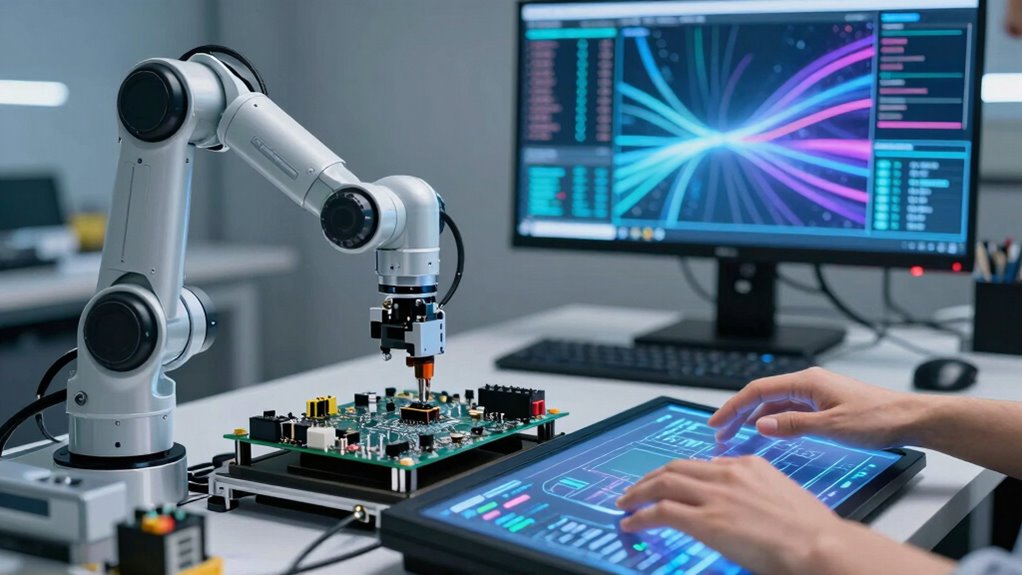

Automation handles repetitive, rule-based tasks quickly and accurately, making processes more efficient. It doesn’t learn or adapt beyond set instructions. Artificial intelligence, on the other hand, adds flexibility by understanding unstructured data and improving over time. AI can recognize patterns, respond to nuanced situations, and make smarter decisions. Understanding these differences helps you choose the right technology for your needs—whether you want speed or adaptability. Keep exploring to see how both can work together effectively.

Get school and study supplies delivered free — and shop member deals
- Fast, free delivery on millions of items
- Access to Prime Big Deal Days deals on October 6–7
- Prime Video, Amazon Music and more included
Key Takeaways
- Automation performs predefined, repetitive tasks, while AI can learn and adapt beyond fixed rules.
- Automation is rule-based and predictable; AI analyzes complex data and makes nuanced decisions.
- Automation handles high-volume, routine processes; AI manages unstructured data and provides intelligent responses.
- Automation improves speed and accuracy for simple tasks; AI enhances decision-making and problem-solving.
- Combining automation and AI creates smarter, more efficient workflows tailored to specific needs.

Many people often confuse automation with artificial intelligence, but the truth is that they serve different purposes and operate in distinct ways. Automation involves using technology to perform repetitive tasks with minimal human intervention. Think of it as a robotic process—simple, rule-based, and predictable. You set it up once, and it keeps running, handling tasks like data entry, processing transactions, or managing inventory without needing ongoing input. Automation is efficient for streamlining workflows, reducing errors, and saving time, but it doesn’t adapt or make decisions beyond its predefined rules. Artificial intelligence, on the other hand, goes a step further. It’s about mimicking human intelligence, enabling systems to learn, reason, and make decisions. With AI, you’re not just automating a process; you’re creating a system that can analyze complex data, recognize patterns, and improve over time. This is where cognitive computing comes in—an advanced form of AI that allows machines to understand, interpret, and respond to nuanced information much like a human would. Instead of following a fixed script, AI systems can adapt to new information, making them suitable for tasks like natural language processing, image recognition, or predictive analytics. Moreover, AI often relies on machine learning techniques to enhance its capabilities and accuracy over time. Understanding the difference between these two is vital because they serve different roles in technology strategies. Automation is often the backbone of operational efficiency, handling high-volume, repetitive tasks quickly and accurately. It’s perfect when you need consistency and speed but don’t require any decision-making capability. Interestingly, technology integration is key to leveraging both automation and AI effectively, ensuring they complement each other to optimize processes. As AI continues to evolve, it increasingly incorporates cognitive computing to tackle more complex and unstructured data. These advancements enable AI to handle unstructured information, making it even more valuable for sophisticated applications. AI and cognitive computing are designed for more sophisticated applications. They’re used when you need systems to interpret unstructured data, make recommendations, or even learn from their environment. This makes AI invaluable in areas like customer service chatbots, fraud detection, or personalized marketing. While automation can be seen as the foundation for many AI systems, they are not interchangeable. Automation simplifies processes, and AI adds intelligence to those processes, making them smarter and more adaptable. If you’re looking to optimize your operations, understanding this distinction helps you determine whether you need to implement robotic process automation or invest in cognitive computing solutions. Both have their strengths, but knowing their differences guarantees you choose the right technology for your specific needs.
automation software for business
As an affiliate, we earn on qualifying purchases.
As an affiliate, we earn on qualifying purchases.
Frequently Asked Questions
Can Automation Systems Learn From Past Experiences?
Yes, automation systems can learn from past experiences through machine learning. These adaptive systems analyze data, identify patterns, and improve their performance over time, making them more effective and efficient. Unlike traditional automation, which follows fixed rules, machine learning enables systems to adapt and evolve based on new information. So, when you work with smart automation, you’re dealing with systems that get better and more intuitive as they process more data.
How Does AI Improve Decision-Making Processes?
AI improves decision-making by leveraging machine learning and data analysis. You can rely on AI to process vast amounts of data quickly, identify patterns, and generate insights that humans might miss. This enables you to make more informed, accurate decisions faster. By continuously learning from new data, AI adapts to changing conditions, helping you optimize strategies, reduce risks, and improve overall outcomes efficiently.
Are All Automated Systems Considered AI?
Not all automated systems are considered AI. Simple automation follows predefined rules without learning or adapting, so they lack elements like robot ethics or the need for human oversight. AI involves machine learning and decision-making capabilities, making systems more complex and requiring ongoing human oversight to guarantee ethical use. If a system adapts or learns from data, it’s more likely to be classified as AI rather than basic automation.
What Industries Benefit Most From AI?
They say, “The future belongs to those who prepare today.” You’ll find AI benefits industries like healthcare, finance, and manufacturing the most. In robotic manufacturing, AI enhances precision and efficiency. Predictive analytics helps companies anticipate trends, optimize operations, and reduce costs. Embracing AI transforms these sectors, offering smarter solutions and a competitive edge. If you harness AI wisely, you’ll stay ahead in an ever-evolving world.
How Secure Are Ai-Driven Automation Solutions?
AI-driven automation solutions can be quite secure if you implement strong measures. You need to focus on data privacy to protect sensitive information and regularly update your systems to fix vulnerabilities. While no system is entirely invulnerable, staying vigilant against potential system vulnerabilities and adhering to best security practices considerably reduces risks. Proper encryption, access controls, and monitoring are essential to guarantee your automation remains safe and trustworthy.
As an affiliate, we earn on qualifying purchases.
Conclusion
You might think automation and AI are the same, but they’re not. Automation follows set rules without thinking, while AI mimics human learning and decision-making. The truth is, AI can adapt and improve over time, making it more powerful than simple automation. Understanding this difference helps you see why AI is revolutionizing industries, not just replacing repetitive tasks but also enabling smarter solutions. Don’t underestimate the impact of truly intelligent systems—they’re changing everything.
robotic process automation tools
As an affiliate, we earn on qualifying purchases.
As an affiliate, we earn on qualifying purchases.
As an affiliate, we earn on qualifying purchases.
Fall Picks
fall essentials
As an affiliate, we earn on qualifying purchases.