
Face recognition works by analyzing your facial features like eye distance, jawline, and cheekbones, then compares them to a large database using complex algorithms. It’s fast and can identify you in seconds, but it’s not perfect. Biases in the training data can lead to inaccuracies, especially for certain groups. These flaws can cause wrongful identifications or unfair treatment. If you’re curious about what causes these mistakes and how the flaws can be fixed, keep exploring.
Key Takeaways
- Face recognition analyzes facial features and compares them to a database using complex algorithms for quick identification.
- Its speed relies on sophisticated processing, but accuracy can be compromised by algorithm biases and limited training data.
- Biases often stem from non-diverse datasets, leading to higher error rates for certain demographic groups.
- False positives and negatives are common, causing potential misidentification and unfair consequences.
- Ethical concerns arise from privacy issues and the technology’s uneven accuracy across different populations.
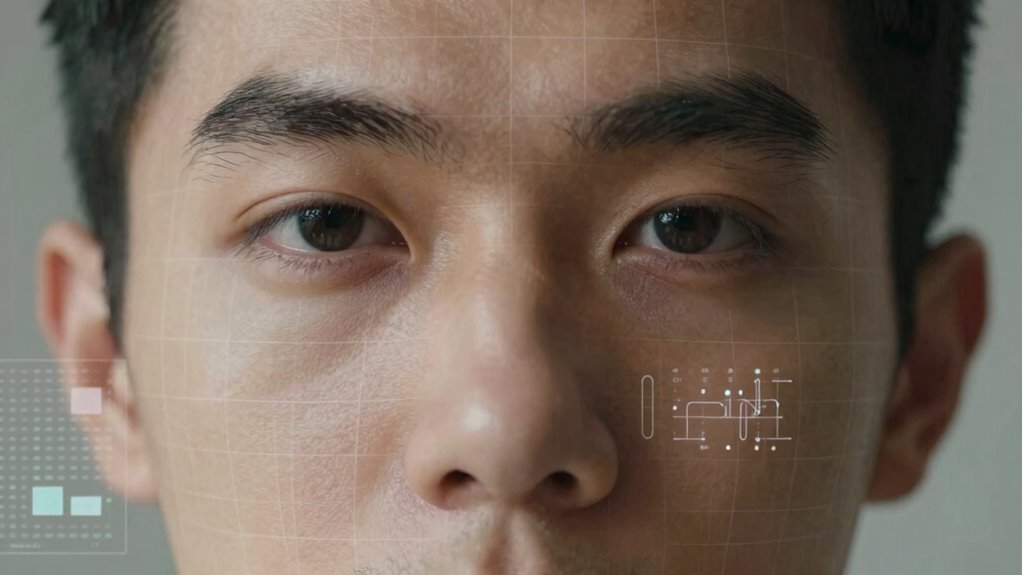
Have you ever wondered how face recognition technology identifies you so quickly? It might seem like magic, but behind the scenes, complex algorithms work tirelessly to analyze your facial features. These algorithms compare key points on your face—like the distance between your eyes, the shape of your jawline, and the contours of your cheekbones—against a vast database. When a match is found, the system confirms your identity in seconds. However, despite its speed, face recognition isn’t flawless. It’s influenced by algorithm biases that can skew results, especially against certain demographic groups. For instance, some algorithms have been shown to work less accurately for people of color or women, leading to false positives or negatives. These biases stem from the data used to train these systems; if the training set lacks diversity, the algorithm becomes less effective at recognizing faces outside its limited scope. That’s a significant concern because it can lead to misidentification, wrongful arrests, or unfair treatment, raising serious privacy concerns about how this technology is used and who it affects most. In addition, the training data used for these systems often lack sufficient diversity, which contributes to these biases. This highlights the importance of diverse datasets in improving accuracy and fairness in face recognition systems. Moreover, ongoing research emphasizes the need for algorithm fairness to reduce bias and improve reliability across different populations. A more inclusive approach to data collection can help address these issues and foster greater trust in the technology.
facial recognition security camera
As an affiliate, we earn on qualifying purchases.
As an affiliate, we earn on qualifying purchases.
Frequently Asked Questions
How Accurate Is Face Recognition in Different Lighting Conditions?
Face recognition accuracy drops markedly in different lighting conditions because of lighting variability. Poor or uneven lighting can obscure facial features, making it harder for algorithms to match faces correctly. Additionally, changes in facial expression can further reduce accuracy, as the system struggles to identify individuals when their expressions differ from stored images. To improve results, many systems require consistent lighting and neutral expressions for better identification.
Can Face Recognition Be Fooled by Disguises or Photos?
Face recognition can be fooled by disguise challenges and photo deception, like a wolf in sheep’s clothing. Disguises, such as masks or makeup, can hide key features, tricking systems into misidentification. Photos, especially high-quality ones, can also be manipulated or used in spoofing attacks. While technology improves, these vulnerabilities remind us that face recognition isn’t foolproof, especially when faced with clever attempts to outsmart it.
How Is Face Data Stored and Protected?
You store face data securely through data encryption, which scrambles information so only authorized systems can access it. Privacy policies guide how this data is collected, used, and shared, ensuring your rights are protected. When organizations handle face data, they implement strict protocols and security measures to prevent unauthorized access or breaches. By following these practices, they aim to keep your facial information safe and respect your privacy.
What Biases Exist in Face Recognition Technology?
Did you know that studies show face recognition algorithms are up to 20% less accurate for women and people of color? You should be aware of the biases in this technology, mainly due to algorithm bias and demographic disparities. These biases stem from limited diverse data sets, leading to misidentification and unfair treatment. Recognizing these issues helps you understand the importance of improving face recognition systems for fairness and accuracy.
How Does Face Recognition Compare to Other Biometric Methods?
You’ll find that face recognition often offers quick, contactless identification compared to fingerprint or iris scans, but it can struggle with facial demographics like age, gender, or ethnicity. While algorithm improvements have enhanced accuracy, biases still impact performance across diverse populations. Unlike other biometric methods, face recognition’s ease of use and scalability make it popular, but ongoing challenges highlight the need for continuous development to guarantee fair, reliable results for everyone.
privacy screen for face recognition
As an affiliate, we earn on qualifying purchases.
As an affiliate, we earn on qualifying purchases.
Conclusion
Understanding how face recognition works helps you see beyond the surface, like peeling back layers of an onion. While the technology has advanced, it’s still prone to mistakes, reminding you that even the most sophisticated tools are not infallible. Just as a mirror can distort your reflection, algorithms can misjudge. So, stay aware, question what you see, and remember—technology’s accuracy is only as good as the flaws it carries inside.
face recognition anti-spoofing mask
As an affiliate, we earn on qualifying purchases.
As an affiliate, we earn on qualifying purchases.
diverse facial recognition dataset
As an affiliate, we earn on qualifying purchases.
As an affiliate, we earn on qualifying purchases.