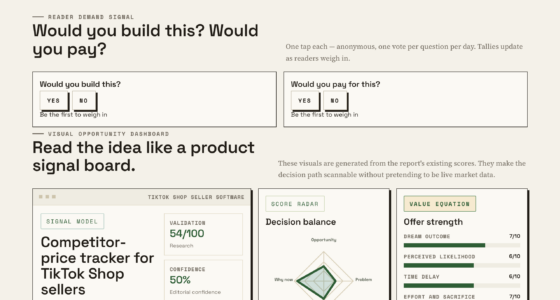
🔍 Read the full analysis: Our Idea Council’s Take On The AI Agent Cost Tracker Pivot on ThorstenMeyerAI.com

Prime made for students and young adults
- Fast, free delivery for dorm and study essentials
- Prime Video and Amazon Music included
- Member-only deals
TL;DR
ThorstenMeyerAI.com says its IdeaClyst council reviewed a proposed AI agent cost-tracking business twice and recommended a pivot. The proposed opening is a cost ledger for agencies and software makers that resell agent work, matching task- and client-level usage to provider invoices; whether customers will pay for it remains untested.
ThorstenMeyerAI.com says its IdeaClyst idea council has recommended pivoting a proposed AI agent cost tracker after two blind reviews. Instead of building another general dashboard, the concept would focus on an invoice-matched cost ledger for agencies and software makers that resell agent work, where a provider’s bill may not show which client or task generated each charge.
The business problem described is a mismatch between how agent services are sold and how model usage is billed. A company might charge several clients a flat fee for an AI agent, while its provider sends a consolidated bill showing a total organized by keys, workspaces or models. That can leave the seller without a clear account of cost and margin by client, according to the proposal.
The suggested product would read usage traces already collected by a team, assign prices to model calls, total the costs by task and client, and compare those totals with the provider’s cost report each day. The intended distinction is not simply showing usage: it is reconciling an internal ledger against the provider’s invoice or cost report. The publication says it found no existing product promising that every ledger line matches the provider bill; that is a finding from its review, not proof that no company offers the capability.
The proposed validation plan is to conduct 10 interviews with agent resellers and manually build one report from customer exports. The plan says to stop if three interviewees report that their existing tools already perform the same reconciliation. No interviews, paid pilots or customer commitments are reported as completed, and the publication says willingness to pay for a standalone ledger remains unknown.
The Margin Problem Behind Agent Costs
The pivot focuses on a business consequence rather than a general need for visibility. A team can see its aggregate AI spending and still be unable to tell whether a fixed-price client contract is profitable. For agencies and software makers reselling agent services, reliable client-level accounting could inform pricing, renewal decisions and margin checks. Those benefits are the rationale for testing the idea, not outcomes demonstrated by a deployed product.
Agent workflows can make the accounting harder because one user request may trigger several model calls as the system plans, uses tools and checks its work. The proposal cites Anthropic’s Claude Code documentation, which says agent teams use roughly seven times more tokens than a standard session when teammates run in plan mode. That figure applies to the documented circumstance; it is not a general estimate for every agent or product.
The commercial question is whether resellers have a gap that existing billing, gateway and tracing products do not already cover—and whether they would pay to close it. A manual reconciliation test could establish whether the issue appears in customer data, but the business case still depends on paid pilots rather than broad interest in AI cost management alone.
Popular right now

Bose QuietComfort Wireless Noise-Cancelling Headphones, Sandstone

Dyson V8 Cordless Vacuum

Vitamix 5200 Blender with 64 oz. Container, Black
As an affiliate, we earn on qualifying purchases.
Existing Tools Cover Parts of the Job
The idea is not based on the premise that AI cost tracking is absent. The proposal describes gateways such as LiteLLM and Portkey as offering budgets and request limits, and tracing software such as Langfuse as showing costs by model, user or tag. It also points to billing products: Paid markets features for managing agent costs and customer margins, while Stripe documents token-based billing with Metronome.
Those examples address parts of the workflow, including setting limits, tracking usage and billing customers. The proposed distinction is a ledger that ties task- and client-level records to the provider’s own cost report. The publication’s review says it did not find a promise that every line would reconcile with the provider bill. That conclusion is limited to the products it considered and does not establish that reconciliation is unavailable through custom integrations or other services.
For broader context, the FinOps Foundation’s 2026 survey reports that 98% of respondents manage AI spend, compared with 31% two years earlier. The survey indicates that AI cost management is on more organizations’ agendas; it does not show demand for this particular ledger, identify likely buyers, or establish that customers would purchase it as a separate product.
“Both said: pivot.”
— IdeaClyst, as described by ThorstenMeyerAI.com
Demand and Reconciliation Remain Untested
The most important unknown is whether companies will pay specifically for a standalone ledger that reconciles agent costs against provider reports. ThorstenMeyerAI.com says its two reviewers disagreed on that question, but does not provide their reasoning or the review scores. No paid pilot or customer commitment is reported.
It is also unclear how consistently providers’ reports and product traces expose the identifiers needed to match each charge to a task and client. The proposed workflow assumes the team has traces it can use, but the account does not specify how it would handle missing records, differences in provider reporting, discounts, or other billing adjustments. Nor does it identify which providers or agent frameworks the initial version would support.
The publication’s claim that it found no product promising line-by-line matching is bounded by its review. The cited products’ listed features show that cost visibility, budgets and billing already exist, but the material does not provide a systematic comparison of their reconciliation capabilities. The 98% survey figure measures organizations managing AI spend, not demand for this particular solution.
Interviews Will Test the Pivot
The next proposed step is a 30-day validation test: interview 10 agencies or software makers that resell agent work, then prepare one reconciliation report by hand from their exported data. The stated stop condition is that three of the 10 say their current tools already do the job. The account presents this as a plan; it does not say that the interviews have begun or that the test has produced findings.
If the interviews show a recurring gap, the manual report could help identify which records buyers need and whether the provider total can be reconciled reliably. A subsequent paid pilot would be needed to test whether customers will pay and whether the approach works with real billing data. If existing tools already satisfy buyers, the proposal’s own test calls for stopping rather than building a broader tracker.
ThorstenMeyerAI.com says a fuller business brief, including its sources, review scores and 30-day plan, appears as The Next 90 Businesses #001 on IdeaNavigatorAI. The publication says the work was researched and drafted with AI assistance, including Anthropic’s Claude, and that Anthropic documentation is cited without endorsement. It also states that IdeaClyst and IdeaNavigatorAI are its own projects and that the article has no sponsor or affiliate links.
Source: ThorstenMeyerAI.com
Key Questions
What is the proposed AI agent cost tracker?
It is a proposed cost ledger for agencies and software makers that resell agent work. The idea is to total model-call costs by task and client, then compare the records with the provider’s cost report.
Why did IdeaClyst recommend a pivot?
ThorstenMeyerAI.com reports that two blind reviews concluded, “Both said: pivot.” The proposed change narrows a broad cost-tracking idea to invoice-matched accounting for resellers. The reviewers’ full assessments are not included in the account.
Do existing tools already track AI costs?
Some tools already offer budgets, usage limits, tracing or billing features. The proposed product would focus on reconciling task- and client-level costs with the provider’s report. The publication says it did not find a product promising that every ledger line matches the bill, but its review does not establish that no such service exists.
Has the business been validated with customers?
Not according to the report. The planned next step is 10 customer interviews and a manually prepared report from exported data. No paid pilot or evidence of willingness to pay is reported.
What does the 98% figure mean?
The FinOps Foundation’s 2026 survey says 98% of respondents manage AI spend, up from 31% two years earlier. It describes survey respondents’ cost-management activity; it does not measure demand for this proposed ledger.
Source: ThorstenMeyerAI.com