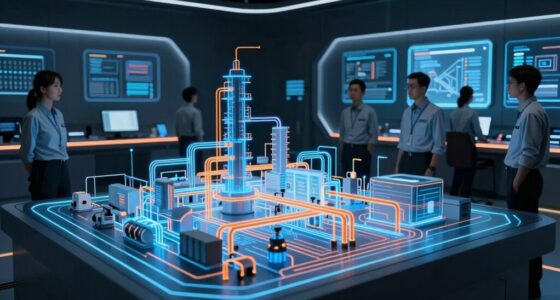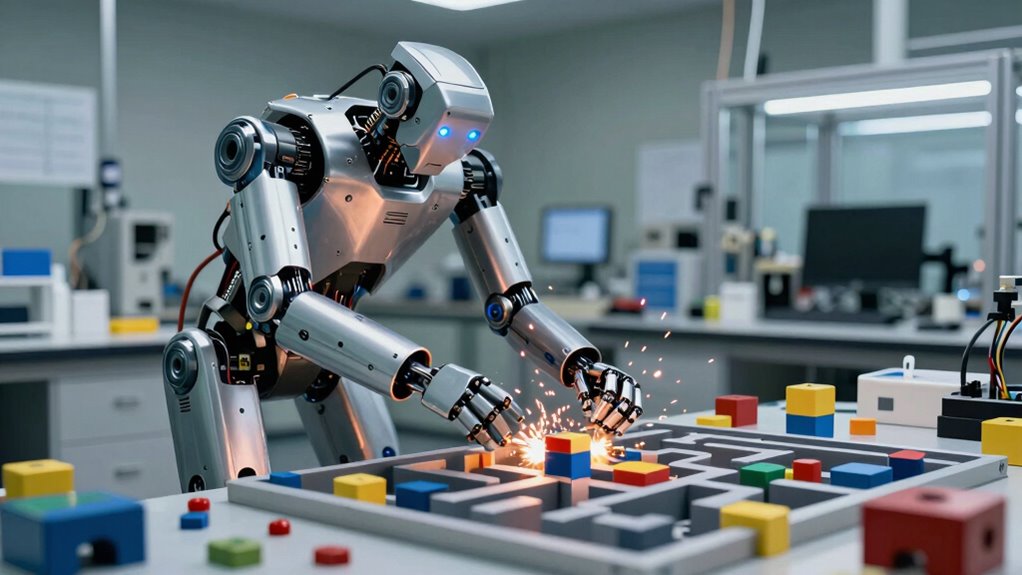

You see, robots learn from trial and error by experimenting with different actions and adjusting based on real-world feedback. They analyze what works and what doesn’t, refining their strategies over time through repeated attempts. Reinforcement algorithms reinforce successful behaviors while discouraging failures. This process allows robots to develop new skills and handle unpredictable situations. If you’re curious about how this continuous learning shapes robotic capabilities, keep exploring — there’s much more to discover.
Listen free for 30 days with Audible
Thousands of audiobooks and originals — cancel anytime.
As an affiliate, we earn on qualifying purchases.
Key Takeaways
- Robots improve their behavior by experimenting with different actions and analyzing outcomes through feedback.
- Reinforcement learning reinforces successful strategies and discourages failures to optimize performance.
- Trial and error enable robots to adapt to complex and unpredictable environments over time.
- Repeated testing and analysis allow robots to refine their movements and strategies autonomously.
- Feedback mechanisms guide robots in adjusting actions, leading to continuous improvement and innovation.
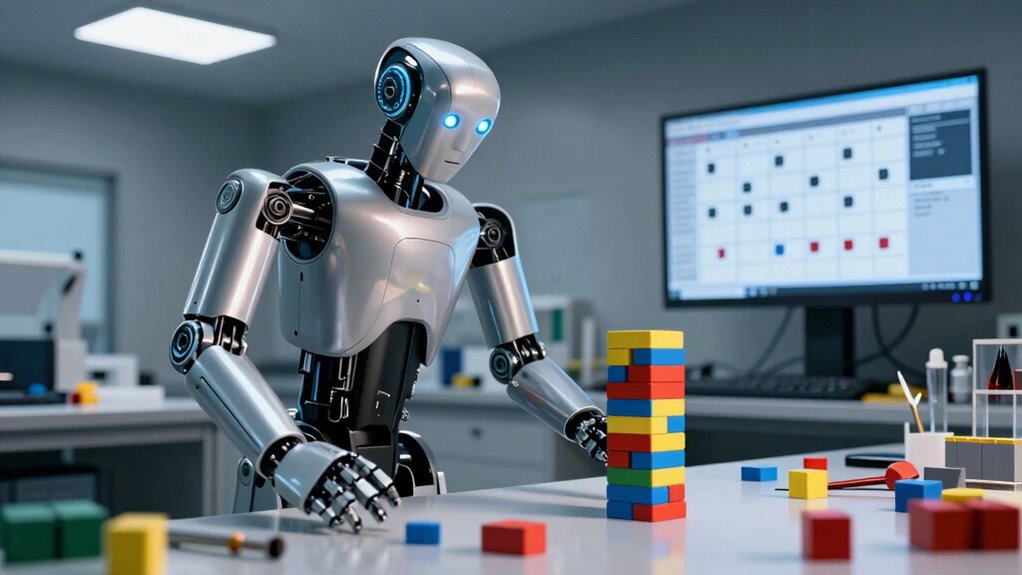
Imagine a robot that learns to perform tasks not by being explicitly programmed but through its own experiences—trial and error. This approach exemplifies robotic flexibility, where machines develop the ability to adjust their actions based on real-world feedback. Instead of following a fixed set of instructions, the robot experiments with different movements and strategies, observing which ones lead to success and which ones fail. Through this process, it gradually refines its behavior, becoming more efficient and effective over time.
Robots learn and adapt through trial and error, improving their skills with real-world experience.
Machine experimentation is at the core of this learning method. You, as the observer, see the robot test various approaches, learning from every attempt. For example, if you’re teaching a robot to pick up objects, it might initially grasp too weakly or too strongly. After each attempt, it analyzes the outcome—did the object slip, or was it too forceful? This feedback guides future actions, allowing the robot to adjust its grip strength or approach angle. Over multiple trials, it learns the most suitable way to grasp different objects, improving its precision without explicit instructions.
This kind of learning mimics how humans and animals adapt to new challenges. You might notice that a robot using trial and error becomes increasingly proficient, even in unfamiliar environments. Its capacity for robotic flexibility hinges on algorithms like reinforcement learning, where positive outcomes reinforce certain actions, and negative ones discourage others. The robot’s ability to experiment freely accelerates its mastery of complex tasks, especially when programmed with the right feedback mechanisms. Additionally, machine experimentation fosters innovation by enabling the robot to explore solutions beyond predefined parameters. Incorporating adaptive algorithms ensures that robots can refine their strategies dynamically, leading to more robust performance in unpredictable situations. Moreover, feedback mechanisms are essential for guiding these adjustments and ensuring meaningful learning. Recognizing the importance of exploration in machine experimentation, robots can develop solutions that are not only effective but also innovative and adaptable, allowing them to respond to unforeseen circumstances more effectively.
As you watch this process unfold, you’ll realize that machine experimentation fosters innovation. Instead of relying solely on pre-set rules, the robot explores possibilities, discovering novel solutions that humans might not have anticipated. This makes robots more versatile and capable of handling unpredictable situations. Over time, their learning isn’t just about repeating tasks but improving them, adapting to changes, and even troubleshooting problems on their own.
In essence, trial and error enable robots to develop true adaptability. Your role shifts from programming every step to designing systems that can learn and evolve through experience. By encouraging machine experimentation, you empower robots to become more autonomous, resilient, and capable of tackling complex tasks that require more than simple pre-programmed responses. This ongoing process pushes the boundaries of what robots can achieve, making them valuable partners in a wide array of industries.
reinforcement learning robot kit
As an affiliate, we earn on qualifying purchases.
As an affiliate, we earn on qualifying purchases.
Frequently Asked Questions
How Do Robots Identify When They’ve Made a Mistake?
You identify mistakes through error detection, which sensors and algorithms monitor during tasks. When a robot’s actions don’t produce expected results, learning algorithms process this discrepancy, signaling an error. You then adjust your behavior based on this feedback, refining your actions over time. This trial-and-error process helps you improve accuracy, ensuring you learn from mistakes and become more efficient at tasks through continuous updates in your learning algorithms.
What Types of Environments Are Best for Robot Trial-And-Error Learning?
Think of simulation environments as safe playgrounds for robots, where they can experiment without real-world risks. These environments, along with physical testing, are ideal for trial-and-error learning because they allow robots to refine skills efficiently. Such settings mimic real-world conditions, helping robots adapt and improve quickly. You’ll find that controlled, varied environments promote faster learning, making robots better at handling complex tasks in unpredictable situations.
Can Robots Learn From Mistakes Without Human Intervention?
Yes, robots can learn from mistakes without human intervention through autonomous adaptation. They use machine intuition to analyze errors and adjust their actions accordingly. By leveraging sensors and algorithms, robots identify when they’ve made a mistake, then refine their behavior in real-time. This process allows them to improve performance independently, making them more efficient and adaptable in dynamic environments without needing constant human guidance.
How Long Does It Typically Take for a Robot to Learn a Task?
It typically takes a robot anywhere from hours to weeks to learn a task, depending on complexity and programming. During robot learning, it uses trial and error to refine its actions. With autonomous adaptation, robots improve faster as they adjust to new environments without human input. The more sophisticated the learning algorithms, the quicker the robot can master tasks, making autonomous adaptation increasingly efficient over time.
Are There Safety Concerns During Robot Trial-And-Error Learning?
You should be aware that safety concerns during robot trial-and-error learning are significant. Ethical considerations come into play, especially if a robot damages property or harms someone. Legal implications may also arise if accidents occur due to the robot’s actions. To minimize these risks, you need to implement strict safety protocols, monitor the robot closely, and verify compliance with relevant regulations, safeguarding both people and the environment.
robot arm for learning and experimentation
As an affiliate, we earn on qualifying purchases.
As an affiliate, we earn on qualifying purchases.
Conclusion
You now see how robots improve through trial and error, much like humans do. Interestingly, studies show that robots can learn new tasks up to 50% faster with this method. By constantly experimenting and adjusting, they become more efficient and adaptable. So, next time you see a robot in action, remember it’s learning and evolving just like us—one mistake at a time, getting closer to mastery. Isn’t that a captivating way technology mimics life?
As an affiliate, we earn on qualifying purchases.
As an affiliate, we earn on qualifying purchases.
Fall Picks
fall essentials
As an affiliate, we earn on qualifying purchases.