
You’ll notice that some stars flicker more than others because of their brightness, size, and distance. Fainter and smaller stars are more affected by atmospheric turbulence, making their flickering appear more intense. Brighter stars tend to look steadier because they’re more stable. The atmosphere’s activity, like wind or temperature changes, also plays a big role. To understand the science behind this flickering and what factors influence it, keep exploring further.
Key Takeaways
- Fainter and smaller stars appear to flicker more due to atmospheric distortions affecting their light.
- Distant stars are more susceptible to atmospheric turbulence because their light behaves like point sources.
- Bright, nearby stars are more stable and exhibit less flickering than dimmer, farther stars.
- External factors like atmospheric turbulence, wind, and temperature shifts increase flickering intensity.
- Light pollution and urban environments amplify perceived star flickering by scattering and diffusing light.
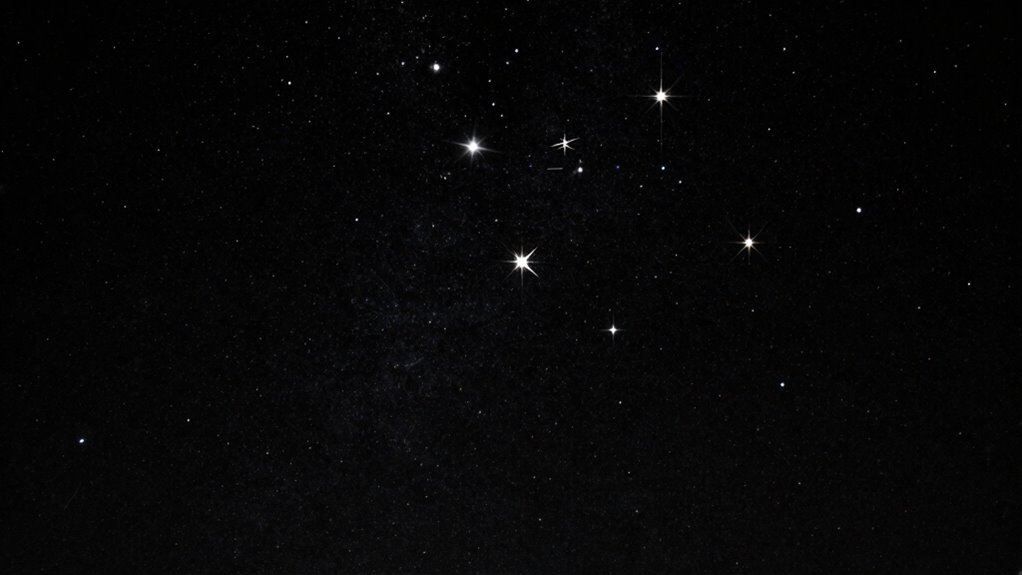
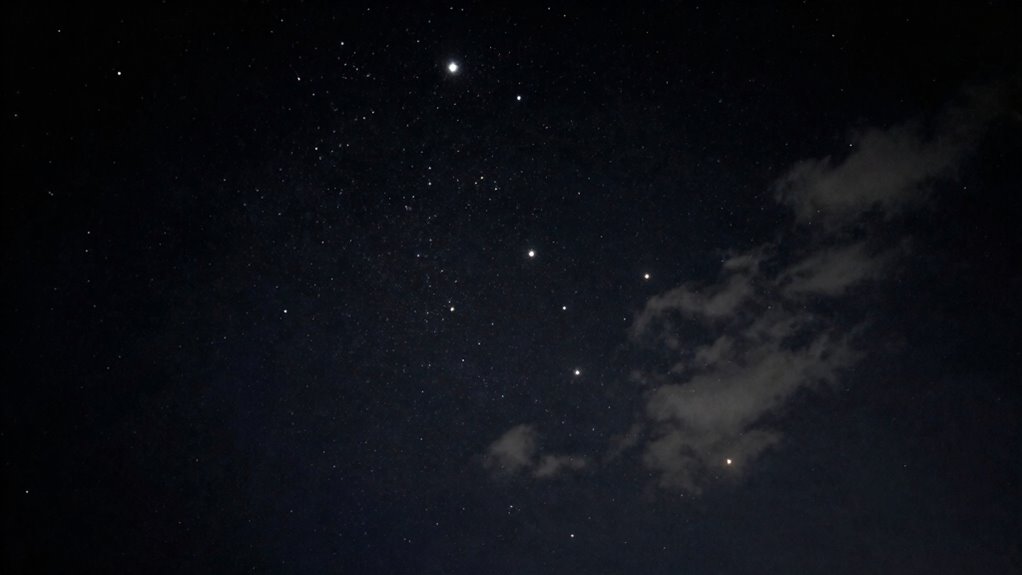
Have you ever noticed that some stars seem to twinkle more than others? That flickering isn’t just a random light show; it’s a fascinating interplay of physics and environment. When you look up at the night sky, the main reason stars appear to twinkle is because their light passes through Earth’s turbulent atmosphere. These stellar atmospheres are constantly shifting, with air currents moving at different speeds and temperatures. As starlight travels through these layers, it bends and refracts in unpredictable ways, causing the star’s apparent brightness to fluctuate. The more turbulent the atmosphere, the more pronounced the twinkling.
Stars twinkle more when Earth’s atmosphere is turbulent, bending and refracting their light unpredictably.
But it’s not just atmospheric turbulence that affects how much a star twinkles. Light pollution, or the excess artificial light that brightens the night sky in urban areas, also plays a role. When you’re in a city or near bright lights, the sky’s overall brightness increases, making it harder to see stars clearly. Instead of viewing a crisp point of light, the star’s light gets scattered and diffused by the excess glow, which can amplify the flickering effect. This scattered light can make some stars seem to flicker more intensely because your eyes are struggling to resolve their true brightness against the bright background.
Furthermore, the type and brightness of the star itself influence how much it twinkles. Bright stars, especially those closer to Earth, tend to flicker less because their light is more stable and less affected by atmospheric distortions. Fainter stars, on the other hand, are more susceptible to the atmospheric ripples, making their flickering more noticeable. The size of the star’s apparent disk also contributes—smaller, more distant stars are point sources, so their light is more easily disturbed, resulting in more flickering. Additionally, atmospheric turbulence can vary throughout the night, affecting how much stars twinkle at different times, as the stability of the atmosphere shifts. Environmental factors such as wind and temperature changes can further influence turbulence levels. Changes in air currents can cause the atmospheric layers to become more or less turbulent, directly impacting the twinkling effect.
In essence, the flickering you see is a combination of the star’s inherent characteristics and external factors like atmospheric conditions and light pollution. If you’re in a dark, clear area away from city lights, you’ll notice less flickering because the atmosphere is calmer, and there’s less scattered light. When you’re in a bright, polluted environment, the stars might seem to flicker more, not because they’re changing, but because your eyes and the atmosphere are creating that illusion. It’s also interesting to note that the type of star can influence how much it twinkles, with larger, brighter stars generally flickering less than faint, distant ones.
As an affiliate, we earn on qualifying purchases.
Frequently Asked Questions
Do All Stars Flicker at Some Point?
Yes, all stars flicker at some point due to cosmic variability. Their stellar brightness isn’t constant because of factors like surface activity, magnetic fields, or pulsations. You might notice this flickering as tiny, rapid changes in brightness. While some stars flicker more noticeably—like variable stars—others show less variation, but every star experiences some degree of cosmic variability, making their brightness subtly shift over time.
How Does a Star’s Size Affect Flickering?
A star’s size influences its flickering because larger stars, like giants, have more stellar brightness variability, causing them to flicker more vividly. For example, a massive supergiant may exhibit irregular brightness changes due to its extensive outer layers. Smaller stars, like dwarfs, tend to be steadier, with less flickering. The size impacts how the star’s surface and internal processes affect brightness, making larger stars more prone to noticeable flickering.
Can Flickering Indicate a Star’s Age?
Yes, flickering can hint at a star’s age, as younger stars often show more stellar brightness fluctuations, leading to luminosity variations. These variations happen because their internal processes are more turbulent. As stars age, their brightness stabilizes. By observing flickering patterns, you can get clues about a star’s evolutionary stage. So, a star’s flicker rate can help you estimate whether it’s relatively young or older.
Why Do Some Stars Flicker Irregularly?
Think of stars as cosmic storytellers, their flickering revealing hidden tales. You notice some flicker irregularly because of their stellar brightness and cosmic variability, which causes unpredictable light changes. This irregular flickering signals turbulent atmospheres or internal processes, reflecting a star’s dynamic nature. Just like life’s surprises, these stars remind us that the universe holds unpredictable beauty, with each flicker telling a story of ongoing change and cosmic complexity.
Does Flickering Impact a Star’s Lifespan?
Flickering doesn’t impact a star’s lifespan directly. It results from variations in stellar atmospheres and magnetic activity, which cause brightness changes. These fluctuations are temporary and don’t alter the star’s core processes or fuel supply. So, even if a star flickers more due to intense magnetic activity or atmospheric instability, its overall lifespan remains unaffected. The flickering is simply a surface phenomenon, not a sign of impending end.
As an affiliate, we earn on qualifying purchases.
Conclusion
So, next time you gaze up at the night sky, remember that those twinkling stars are like celestial dancers, each with its own rhythm and flair. Some flicker like fiery candles, while others shine steady as a calm lake. Their shimmering dance tells a story of shimmering atmospheres and distant worlds. Truly, in their flickering, they whisper secrets of the universe, inviting you to marvel at the cosmic ballet unfolding above your head.
As an affiliate, we earn on qualifying purchases.
As an affiliate, we earn on qualifying purchases.