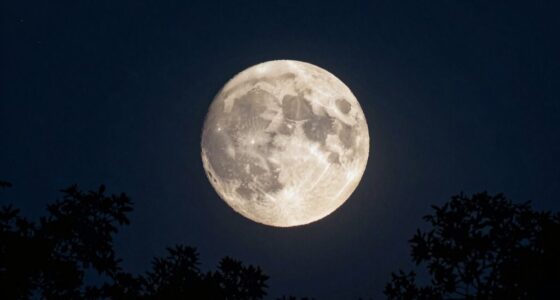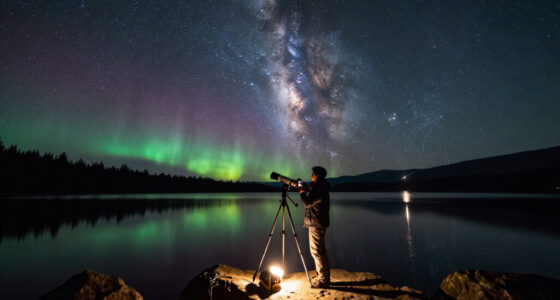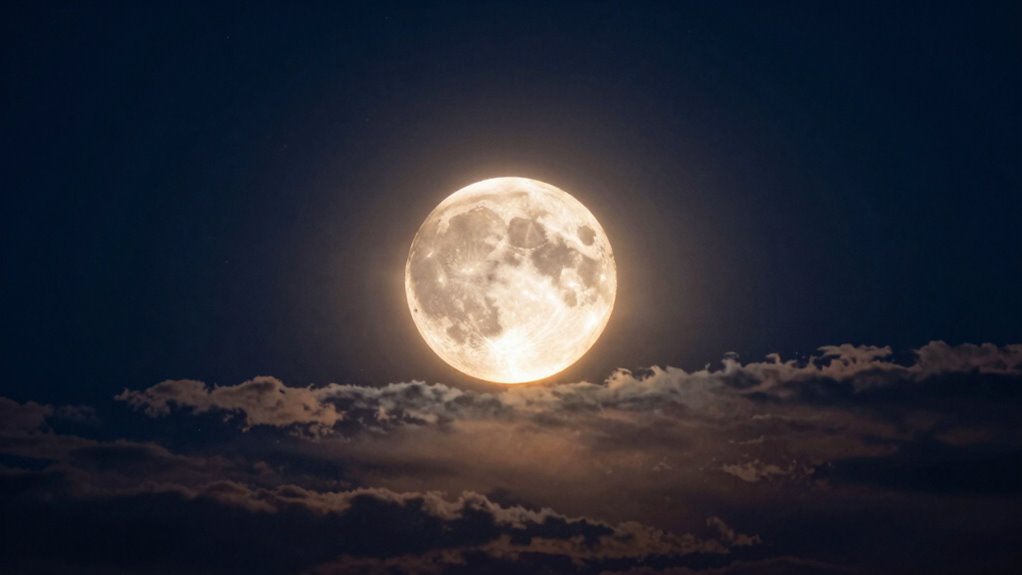

Eclipses are rare because they happen only when the Sun, Moon, and Earth perfectly align, which doesn’t happen often due to the Moon’s tilted orbit. Despite their rarity, scientists can predict eclipses with incredible accuracy because of centuries of studying celestial mechanics and orbit patterns. Advanced calculations and observations, including Einstein’s theories, help forecast these events decades ahead. Curiosity about these fascinating events will reveal how both rarity and predictability come together in celestial motions.

Prime made for students and young adults
- Fast, free delivery for dorm and study essentials
- Prime Video and Amazon Music included
- Member-only deals
Key Takeaways
- Eclipses require precise alignment of the Sun, Moon, and Earth, which is infrequent due to the Moon’s tilted orbit.
- Complex mathematical models based on celestial mechanics enable accurate long-term predictions of eclipse events.
- The specific points in the lunar cycle needed for eclipses occur only during certain phases, making them rare.
- Advances in technology and understanding of orbital patterns have refined predictions, enhancing their accuracy.
- Cultural significance and scientific studies have historically driven detailed observation, improving our grasp of eclipse predictability.
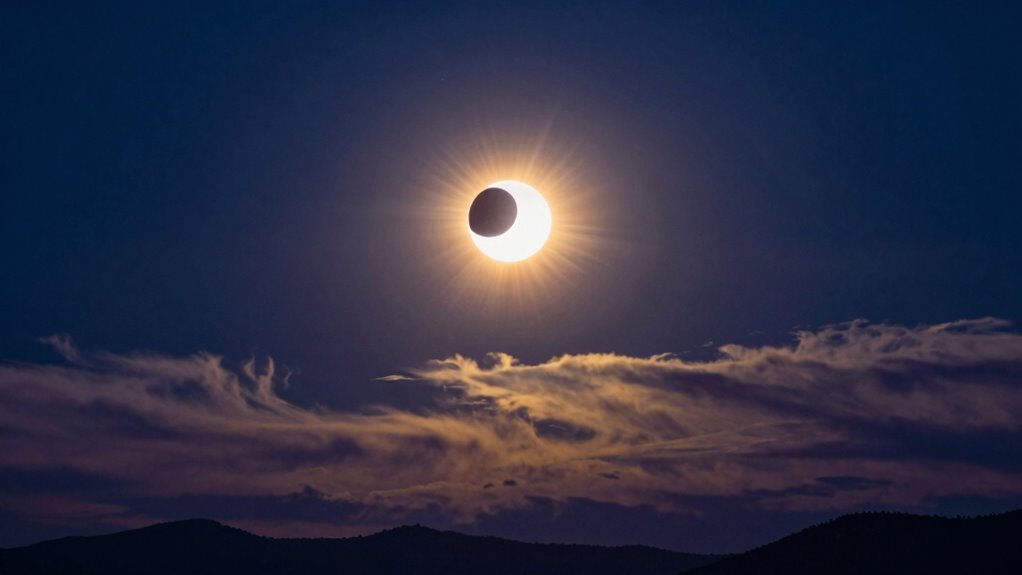
Have you ever wondered why eclipses are both rare and yet so predictable? It’s because, despite their infrequent appearance, astronomers have studied their patterns for centuries, allowing us to forecast their occurrences with remarkable accuracy. Eclipses happen when the Sun, Moon, and Earth align just right, but these alignments don’t happen often. The Moon’s orbit around Earth is tilted about 5 degrees relative to Earth’s orbit around the Sun. This tilt means that most of the time, the Sun’s light isn’t blocked during a new moon, and a solar eclipse doesn’t occur. Similarly, during a full moon, the Earth often blocks the Sun’s light but not always perfectly aligned, which is why lunar eclipses are also infrequent. The precise conditions needed for an eclipse happen only during specific points in the lunar cycle, making them rare events. This alignment depends heavily on the celestial mechanics, which astronomers have mapped and understood over centuries. These orbital patterns are crucial for understanding why eclipses are both predictable and infrequent, and they continue to be refined with advances in technology. Yet, despite their rarity, eclipses are highly predictable. Astronomers have mapped the orbits of the Moon and Earth for centuries, calculating when the necessary alignments will occur. They use complex mathematical models based on Newtonian physics, and more recently, Einstein’s theories, to forecast eclipse dates decades or even centuries in advance. This precision is why you can plan to witness an eclipse long before it happens. It’s a confirmation of human curiosity and our ability to understand celestial mechanics. Eclipses also carry deep cultural significance across civilizations. Historically, they’ve been seen as powerful omens or messages from the gods, often interpreted as warnings or divine signals. Many ancient societies recorded these events meticulously, attaching spiritual and mythological meanings to them. Some believed eclipses foretold important political or social changes, while others saw them as moments of reflection or renewal. These cultural interpretations have persisted, and even today, eclipses inspire awe and curiosity, fueling stories and traditions around the world. Looking at the historical occurrences, eclipses have played crucial roles in scientific discoveries. For example, during a solar eclipse in 1919, astronomers tested Einstein’s theory of general relativity by observing the bending of starlight around the Sun. Such events demonstrate how eclipses serve as natural laboratories, allowing us to explore the universe’s fundamental laws. Their infrequency combined with precise predictability has made them symbols of both mystery and scientific progress. So, while eclipses are rare in occurrence, our understanding of them allows us to predict them with confidence, connecting us across time and cultures by revealing the cosmos’s grand design.
As an affiliate, we earn on qualifying purchases.
Frequently Asked Questions
How Often Do Total Solar Eclipses Occur Worldwide?
Total solar eclipses happen roughly once every 18 months somewhere on Earth, but their global visibility is limited. Eclipse frequency varies because not every eclipse is visible from your location. When a total eclipse does occur, it’s usually only visible along a narrow path on Earth’s surface. So, while they’re relatively common worldwide, witnessing one in person depends on where you are and the eclipse’s path.
Can Eclipses Be Visible From the Same Location Repeatedly?
Like the myth of the phoenix, eclipses can reappear in the same spot, but only after many years. You might see an eclipse from the same location, but it’s rare due to Earth’s shifting orbit and the eclipse cycle. In many cultures, eclipse mythology highlights their cultural significance, making each sighting special. So, while possible, witnessing repeated eclipses from the same place remains a once-in-a-lifetime experience.
What Are the Different Types of Solar and Lunar Eclipses?
You see different types of solar and lunar eclipses based on the eclipse mechanism and celestial alignment. Solar eclipses include total, partial, and annular types, depending on how the moon covers the sun. Lunar eclipses are penumbral, partial, or total, based on how Earth’s shadow falls on the moon. These variations occur because of specific celestial alignments, making each eclipse unique and predictable through understanding their underlying mechanisms.
How Do Astronomers Predict Eclipse Paths Centuries in Advance?
Astronomers predict eclipse paths centuries in advance through celestial mechanics and orbital calculations. They analyze the Moon’s and Earth’s orbits, considering factors like gravitational influences and orbital eccentricities. By modeling these movements precisely, they forecast where and when eclipses will occur. This detailed understanding of celestial mechanics allows astronomers to accurately map eclipse paths long before they happen, making these events both rare and highly predictable.
Why Are Some Eclipses Visible Only From Specific Regions?
You see, some eclipses are visible only from specific regions because the Moon’s shadow falls on particular parts of Earth during an eclipse. The geographic visibility depends on where the Moon’s shadow, like the umbra or penumbra, crosses Earth’s surface. As a result, only viewers within that shadow’s path get to witness the eclipse, making it a localized event based on the alignment of the Moon, Earth, and Sun.
As an affiliate, we earn on qualifying purchases.
Conclusion
So, next time you witness an eclipse, remember it’s a cosmic dance, rare yet predictable. Like a master illusionist, the universe pulls off its grand performance with precision, reminding you that even in chaos, there’s order. Isn’t it amazing how the heavens align, offering us fleeting moments of wonder? Embrace these celestial events—they’re nature’s secret whispers, inviting you to marvel at the universe’s timeless, intricate choreography.
As an affiliate, we earn on qualifying purchases.
As an affiliate, we earn on qualifying purchases.
Halloween Picks
halloween
As an affiliate, we earn on qualifying purchases.