
Space is silent to human ears, so astronomers use special instruments to detect energy forms like gravitational waves and quantum vibrations. These signals carry information about cosmic events across vast distances. Advanced tools, such as laser interferometers and quantum sensors, convert tiny vibrations into data that can be analyzed. Noise reduction techniques guarantee accuracy, revealing the universe’s secrets. If you keep exploring, you’ll discover how these groundbreaking methods uncover the universe’s hidden stories.
Open a free Amazon Business account
Business pricing, bulk buying and tax-exempt orders.
As an affiliate, we earn on qualifying purchases.
Key Takeaways
- Space is silent; astronomers detect energy signals, not sound waves, to study cosmic events.
- They use advanced instruments like laser interferometers to measure tiny vibrations caused by gravitational waves.
- Quantum sensors detect faint quantum vibrations that reveal information about the early universe.
- Data from vibrations is processed and analyzed to interpret signals from billions of light-years away.
- Noise reduction and isolation techniques ensure accurate detection of cosmic signals in a noise-free environment.

Although space is silent to the human ear, astronomers have developed innovative ways to “listen” to the universe by detecting signals beyond sound waves. Instead of relying on traditional sound, they focus on various forms of energy that carry information from distant cosmic events. One of the most fascinating tools in their arsenal involves detecting gravitational waves—ripples in spacetime caused by violent astrophysical phenomena like merging black holes or neutron stars. When these massive objects collide, they generate vibrations in the fabric of the universe, and these vibrations travel across space at the speed of light. With advanced detectors like LIGO and Virgo, astronomers can sense these minute distortions, translating them into data that reveal the universe’s most powerful and energetic events.
Beyond gravitational waves, scientists also explore quantum vibrations—tiny fluctuations at the quantum level that can provide insight into the fundamental nature of the universe. These vibrations occur within the fabric of spacetime itself and can be influenced by the universe’s earliest moments, such as during the Big Bang. By measuring these subtle quantum signals, astronomers attempt to piece together the universe’s origins and its underlying structure. These vibrations are extremely faint, but highly sensitive instruments can pick up these signals, allowing researchers to “listen” to the universe’s most subtle whispers. quantum vibrations are especially promising for unlocking new knowledge about the universe’s earliest moments and its fundamental physics, and researchers continue to develop increasingly sophisticated detection techniques to improve their sensitivity. The process of detecting these signals involves sophisticated technology and meticulous data analysis. Instruments like laser interferometers measure the tiny shifts caused by gravitational waves, while quantum sensors detect the faint vibrations predicted by quantum physics. These tools operate in environments isolated from seismic and electromagnetic noise to guarantee the integrity of the signals. Additionally, ongoing advancements in noise reduction are crucial for improving the accuracy of these measurements. Once captured, the data is processed and decoded, transforming the undetectable vibrations into meaningful information about cosmic events occurring millions or billions of light-years away.
laser interferometer for gravitational wave detection
As an affiliate, we earn on qualifying purchases.
As an affiliate, we earn on qualifying purchases.
Frequently Asked Questions
How Do Astronomers Convert Signals Into Visual Images?
You convert signals into visual images by analyzing cosmic vibrations, which are collected by telescopes and detectors. Astronomers process this data through data visualization techniques, transforming the raw signals into images that reveal celestial objects and phenomena. They use specialized software to map the intensity and frequency of the signals, creating visual representations. This process helps you better understand the universe by turning invisible cosmic vibrations into detailed, comprehensible images.
What Instruments Are Used to Detect These Signals?
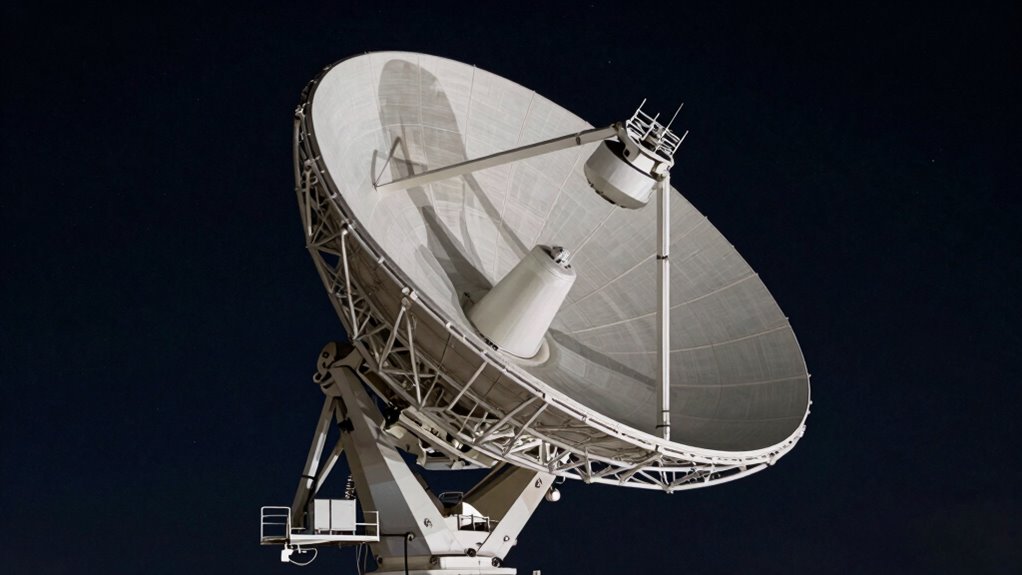
You use instruments called radio telescopes to detect signals, mainly radio waves, from space. These telescopes have large dish-shaped antennas that pick up faint signals amid cosmic noise. The radio waves are then converted into electrical signals, which astronomers analyze to understand celestial phenomena. Unlike human ears, these instruments allow you to listen to the universe’s hidden symphony, revealing secrets that are invisible to the naked eye.
Can We Hear Sounds From Space With Special Equipment?
Yes, you can hear sounds from space using special equipment. Scientists convert space weather and cosmic vibrations—radio signals and electromagnetic waves—into audible sounds through a process called sonification. This allows you to listen to phenomena like solar flares or pulsars, transforming invisible cosmic vibrations into audio that reveals the universe’s dynamic activity. These techniques help us understand space better beyond just visual data.
How Do Astronomers Differentiate Between Noise and Genuine Signals?
You can tell genuine signals from noise through advanced signal processing techniques. Astronomers use noise reduction methods to filter out background interference, ensuring they focus on authentic signals. They analyze the data’s pattern, frequency, and strength, comparing it to known sources. If a signal remains consistent after noise reduction, it’s likely genuine. This careful differentiation helps astronomers detect cosmic phenomena accurately without mistaking noise for meaningful information.
Are There Any Sounds From Space That Have Been Successfully Interpreted?
Yes, you can hear interpreted sounds from space, like cosmic vibrations and signals from extraterrestrial communication. Scientists use special instruments to convert radio waves into audio, revealing phenomena like pulsar signals or solar bursts. These sounds, though not audible naturally, help you understand cosmic events and potential signals from other civilizations. When you listen to these recordings, you’re hearing the universe’s hidden symphony, decoded for human understanding.
quantum sensors for physics experiments
As an affiliate, we earn on qualifying purchases.
As an affiliate, we earn on qualifying purchases.
Conclusion
Just as Da Vinci gazed into the heavens seeking secrets beyond sight, you now understand how astronomers tune into the universe’s whispers beyond sound. They listen through radio waves and gravitational ripples, uncovering cosmic symphonies played in frequencies our ears can’t hear. In this silent symphony, the universe reveals its ancient stories, reminding you that sometimes, the most profound messages are those we must learn to perceive beyond our natural senses—echoes of eternity waiting to be understood.
noise reduction equipment for scientific research
As an affiliate, we earn on qualifying purchases.
As an affiliate, we earn on qualifying purchases.
As an affiliate, we earn on qualifying purchases.
Flea & tick season Picks
flea and tick prevention
As an affiliate, we earn on qualifying purchases.