
📊 Full opportunity report: When One Agent Isn’t Enough: Claude Now Builds Its Own Team of Agents on the Fly on ThorstenMeyerAI.com — validation score, market gap, and execution plan.

Prime made for students and young adults
- Fast, free delivery for dorm and study essentials
- Prime Video and Amazon Music included
- Member-only deals
TL;DR
Claude has added a new feature called dynamic workflows, allowing it to create and orchestrate multiple agents on the fly for complex tasks. This development aims to improve performance on high-value, multi-step projects. Details about implementation and limitations are still emerging.
Anthropic’s Claude has introduced a new capability called dynamic workflows, enabling it to build and orchestrate its own team of specialized agents on the fly for complex tasks. This marks a significant evolution in AI orchestration, allowing Claude to better handle multi-faceted projects that exceed the limits of a single-agent approach. The feature is aimed at high-value, multi-step workflows where traditional single-agent models underperform.
The dynamic workflows feature allows Claude to generate custom scripts—small JavaScript programs—that spawn, coordinate, and manage multiple subagents, each with dedicated roles and isolated contexts. These subagents can be assigned different models based on task complexity, from fast, inexpensive models for grunt work to powerful ones for judgment and verification.
According to Anthropic, this approach addresses common failure modes seen in single-agent tasks, such as agentic laziness, self-preferential bias, and goal drift. By dividing a project into focused sub-tasks managed by separate agents, Claude can maintain better accuracy, reduce bias, and stay aligned with the original objectives. The system can also resume interrupted workflows, making it suitable for long or iterative projects.
Mechanically, the workflows are dynamically generated JavaScript programs that include functions for spawning agents, assigning tasks, and merging results. They can decide which model each subagent uses and whether agents operate in isolated worktrees to prevent interference. This flexibility allows Claude to tailor the orchestration to specific tasks, such as fact-checking, source verification, or complex code refactoring.
When one agent isn’t enough: Claude now builds its own team on the fly
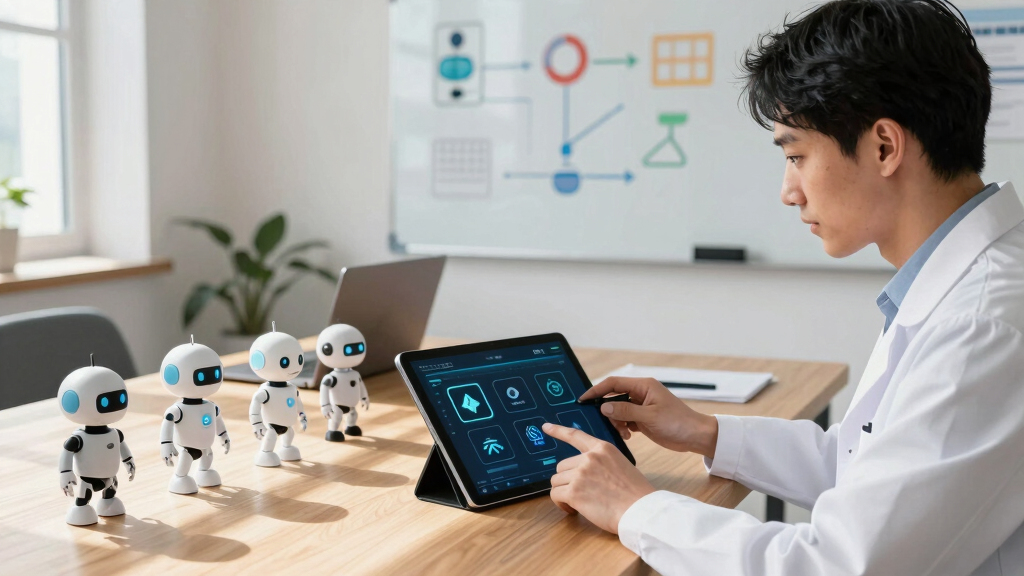
Skills package what you know; loops decide how far you delegate over time. Dynamic workflows are the third axis — within a single task, Claude writes its own harness and assembles a temporary team of subagents. Think of it as Claude drawing an org chart for one job.
The shift is from prompting a worker to commissioning a team — more output, more cost, and a manager’s judgment required. Reach for a workflow when a task is big, parallel, adversarial, or judgment-heavy — and when you can feel a single agent getting lazy, grading its own homework, or losing the plot. Bound it (token budgets, pilot first) — workflows can spawn hundreds of agents and burn far more tokens. For everything else, don’t hire five people to change a lightbulb.
Implications for AI Task Management
This development could significantly enhance AI performance on complex, multi-step projects, especially in professional and enterprise contexts. By enabling Claude to autonomously assemble and manage teams of agents, organizations can expect more accurate, reliable, and efficient handling of high-value tasks like research, verification, and complex problem-solving. However, the increased token usage and computational resources required mean this approach may be less suitable for simple or low-stakes tasks.
While the technology promises greater robustness, it also introduces new layers of complexity in managing AI workflows, raising questions about control, transparency, and resource consumption. The ability for Claude to dynamically generate and run custom scripts represents a step toward more autonomous AI systems capable of managing their own orchestration, which could influence future AI development and deployment strategies.
As an affiliate, we earn on qualifying purchases.
Evolution of AI Orchestration Techniques
Anthropic’s Claude has previously introduced skills packages and looping capabilities to improve task delegation and execution. The addition of dynamic workflows completes a trilogy aimed at making Claude more adaptable and capable of handling complex projects. Historically, single-agent models have been effective for straightforward tasks but struggled with long, parallel, or adversarial projects, often suffering from issues like partial completion and goal drift.
The concept of orchestrating multiple agents is inspired by human team management principles, such as dividing work, independent review, and iterative refinement. Prior to this, similar multi-agent setups required manual wiring and static configurations, limiting flexibility. The new approach automates this process, allowing Claude to generate tailored workflows based on the task at hand, first shipped with Claude Opus 4.8.
“With dynamic workflows, Claude can now write its own harness—custom-built for each task—enabling more reliable handling of complex, multi-step projects.”
— Thorsten Meyer, AI researcher at Anthropic
As an affiliate, we earn on qualifying purchases.
Unresolved Questions About Workflow Limitations
It is not yet clear how well these dynamic workflows perform in real-world, high-stakes environments or how they handle errors and unexpected interruptions over extended periods. Details about resource consumption, cost, and potential security concerns remain under discussion. Additionally, the extent to which users can control or customize these workflows is still being explored.
As an affiliate, we earn on qualifying purchases.
Next Steps for Deployment and Evaluation
Anthropic plans to continue refining the dynamic workflows feature, with broader deployment expected in upcoming software updates. Future evaluations will likely focus on performance metrics, resource efficiency, and user control options. Researchers and enterprise users will be watching for case studies demonstrating practical benefits and limitations in diverse tasks.
complex AI project management tools
As an affiliate, we earn on qualifying purchases.
As an affiliate, we earn on qualifying purchases.
Key Questions
How does Claude decide which agents to spawn?
Claude uses orchestration patterns embedded in the generated JavaScript to determine roles, such as classification, verification, or synthesis, based on the task requirements.
Can users customize or control the workflows Claude creates?
Currently, workflows are generated automatically based on the task, but users can influence the process by specifying keywords like ‘ultracode’ or requesting particular orchestration patterns.
What are the resource implications of using dynamic workflows?
Dynamic workflows require more tokens and computational resources, which could increase costs and processing time, especially for complex, long-running projects.
Are there risks or limitations to this approach?
Potential risks include resource exhaustion, difficulty in debugging complex orchestrations, and managing security when running custom scripts. Effectiveness in real-world scenarios remains to be fully validated.
Source: ThorstenMeyerAI.com
Fall Picks
fall essentials
As an affiliate, we earn on qualifying purchases.