

Parents comparing educational science kits often face a choice between building deep familiarity with one field and sampling several kinds of science. Snap Circuits focuses on electronics: children connect components to make working projects and learn how circuits behave. National Geographic sells a range of themed kits, from crystal growing and rock collecting to chemistry experiments, so the experience depends on the particular kit.

Prime made for students and young adults
- Fast, free delivery for dorm and study essentials
- Prime Video and Amazon Music included
- Member-only deals

Doctor Jupiter Preschool Science Kit for Ages 3–5
- ✔ Recommended age: 3 years and up; described for ages 3–5
- ✔ Activities: 100+
- ✔ Themes: Biology, chemistry, earth science, and physics
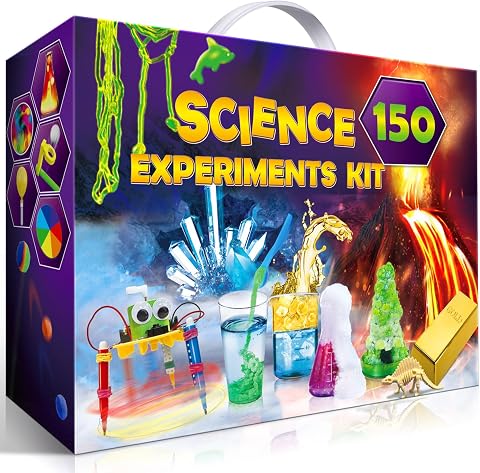
UNGLINGA 150-Experiment Science Kit for Kids
- ✔ Brand: UNGLINGA
- ✔ Recommended age: 8 years and up
- ✔ Experiment count: 150

National Geographic Junior Chemistry Set with 50 Experiments
- ✔ Brand: Blue Marble
- ✔ Age range: 4 years and up
- ✔ Experiments: 50
That difference shapes the best buy. Snap Circuits is the stronger fit for a child who likes constructing, testing, and revising projects, and for families who want one kit to support repeated play. A National Geographic kit can be a better introduction for a child drawn to a specific topic or for a parent who wants a compact, giftable activity. Age guidance, contents, and adult involvement vary by product, so check the individual kit before buying.
At a Glance
| Criteria | Snap Circuits | National Geographic Science Kits | Winner |
|---|---|---|---|
| Learning focus | Electronics, circuits, and cause and effect | Varies by kit; may cover chemistry, geology, fossils, or other themes | Depends |
| Repeat play | High: reusable components support many configurations | Usually tied to the selected experiment or activity; consumables can limit repeats | A |
| Range of topics | Narrower focus, with projects built around electronics | Broad across the product range, but each individual kit has a specific theme | B |
| Adult involvement | Often manageable for children who can follow diagrams; younger users may need help | Varies considerably; measuring, handling materials, or setup may call for adult help | Depends |
| Best fit by interest | Children who enjoy construction, mechanisms, and troubleshooting | Children with a clear interest in a particular science theme or a preference for varied activities | Depends |
| Value over time | Can be strong if the child returns to the components and builds beyond the first projects | Good when the chosen theme matches a child’s interest; value depends on contents and repeatability | A |
Doctor Jupiter Preschool Science Kit for Ages 3–5
For a child just beginning to explore science, age-appropriate sensory play is more useful than a long list of advanced experiments. Doctor Jupiter’s kit is designed for ages 3 and up and offers more than 100 activities involving colors, bubbles, water, motion, sound, and simple reactions. That makes it the clearest fit in this lineup for introducing observation: children can notice what changes when they mix, pour, spray, or move materials, with an adult helping them connect the activity to a simple idea.Its activity range is broader than the chemistry-only emphasis of the National Geographic Junior set, and the described themes span biology, chemistry, earth science, and physics. The included beaker, cups, funnel, spray bottle, and color-mixing tray support varied forms of play, while illustrated instructions and online activity access offer families ways to follow along. The materials are described as child-safe and food-grade; that claim does not mean a young child should use the kit without supervision. The activities are intended for adult-guided exploration, so it suits shared learning better than independent projects.Compared with UNGLINGA’s set, Doctor Jupiter is much more firmly aimed at preschoolers and does not promise the same fit for older children seeking sustained, varied experiments. Its 100+ activities sound extensive, but the description does not establish that every activity has all necessary materials in the box. Families should also expect to be active participants. For the right age, though, it puts simple concepts and hands-on discovery ahead of complexity, which is exactly what makes it the most approachable starting point here.
Pros:
- More than 100 activities explore colors, bubbles, water, motion, sound, and simple reactions.
- Described as using child-safe, food-grade materials.
- Illustrated instructions and online activity access support adult-guided learning.
- Includes tools for mixing, pouring, spraying, and sensory exploration.
Cons:
- Activities are intended for children to explore with an adult.
- The preschool focus may feel too basic for older children.
- The description does not confirm that every activity’s materials are included.
Best for: Families introducing science concepts to children ages 3–5 through adult-guided, hands-on activities.
Not ideal for: Older children who want challenging, more independent experiments or families seeking a kit intended for unsupervised use.
Bottom line: For preschoolers starting to notice how the world works, Doctor Jupiter offers the most age-matched and approachable learning experience in this group.
“For preschoolers starting to notice how the world works, Doctor Jupiter offers the most age-matched and approachable learning experience in this group.”
UNGLINGA 150-Experiment Science Kit for Kids
When a child is ready to explore more than one branch of science, UNGLINGA’s stated 150 experiments give this kit the broadest scope in the lineup. Its activities cover chemistry, physics, earth science, and surface tension, so it can suit a child whose curiosity shifts from one kind of question to another. That range is its main advantage over the National Geographic Junior set, which is centered on chemistry, and over Doctor Jupiter, which is tuned to preschool activities.The illustrated, step-by-step manual is important here: variety is only useful educationally if children can follow the process and see how an activity unfolds. The kit includes tools and materials, and some projects use common household items. That can make experiments easier to extend into everyday observation, but it also means the box is not described as containing everything. Families should be ready to check project instructions before starting and gather supplies when needed.UNGLINGA is recommended for ages 8 and up, which gives it a clear place for older elementary-age learners, but also rules it out as the youngest child’s first kit. Compared with Doctor Jupiter’s adult-guided preschool approach, it asks for a more mature learner; the description does not specify how much adult supervision particular experiments require. Nor does a total of 150 guarantee that every child will want to complete each project. This is the best choice for breadth if the child is old enough to follow the manual and the family is comfortable supplying some household items. It is less suitable when simplicity, a narrowly defined subject, or preschool readiness is the priority.
Pros:
- States a total of 150 experiments.
- Covers chemistry, physics, earth science, and surface tension.
- Includes tools and materials for hands-on projects.
- Illustrated, step-by-step manual supports following procedures.
Cons:
- Some experiments require household items, and not all materials are included.
- Recommended for ages 8 and up, making it unsuitable for younger beginners.
- The broad scope may be less appealing than a focused chemistry set for a child with one strong interest.
Best for: Children ages 8 and up who are curious about several science topics and can work through illustrated instructions with appropriate adult support.
Not ideal for: Preschoolers, families wanting a chemistry-only kit, or buyers expecting every project’s materials to be supplied.
Bottom line: For older kids who want variety across science subjects, UNGLINGA is the most expansive option, provided the family is comfortable filling in some supplies.
“For older kids who want variety across science subjects, UNGLINGA is the most expansive option, provided the family is comfortable filling in some supplies.”
National Geographic Junior Chemistry Set with 50 Experiments
Some young learners are more interested in fizzing mixtures and lab equipment than in a kit that jumps among several science fields. The National Geographic Junior Chemistry Set serves that narrower interest with 50 hands-on experiments and more than 20 lab tools. Its chemistry focus makes the purpose easy to understand: children can follow illustrated steps and use tools such as test tubes and goggles while exploring activities that may draw on household staples like baking soda and vinegar.Against UNGLINGA, this set trades a wider subject mix and larger experiment count for a more defined chemistry experience. It is also listed for ages 4 and up, so it reaches younger children than UNGLINGA’s age-8 recommendation. That broader age entry does not make it the better preschool choice for every child: Doctor Jupiter is explicitly designed around preschool sensory activities and adult participation, while this set centers on chemistry experiments. The tools may make it feel more like a small lab, but parents should still review each activity and help as appropriate.Some experiments call for household items, so the included tools do not necessarily cover every project’s supplies. And while 50 experiments is a substantial set of activities, children who want physics, earth science, or a wider set of themes may get more variety from UNGLINGA’s kit. We see this as a focused entry into chemistry, especially for a younger child who enjoys following a sequence and handling simple lab tools. Skip it if broad topic coverage is the main goal or if you want a kit whose activities are described primarily as preschool sensory play.
Pros:
- Offers 50 hands-on chemistry experiments.
- Includes more than 20 child-safe lab tools, including test tubes and goggles.
- Illustrated step-by-step instructions support young learners.
- Some projects use familiar household items such as baking soda and vinegar.
Cons:
- Some experiments require additional household items.
- Chemistry focus offers less subject variety than UNGLINGA.
- The age range may not suit older children looking for more advanced activities.
Best for: Children ages 4 and up who are drawn to chemistry activities and families who value a collection of introductory lab tools.
Not ideal for: Children seeking multiple science disciplines, or families expecting every experiment to include all required household materials.
Bottom line: Choose this set when chemistry and lab tools are the draw; choose UNGLINGA for broader science coverage or Doctor Jupiter for preschool-centered sensory exploration.
“Choose this set when chemistry and lab tools are the draw; choose UNGLINGA for broader science coverage or Doctor Jupiter for preschool-centered sensory exploration.”
As an Amazon Associate we earn from qualifying purchases.
Key Differences
The central difference is continuity versus variety. Snap Circuits gives children a reusable set of parts and a consistent system. They can follow project instructions, notice how a changed connection affects the result, and try new combinations. That makes it easier to build skill over time. National Geographic kits vary by theme and contents, so the range offers more ways into science, but a single kit is usually a focused activity rather than one expandable platform.
Neither choice guarantees independent play or a particular learning outcome. A child’s age, reading comfort, patience, and interest matter, as do the instructions and materials in the exact product. Some themed kits involve setup or supplies that adults should supervise; circuit projects may also frustrate a child who dislikes diagrams or troubleshooting. For repeat use, reusable components give Snap Circuits an advantage. For a child excited by rocks, crystals, or a specific experiment, a well-matched National Geographic kit may be the more engaging purchase.
Price makes sense only in relation to likely use. A larger reusable circuit set can cost more upfront, but frequent rebuilding may justify the extra spend. A themed kit can offer better value as a lower-commitment gift or a focused first experiment, provided its contents match the child’s age and interest. Compare what is included, whether materials are consumed, and whether expansion parts or replacement supplies are available before deciding.
Detailed Comparison
Learning focus (moderate difference)
Snap Circuits has the clearer, more connected learning path: children explore how components combine to make a circuit work. The win is moderate for families who want concepts to build from project to project. National Geographic offers more subject variety across its range, but the learning focus changes with each kit, so check the specific product rather than assuming every kit covers the same science.
Repeat play (Snap Circuits wins — moderate)
Snap Circuits wins by a moderate margin because its reusable pieces can support multiple configurations and revisiting earlier builds. That suits children who like experimentation after completing instructions. Many National Geographic kits center on a particular activity, and some use materials that are consumed or altered, which can make repetition less straightforward. Individual kit contents can change this comparison.
Range of topics (National Geographic Science Kits wins — major)
National Geographic wins clearly across its product range, which spans multiple science themes. This helps parents find a kit around an existing interest or introduce a subject beyond electronics. Snap Circuits remains focused on circuits and related building concepts. If broad exposure is the priority, the National Geographic range offers more choice; if sustained practice in one area matters more, that breadth is less useful.
Adult involvement (moderate difference)
There is no reliable winner without comparing exact kits and the child’s age. Snap Circuits instructions and component handling may suit a child who can follow diagrams, while younger children can need help interpreting steps or troubleshooting. A National Geographic activity may be simple to set up or may require supervision with materials and measurements. Parents should check age labeling, safety directions, and the listed contents before purchase.
Best fit by interest (major difference)
This is a close, child-specific decision. Snap Circuits is the better match for a builder who enjoys seeing a design function and figuring out why it does or does not work. National Geographic is the better match when a child already asks about a subject such as rocks, crystals, or chemistry. The winning kit is usually the one connected to the child’s current curiosity, not the one with the broadest label.
Value over time (Snap Circuits wins — moderate)
Snap Circuits has the edge for repeated use because the same components can be rearranged into different projects. The advantage is moderate, and it depends on the child returning to the kit. A themed National Geographic kit may be better value when its materials and activity are exactly what the child wants, especially as a first science gift. Compare the actual price, number of activities, consumable supplies, and likely reuse.
Snap Circuits: Pros and Cons
Pros:
- Reusable parts invite repeated building and experimentation.
- A consistent electronics focus can help children connect one project to the next.
- A good match for hands-on learners who enjoy construction and troubleshooting.
Cons:
- The subject is narrower than the range of themed kits available from National Geographic.
- Diagrams and circuit troubleshooting may frustrate some children.
- The higher-priced sets are harder to justify if the kit is used only once.
National Geographic Science Kits: Pros and Cons
Pros:
- The product range covers multiple themes, making it easier to match a specific interest.
- A focused kit can make an appealing introduction to one science activity.
- A suitable individual kit can be a lower-commitment choice than a larger reusable set.
Cons:
- The experience, contents, and adult help required vary from one kit to another.
- Some activities use materials that may not support repeated experiments.
- One kit does not provide the same consistent building system as a reusable circuit set.
Who Should Choose What
Choose Snap Circuits if:
- Your child likes building, following project diagrams, and finding out what changes when a connection is altered.
- You want reusable materials that can support more than one sitting.
- Electronics are a strong interest and you expect the child to revisit the kit.
Choose National Geographic Science Kits if:
- Your child is especially interested in a particular topic such as geology, crystals, fossils, or chemistry.
- You want to choose from several science themes rather than commit to electronics.
- You are buying a focused activity and have checked its age guidance, contents, and supervision needs.
Skip both if: Neither fits if your child is not interested in guided hands-on activities, or if the kit’s age level and supervision needs do not suit your household. Choose a book, museum visit, or simpler activity tied to their interests instead.
Value for Money
Pay more for Snap Circuits only if the reusable format is likely to get regular use. Its parts can be rearranged, giving a curious builder reasons to return after the first set of projects. That repeat potential can make a larger kit better value over time, but unused components do not create value on their own.
A National Geographic kit can be the smarter spend when a particular theme is a strong match, or when you want a single contained activity at a lower commitment. Since kit contents and prices vary, compare the number of activities, whether supplies run out, and whether replacement materials are practical to obtain. If the child’s interest is firmly electronics, lean toward Snap Circuits; if a specific topic is the draw, favor the relevant themed kit.
Final Verdict
For a child who enjoys building and is likely to experiment more than once, choose Snap Circuits. Its reusable components and focused learning path make it the stronger long-term buy for an electronics-minded learner. Choose a National Geographic kit when a child’s curiosity points to a particular subject and a themed activity is more likely to hold their attention. The deciding factor is repeat use: pay more for Snap Circuits when the child will keep rebuilding; otherwise, buy the theme they are excited about and verify the exact kit’s age and supervision guidance.
Frequently Asked Questions
Which is better for a child who likes to build things?
Snap Circuits is usually the better match because projects ask children to connect components and see the result. A National Geographic kit may suit a builder too, but its activity depends on the specific theme and contents.
Do National Geographic science kits cover the same topics?
No. The range includes distinct themed products, and an individual kit focuses on its own subject and activities. Read the product description and included materials before assuming what a kit teaches.
Which kit is better value?
Snap Circuits can offer better value when a child reuses its components for multiple projects. A National Geographic kit can be better value for a child eager to try its particular theme. Compare current price, activity count, and consumable supplies.
Will a child need adult help?
That depends on the child’s age and the exact kit. Check age recommendations and instructions; activities involving setup, measurements, or materials may call for adult supervision, while younger circuit builders may need help following diagrams.