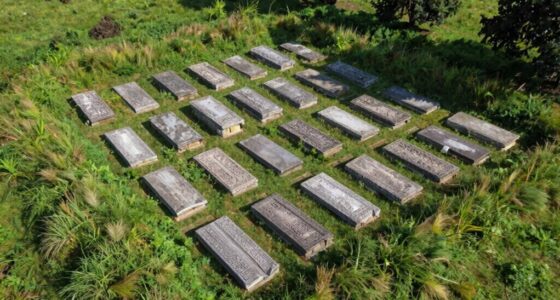
DNA analysis is rewriting human history by revealing deep ancestral connections, migration patterns, and ancient interactions with archaic humans like Neanderthals and Denisovans. You can see how our genetics show adaptations to different environments and resistance to diseases. This scientific breakthrough fills gaps left by traditional history and uncovers surprises about our origins. As DNA continues to reshape our understanding, you’ll discover even more fascinating insights into where we come from and how we evolved.

Prime made for students and young adults
- Fast, free delivery for dorm and study essentials
- Prime Video and Amazon Music included
- Member-only deals
Key Takeaways
- Ancient DNA analysis uncovers previously unknown human migrations and interbreeding with archaic species like Neanderthals.
- Genetic studies reveal adaptations to environments, climate resilience, and resistance to diseases over time.
- DNA evidence fills gaps in traditional history, confirming and expanding understanding of human origins and cultural spread.
- Ongoing genetic research continually uncovers new insights, reshaping perspectives on human evolution and interconnectedness.
- Genomic data links modern populations to ancient ancestors, highlighting diverse origins and complex evolutionary paths.

DNA is transforming our understanding of human history by revealing stories that were once hidden in our genes. Through the study of genetic ancestry, you can trace your lineage back thousands of years, uncovering connections to ancient populations and migrations. Unlike traditional history methods, which rely on artifacts or written records, DNA provides a direct link to your ancestors, allowing you to see where your ancestors came from and how they moved across the globe. This genetic information sheds light on the complex tapestry of human migration patterns, revealing unexpected links between distant populations and highlighting the diverse origins of modern humans.
DNA uncovers hidden stories of our ancestors and ancient migrations, revealing the diverse origins of modern humans.
As you explore your genetic ancestry, you gain more than just a family tree; you gain a deeper understanding of human evolution. DNA offers invaluable evolutionary insights, showing how different groups adapted to their environments over time. For example, certain genetic markers reveal how populations developed resistance to diseases, adapted to climate changes, or evolved specific physical traits. These insights help you comprehend not only your personal history but also the broader story of how humans have evolved in response to changing conditions. They paint a picture of resilience and innovation, illustrating how our ancestors survived and thrived in a wide array of environments. genetic markers also serve as important clues to trace ancient population movements and interactions.
By examining ancient DNA, scientists can now piece together the story of our distant past with unprecedented clarity. You might discover that your ancestors interbred with archaic humans such as Neanderthals or Denisovans, revealing a more intertwined story of human evolution than previously understood. This blending of genetics from different hominin species demonstrates that human evolution wasn’t a straightforward path but a complex web of interactions and exchanges. The ability to analyze ancient genomes allows you to see how modern humans inherited traits from these archaic relatives, influencing everything from immune responses to physical features.
In essence, DNA is rewriting your history by filling in gaps that traditional archaeology and history might have left open. It confirms ancient migrations, reveals surprises about the spread of cultures, and highlights the interconnectedness of all human beings. With each new genetic discovery, you’re gaining a clearer picture of where you come from and how your ancestors contributed to the story of humanity. This revolution in understanding doesn’t just change science; it transforms how you see yourself within the vast, intricate history of humankind. Furthermore, advancements in ancient DNA analysis are continually expanding our knowledge, revealing new details about our shared past.
As an affiliate, we earn on qualifying purchases.
Frequently Asked Questions
How Accurate Are Ancient DNA Reconstructions?
Ancient DNA reconstructions are quite accurate but have limitations. You should know that genetic mutations over time can complicate interpretations, and contamination risks could affect results. Despite these challenges, scientists use advanced techniques to piece together evolutionary timelines, providing remarkably detailed insights. While not perfect, these reconstructions often reveal essential information about human history, helping you understand our past more clearly.
Can DNA Analysis Identify Individual Ancestors?
Yes, DNA analysis can identify individual ancestors by tracing genetic lineage through ancestral markers. Think of your DNA as a family tree written in code—each marker a leaf connecting you to specific ancestors. By comparing these markers with others in genetic databases, you can uncover unique ancestral links. This process transforms abstract genetic data into a vivid map of your personal history, revealing individual ancestors with remarkable precision.
What Ethical Concerns Arise From DNA Research?
You face ethical dilemmas with DNA research, especially around genetic privacy. As you gather and analyze genetic data, concerns about protecting individuals’ sensitive information grow. You must navigate issues like consent, potential misuse, and discrimination based on genetic traits. Ensuring strict privacy measures and transparent practices is essential to prevent harm and uphold ethical standards, balancing scientific progress with respect for personal rights and societal implications.
How Does DNA Influence Current Cultural Identities?
Think of your DNA as a storyteller, shaping your cultural identity through genetic storytelling. It influences your traditions, language, and even sense of belonging. For example, a recent study shows that genetic markers help trace migration patterns, fueling cultural evolution. You carry a mosaic of ancestral stories, which connect you to your community and history, reinforcing your identity in a rapidly changing world. Your DNA is a living narrative shaping who you are today.
Will DNA Technology Replace Traditional Archaeology Methods?
DNA technology won’t fully replace traditional archaeology methods but will considerably enhance them. You’ll find that genetic genealogy and fossil DNA analysis complement physical excavations, helping you trace ancient migrations and origins more accurately. While excavation reveals artifacts and context, DNA provides insights into ancestral relationships. Together, these methods create a fuller picture, making your understanding of history richer and more precise, rather than replacing the foundational archaeological work.
As an affiliate, we earn on qualifying purchases.
Conclusion
So, there you have it—your DNA is basically the ultimate gossip about your ancestors, spilling secrets you never knew and rewriting history’s script. Thanks to science, your family drama is now a published bestseller. Who knew that a tiny strand could hold the key to your past, all while making you question if you’re really a unique snowflake or just a recycled blueprint? Welcome to the era where your genes are the new history teachers—no homework required.
As an affiliate, we earn on qualifying purchases.
As an affiliate, we earn on qualifying purchases.
Fall Picks
fall essentials
As an affiliate, we earn on qualifying purchases.