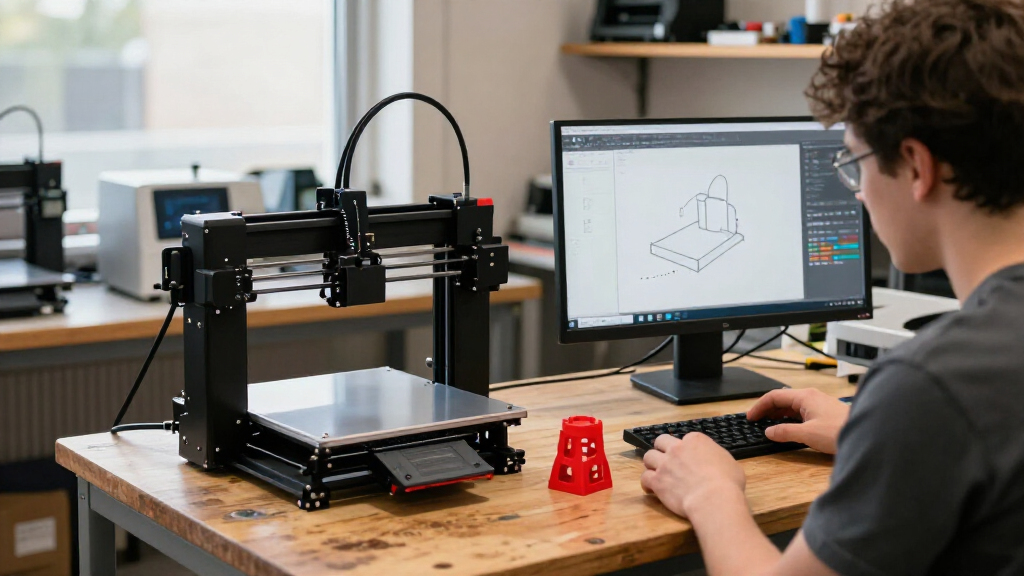
🔍 Read the full analysis: AI For 3D Printing: What Works And What’s Still Hype? on ThorstenMeyerAI.com

Prime made for students and young adults
- Fast, free delivery for dorm and study essentials
- Prime Video and Amazon Music included
- Member-only deals
TL;DR
AI is already used to generate lightweight part designs and monitor some 3D printers for common faults. But text-to-CAD remains research, and AI-generated parts still need human review, engineering analysis and physical testing before they can be trusted.
A November 29 report from ThorstenMeyerAI.com says AI is already helping with two defined parts of 3D printing: generating designs around engineering constraints and monitoring some printers for production errors. The report also stresses that AI-generated parts still require human checks and physical testing, while turning a text prompt into a reliable, ready-to-print component remains a research-stage capability rather than a dependable tool.
The clearest design example in the report comes from NASA Goddard Space Flight Center, where research engineer Ryan McClelland uses generative-design software to create what he calls “evolved structures.” Engineers specify requirements such as connection points, bolt locations and areas that must remain clear; the software then proposes a shape intended to carry the required loads while removing material that contributes little to strength. This approach is known as topology optimisation.
For a bracket designed for NASA’s EXCITE balloon telescope, McClelland’s paper compares the software-assisted process with a conventional design by two expert engineers. The paper says the conventional work took two days for two engineers. The software-assisted design took about 30 minutes for one engineer to encode requirements and about an hour of computing. Those figures describe the reported design process, not a general guarantee of savings for every part or project.
AI can also be used during printing. The report describes a University of Cambridge system trained to identify and correct common nozzle-related errors as a material-extrusion printer operates. That is a narrower task than checking every possible defect or certifying a finished object. The report says text-to-CAD systems remain research: software producing a model or executable code does not establish that the geometry meets its intended dimensions, loads or safety requirements.
From idea to printed part: where AI looks over your shoulder
The orange marker shows where AI helps today. The last word still belongs to a real test.
Design: you set the loads, bolts and keep-out zones. The software proposes the shape.
Check: simulation predicts how the part bends. Only a real test shows how strong it is.
Print: a camera next to the nozzle spots common errors and corrects them during the print.
Every step: AI guesses from patterns. For parts that carry weight, people still test.
Where AI Saves Time—and Where It Cannot
For engineers, generative design can reduce the time spent exploring shapes, particularly when a part has defined loads and boundaries. A lighter design may be useful in applications where mass matters, but the software relies on the requirements people provide. If a fastener, clearance or force is omitted, the resulting model may not work in the intended assembly.
Printer monitoring may help users identify visible problems while a job runs. It is an additional monitoring tool, not a guarantee: a camera or prediction system cannot replace inspection of the first layers or verify every property of a finished part. Components that carry weight, protect people or are used in flight require engineering review and testing because hidden defects can have serious consequences.
A digital model does not by itself establish that a manufactured object is reliable. AI can assist with design or monitoring, but verification remains a separate step. The report says NASA’s AI-assisted parts still undergo stress analysis and testing as part of hardware validation.
Popular right now

Dyson Airwrap Multi-Styler Complete Long

Vitamix Propel Series 510 Professional-Grade Blender, 48 oz, Slate

Roborock F25 GT Gen 2 Cordless Wet-Dry Vacuum Mop
As an affiliate, we earn on qualifying purchases.
From CAD Model to Printed Part
A typical 3D-printing workflow begins with a precise digital model made in computer-aided design, or CAD. Engineers may then simulate how it responds to forces. A slicer divides the model into layers and creates the printer’s instructions, often G-code, before the machine builds the object layer by layer. AI can be added at different points, but each stage has different limits: design software proposes geometry, while monitoring software looks for signs of trouble during production.
The examples in the report have different levels of maturity. NASA’s generative-design work is a documented engineering application with stated constraints and a comparison of design time. The Cambridge system is a research example focused on common errors in material extrusion, a widely used method in which a nozzle deposits material. Neither example establishes that AI can independently produce and certify a safe part from a plain-language prompt.
The report also notes legal limits in the United States: purely AI-generated output does not receive copyright protection, and only human beings can be named as inventors. Those rules are separate from technical performance, but they underline that using AI does not remove questions about human responsibility and ownership.
Reliability Beyond the Digital Model
The report does not establish how often the Cambridge monitoring system catches faults across different printers, materials or operating conditions, or how reliably it corrects them outside the tested cases. It also does not show that text-to-CAD systems can consistently meet engineering requirements or produce parts ready for use without expert intervention.
The reported NASA time comparison concerns one bracket and a particular workflow. The source material does not provide enough information to treat it as a general productivity benchmark, nor does it establish that every AI-designed part will be lighter or stiffer. Performance depends on the loads, constraints, material, manufacturing process and validation used. Testing remains necessary, especially where a failure could cause injury or damage.
Validation Is the Next Test
The practical next step is wider validation: monitoring systems need to show how they perform across machines and print conditions, while generative-design workflows need to keep documenting their assumptions and test results. The report does not name a new product launch or a specific upcoming milestone. For now, users can treat AI as a tool for proposing designs or flagging possible printer problems, then check the output against engineering requirements and the finished part against real-world tests.
Key Questions
Can AI design a 3D-printed part today?
Yes. Generative-design software can propose shapes from constraints such as loads, attachment points and areas that must stay clear. Engineers still need to review whether the inputs are complete and whether the resulting part performs as required.
Can AI turn a text prompt into a reliable part?
The report characterises text-to-CAD as research rather than a dependable way to produce a trusted, ready-to-use component. A model or code that runs does not prove the part meets its dimensions, strength or safety requirements.
Can AI prevent 3D-printing failures?
Some systems can monitor a printer and address specific common errors, according to the report’s account of University of Cambridge research. That is not a guarantee against all failures, and the reported system concerns nozzle-based material extrusion.
Do AI-designed parts still need testing?
Yes. The report says AI-assisted parts still need human checks, engineering analysis and physical tests. This is particularly important for parts that carry loads, protect people or are used in flight.
Source: ThorstenMeyerAI.com