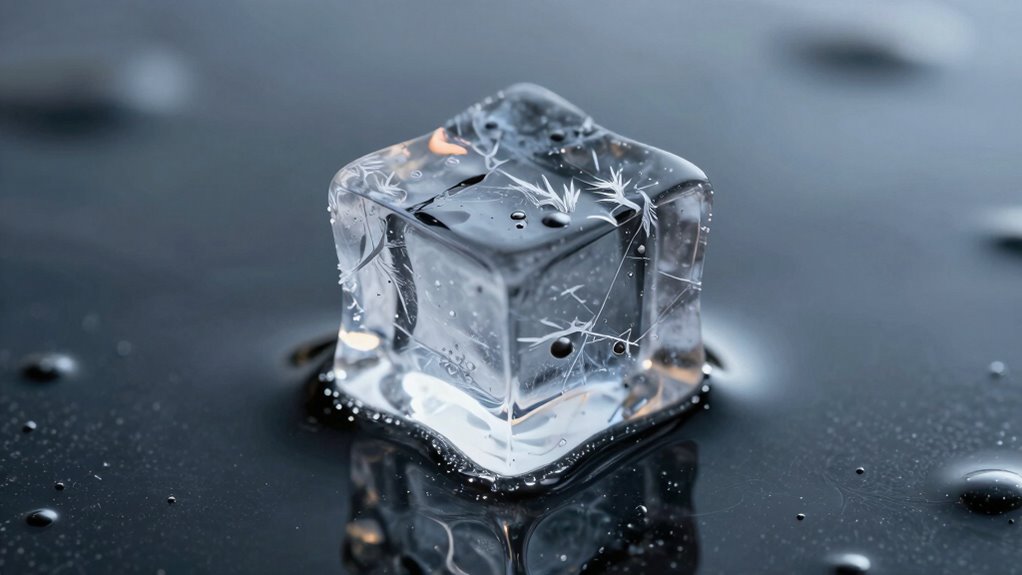

Ice floats because its molecular structure creates a less dense, crystalline lattice. When water freezes, hydrogen bonds cause molecules to spread out into an open hexagonal pattern, making ice occupy more space than liquid water. This lower density allows ice to stay on top of water surfaces, like ponds or glasses. The fascinating physics behind this phenomenon influences our climate and environment. Keep exploring to understand why water’s odd behavior is so essential.

Prime made for students and young adults
- Fast, free delivery for dorm and study essentials
- Prime Video and Amazon Music included
- Member-only deals
Key Takeaways
- Water molecules form an open hexagonal lattice in ice due to hydrogen bonding, increasing volume and decreasing density.
- Ice’s crystalline structure is less dense than liquid water, causing it to float.
- Hydrogen bonds cause water molecules in ice to stay farther apart, resulting in expansion upon freezing.
- The density anomaly ensures ice remains buoyant, insulating aquatic ecosystems during cold seasons.
- This unique molecular arrangement directly explains why ice floats on water surfaces.
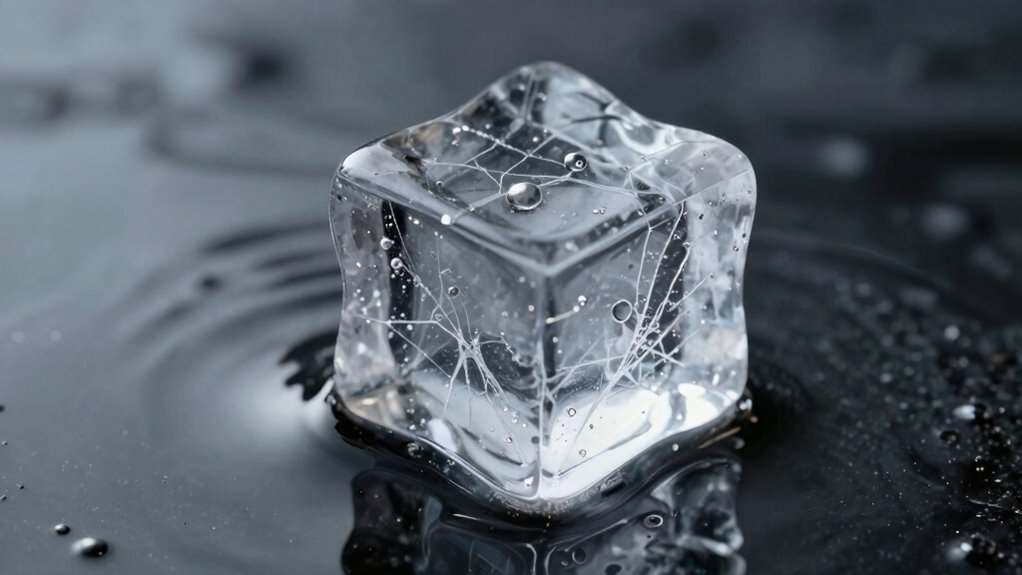
Have you ever wondered why ice floats on water instead of sinking? It’s a curious phenomenon that puzzles many, but the answer lies in the unique molecular structure of water and its density anomaly. When water cools down to near freezing, its molecules start to slow and arrange themselves in a specific pattern. Unlike most substances, which become denser as they cool, water reaches a point where it begins to expand again. This unusual behavior is directly tied to its molecular structure.
Water’s unique molecular structure causes it to expand when cooled, making ice less dense and allowing it to float.
In solid form, ice, water molecules arrange themselves into a crystalline lattice that’s more open and spacious than in liquid water. This structure is caused by hydrogen bonds, the attractive forces between the slightly positive hydrogen atoms and the slightly negative oxygen atoms of neighboring molecules. These bonds force the molecules into a rigid, hexagonal pattern that creates more space between each molecule. Because of this, ice has a lower density than liquid water, even though it appears solid and compact. It’s this lower density that allows ice to float. Interestingly, the molecular structure of water is responsible for its unique properties and behaviors, influencing many natural processes.
This phenomenon is known as the density anomaly of water. Most substances become denser as they cool, but water’s molecules behave differently due to their molecular structure. As water cools and approaches 4°C, it reaches its maximum density. Below this temperature, the hydrogen bonds become more prominent, forcing the molecules into the open lattice of ice. This expansion means that ice occupies more volume than the same amount of liquid water, leading to a lower overall density. Interestingly, this density anomaly also influences how icebergs form and drift in the ocean, allowing massive chunks of ice to float without sinking. This property is essential for regulating Earth’s climate by maintaining temperature stability in aquatic ecosystems. Additionally, this molecular arrangement is crucial for maintaining aquatic ecosystems in cold environments. The unique molecular interactions of water are fundamental to understanding these behaviors and their impact on our environment.
Understanding this molecular structure and density anomaly helps you make sense of a common observation in everyday life. It’s why lakes freeze from the top down, creating an insulating layer of ice that protects aquatic life below. It’s also why icebergs, massive chunks of ice, can drift in the ocean without sinking completely. The science behind it is simple yet fascinating: water’s unique molecular arrangement leads to a lower density in solid form. So next time you see ice floating in your glass or on a pond, you can appreciate the weird physics at play—an elegant consequence of water’s unusual molecular structure and its density anomaly. This simple yet extraordinary property shapes many aspects of our environment and climate, making it one of nature’s most interesting quirks.
As an affiliate, we earn on qualifying purchases.
Frequently Asked Questions
Does Ice Always Float in All Liquids?
No, ice doesn’t always float in all liquids. While it floats in water due to its density, in some liquids like liquid nitrogen, ice sinks because the density differences are different. Quantum tunneling and magnetic levitation don’t directly affect whether ice floats, but they show how strange physics can be. These phenomena highlight how material behaviors depend on specific properties, making ice’s floating behavior unique to particular liquids.
How Does Pressure Affect Ice’s Buoyancy?
You might find that increasing pressure causes ice to sink, as it triggers a phase change to denser forms. For example, at about 2,200 atmospheres, ice transforms into ice VI, which is denser than liquid water. This occurs because higher pressure weakens the molecular bonding that keeps ice less dense, making it more compact. So, pressure directly influences buoyancy by altering ice’s molecular structure and phase.
Why Is Ice Less Dense Than Water?
Ice is less dense than water because its molecular structure forms a crystalline lattice that keeps molecules farther apart, creating more space between them. When water freezes, thermal expansion causes this structure to expand, increasing volume without adding mass. This expanded lattice makes ice float, as its density drops below that of liquid water. So, your ice floats because of molecular arrangement and the effects of thermal expansion during freezing.
Can Ice Sink Under Certain Conditions?
Ice can sink if quantum anomalies or strong magnetic influences alter its density, though this is rare under normal conditions. You might consider extreme environments, like near absolute zero or in powerful magnetic fields, where unusual physics could cause ice to behave differently. In such cases, the usual buoyancy rules break down, and ice might become denser than water, leading it to sink instead of float.
How Does Impurity Content Change Ice’s Floating Ability?
Impurity content considerably affects ice’s floating ability by altering its crystal structure. When impurities are present, they disrupt the regular lattice of ice crystals, making the structure less uniform and slightly denser. This increases the overall density, which can cause the ice to sink or float less effectively. So, higher impurity effects weaken ice’s buoyancy, while purer ice maintains a more stable crystal structure, helping it float more reliably.
As an affiliate, we earn on qualifying purchases.
Conclusion
So, next time you’re skating on a frozen pond or grabbing a cold drink, remember the quirky physics at play. Thanks to water’s unique behavior, ice floats, keeping lakes alive in winter and your soda from becoming a giant icy brick. It’s like a secret science magic trick from the days of Newton’s apple—only instead of gravity, it’s hydrogen bonds doing the dance. Truly, water’s weirdness is what keeps our world interesting!
hydrogen bonding educational kit
As an affiliate, we earn on qualifying purchases.
As an affiliate, we earn on qualifying purchases.
As an affiliate, we earn on qualifying purchases.
Fall Picks
fall essentials
As an affiliate, we earn on qualifying purchases.