
Meteors are streaks of light you see in the sky when space debris burns up entering Earth’s atmosphere. If a piece survives and lands on the ground, it’s called a meteorite. Asteroids are larger space rocks mainly orbiting in the asteroid belt between Mars and Jupiter, rarely reaching Earth intact. Understanding these differences helps you grasp how space debris interacts with our planet, and there’s much more to uncover about each type’s role in our solar system.

Prime made for students and young adults
- Fast, free delivery for dorm and study essentials
- Prime Video and Amazon Music included
- Member-only deals
Key Takeaways
- Meteors are glowing streaks caused by space debris burning up in Earth’s atmosphere.
- Meteorites are fragments of space debris that survive atmospheric entry and land on Earth’s surface.
- Asteroids are large celestial bodies mainly in the asteroid belt, orbiting the Sun.
- Meteors occur during atmospheric entry; meteorites are found on Earth; asteroids remain in space.
- The main difference lies in size, location, and whether the object burns up or reaches Earth’s surface.
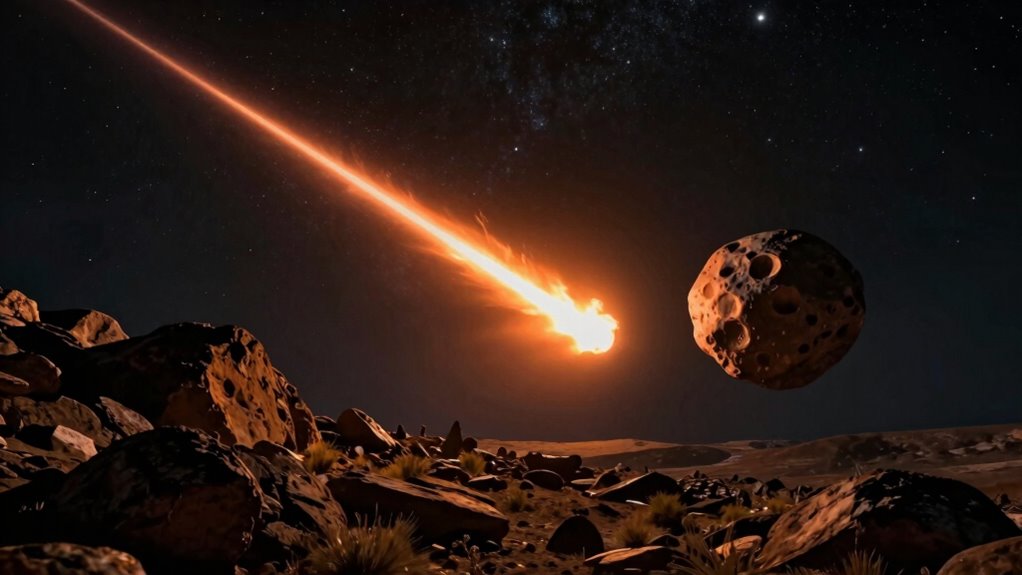
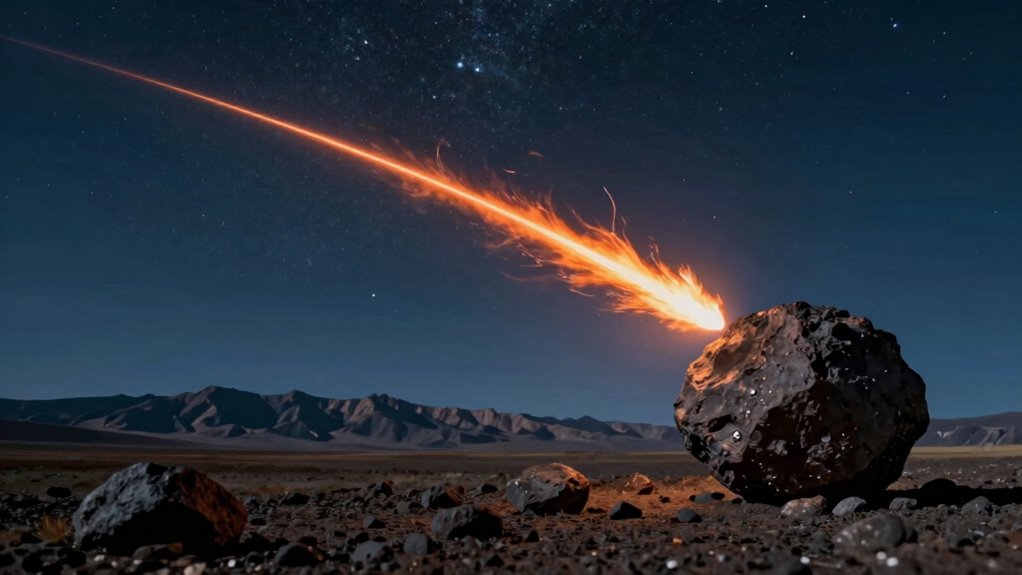
Many people confuse meteors, meteorites, and asteroids because they all involve space rocks, but each term refers to a different stage or type of object. When you look up at the night sky and see a streak of light, you’re witnessing a meteor—a glowing trail created as a tiny fragment of space debris burns up upon entering Earth’s atmosphere. These objects are usually small, often just a pebble or tiny rock, and they travel at high speeds. As they hurtle through the atmosphere, the intense friction heats them up, causing them to glow brightly before disintegrating completely. If, by chance, a piece survives the fiery passage and lands on Earth’s surface, that’s when you’re dealing with a meteorite. Meteorites are the remnants of space debris that make it through the atmosphere intact, offering scientists valuable clues about the early solar system. They come in various sizes and compositions, including iron, stone, or a mix of both, and analyzing them helps us understand celestial bodies that once roamed the solar system. Studying meteorites provides crucial insights into the composition and history of our solar system’s formation.
Asteroids, on the other hand, are much larger celestial bodies that mostly reside in the asteroid belt between Mars and Jupiter. Think of them as the leftover building blocks from the formation of planets, remnants of primordial material that never coalesced into a planet. Unlike meteors or meteorites, asteroids usually don’t burn up in Earth’s atmosphere because they’re notably bigger, often spanning miles across. They are classified as celestial bodies—objects that orbit the Sun but aren’t classified as planets or dwarf planets. Many asteroids are composed of rock and metal, and their surfaces are often cratered from collisions with other space debris. Some asteroids are even considered potential threats because of their proximity to Earth, which is why astronomers keep a close eye on them. Their study provides insights into the early conditions of the solar system and the processes that led to planet formation, especially when considering primordial material, which can reveal the initial building blocks of planets.
As an affiliate, we earn on qualifying purchases.
Frequently Asked Questions
How Are Meteoroids Classified by Size?
Meteoroids are classified by size into three categories: micrometeoroids, which are tiny particles less than a millimeter; small meteoroids, ranging from a millimeter to a few centimeters; and large meteoroids, measuring several centimeters or more. This size classification helps determine their behavior when entering Earth’s atmosphere and whether they become meteors or meteorites. Recognizing these categories allows you to understand the different effects and potential hazards they pose.
Can Meteorites Be Found on the Moon?
Yes, meteorites can be found on the Moon. Lunar meteorite discoveries happen when pieces of space debris travel from space, land on the Moon, and are later found by scientists or astronauts. These meteorites provide insight into the Moon’s surface composition and the broader solar system. Studying them helps us understand the Moon’s geological history and how it compares to meteorites found on Earth.
What Is the Origin of Most Asteroids?
Think of the asteroid belt as a vast treasure chest, where most asteroids originate from shattered remnants of early solar system bodies. These space rocks are primarily composed of metal and rock, symbolizing potential riches for future space mining opportunities. You can imagine each asteroid as a fragment of celestial history, holding clues to the solar system’s birth, making them fascinating targets for exploration and resource extraction.
Do All Meteors Burn up in the Atmosphere?
Not all meteors burn up in the atmosphere; many do, creating stunning visual phenomena as atmospheric friction heats the meteoroid. Smaller meteors typically disintegrate completely, vanishing before reaching the ground. However, larger meteoroids can survive the fiery descent, becoming meteorites. The size, composition, and angle of entry influence whether a meteor burns up entirely or leaves behind a trail, making each atmospheric encounter unique.
Are Meteor Showers Caused by Asteroid Debris?
You’ll be fascinated to know that most meteor showers originate from space debris left by comets, not asteroids. About 60% of annual meteor shower activity comes from comet fragments, with the rest from asteroid debris. This debris streaks through Earth’s atmosphere, creating spectacular displays. The frequency of meteor showers varies each year, but understanding their source helps you appreciate how cosmic leftovers light up our skies in breathtaking ways.
As an affiliate, we earn on qualifying purchases.
Conclusion
Now that you know the difference between meteors, meteorites, and asteroids, you can see how these space rocks tell a story of our solar system’s past. Think of it as a puzzle coming together, each piece revealing a bit more about the universe’s history. Remember, understanding these cosmic visitors helps you see the sky with fresh eyes—like opening a treasure chest filled with cosmic secrets waiting to be uncovered.
astronomy telescope for beginners
As an affiliate, we earn on qualifying purchases.
As an affiliate, we earn on qualifying purchases.
As an affiliate, we earn on qualifying purchases.
Halloween Picks
halloween
As an affiliate, we earn on qualifying purchases.