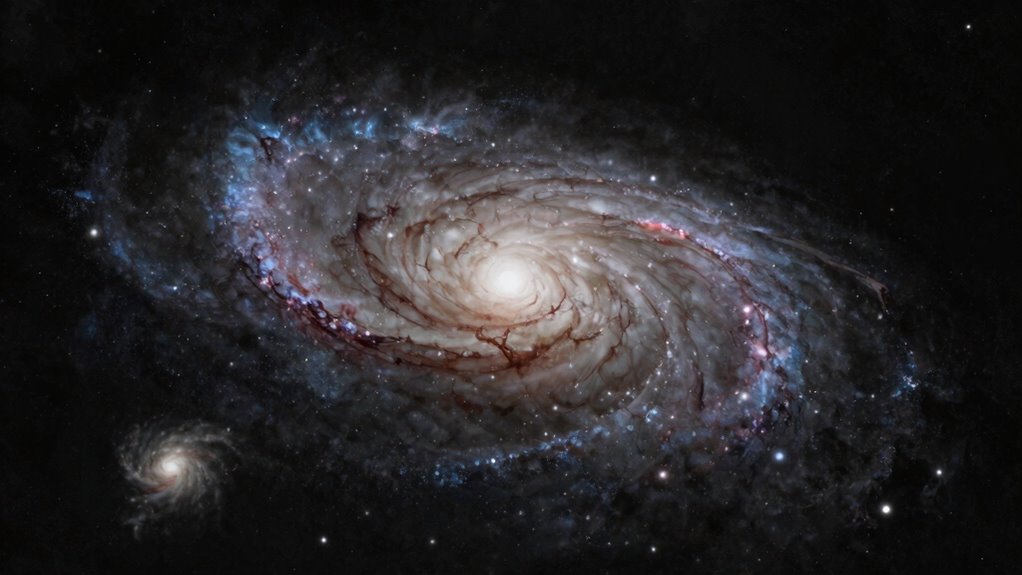

You see the beauty of spiral galaxies because their graceful arms are shaped by dark matter’s gravity and ongoing star formation. When gas and dust collapse, new stars brighten the arms, making them vibrant and lively. However, interactions with nearby galaxies or internal disruptions can distort or weaken these structures, creating less symmetrical shapes. If you want to understand how these factors work together and what makes some galaxies truly stunning, keep exploring the cosmic details.

Prime made for students and young adults
- Fast, free delivery for dorm and study essentials
- Prime Video and Amazon Music included
- Member-only deals
Key Takeaways
- The presence of dark matter’s gravity helps maintain the structure of spiral arms.
- Active star formation in gas clouds makes spiral arms bright and visually appealing.
- Gravitational interactions with neighboring galaxies can distort or disrupt spiral patterns.
- The distribution of gas and dust influences the clarity and symmetry of spiral arms.
- Internal conditions and cosmic forces determine whether a galaxy develops a graceful spiral or an irregular shape.
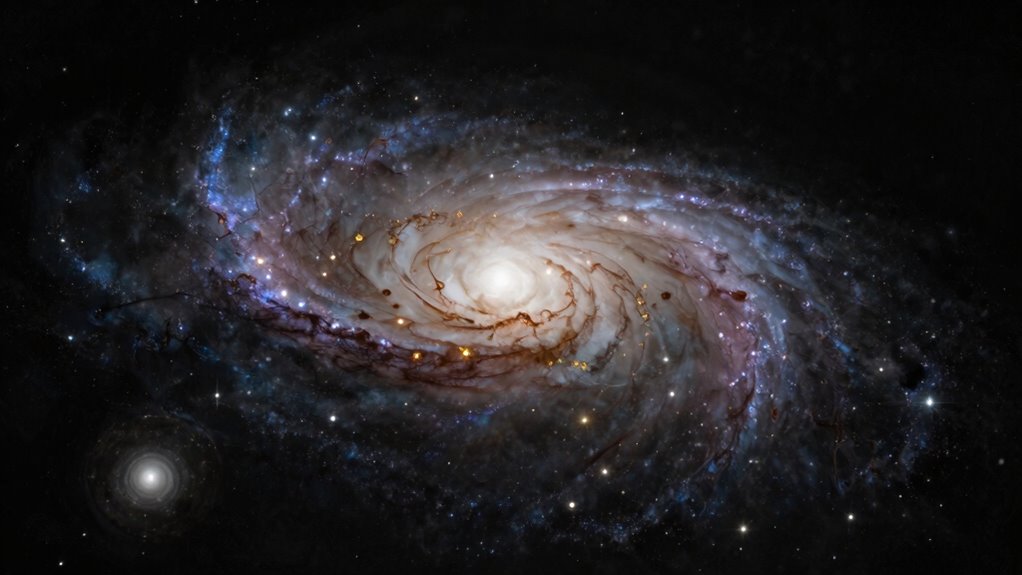
Galaxies come in many shapes and sizes, but some are especially stunning because of their graceful spiral arms. These spirals captivate the eye because they showcase a delicate balance of cosmic forces. The beauty of spiral galaxies isn’t just about their visual appeal; it’s rooted in the complex processes happening within them. One key element is dark matter, an elusive substance that makes up most of the universe’s mass. Dark matter’s gravity helps hold the spiral arms in place, providing the structure that allows these galaxies to maintain their elegant shape. Without dark matter’s influence, the arms might dissipate or become less defined, and the galaxy could lose its distinctive spiral form. The presence of dark matter is crucial in maintaining the galactic structure that defines these galaxies. Star formation also plays an integral role in the beauty of these galaxies. In the spiral arms, gas and dust clouds undergo intense compression, triggering the birth of new stars. These young, bright stars illuminate the arms, making them stand out against the galaxy’s core. The constant cycle of star formation keeps the arms vibrant and dynamic, giving each spiral a lively, glowing appearance. When you look at a spiral galaxy, you’re witnessing the ongoing process of stellar birth and death—an intricate dance that sustains its beauty over millions of years. Additionally, dark matter’s role in shaping these galaxies highlights how invisible forces influence visible structures on a cosmic scale. Interestingly, other factors such as the distribution of gas and dust also significantly impact whether a galaxy develops a clear spiral pattern. These gravitational interactions with neighboring galaxies can also disrupt the delicate spiral pattern, twisting or even destroying the arms altogether. This is why many galaxies appear more irregular or elliptical—they’ve experienced gravitational disturbances, or their internal conditions don’t support the formation of graceful arms. Fundamentally, the presence of dark matter and active star formation are what give some galaxies their iconic spiral shape, while their absence or disruption results in less symmetrical, more chaotic forms.
galaxy telescope for astrophotography
As an affiliate, we earn on qualifying purchases.
As an affiliate, we earn on qualifying purchases.
Frequently Asked Questions
How Do Galaxy Collisions Influence Spiral Formation?
Galaxy collisions can trigger spiral formation by creating a gravitational tug that disturbs the galaxy’s structure. As stars and gas clouds interact, stellar winds and gravitational forces help organize the material into spiral arms. These collisions can also induce bursts of star formation, making the galaxy appear more vibrant. So, your galaxy’s beauty might stem from past interactions that shaped its majestic spiral arms through these dynamic processes.
Can Galaxies Change Shape Over Time?
Yes, galaxies can change shape over time. About 70% of galaxies are irregular or elliptical, showing that shape transformation is common in galaxy evolution. Collisions and gravitational interactions often trigger these changes, turning spirals into ellipticals or irregulars. So, as galaxies interact and evolve, their structures shift, revealing a dynamic universe where shape transformation is a natural part of the cosmic life cycle.
What Role Do Dark Matter and Dark Energy Play?
Dark matter effects help shape galaxy structures by providing the unseen mass that holds stars together, especially in spiral galaxies. Dark energy influence, on the other hand, drives the universe’s expansion, affecting how galaxies evolve over time. You see, dark matter keeps galaxies intact, while dark energy pushes them apart, leading to different shapes and behaviors. Their combined roles are essential in understanding why galaxies look the way they do.
Are There Any Undiscovered Types of Galaxy Structures?
You might discover new galaxy structures someday, as galaxy formation continues to surprise astronomers. Researchers are exploring celestial morphology to identify potential undiscovered types, like peculiar or hybrid forms that don’t fit traditional categories. Advances in telescope technology and data analysis constantly reveal more about how galaxies evolve, so it’s possible that future observations will uncover entirely new structures, expanding our understanding of the universe’s diverse and complex galaxy formations.
How Do Scientists Classify Irregular Galaxies?
Scientists classify irregular galaxies based on their lack of a defined shape, which makes them stand out from other galaxy types. These galaxies often display traits like chaotic structures, asymmetrical forms, and uneven star distribution. During galaxy classification, astronomers observe these irregular traits to categorize them properly, noting their unique features. Understanding these traits helps scientists study galaxy formation and evolution, revealing why some galaxies don’t fit into the typical spiral or elliptical categories.
As an affiliate, we earn on qualifying purchases.
Conclusion
So, next time you gaze up at the night sky, remember that the universe’s most dazzling spirals are like rare gems, their beauty shaped by gentle cosmic forces and subtle cosmic chatter. While some galaxies wear their elegant arms proudly, others quietly hide their charm behind a more modest appearance. It’s a reminder that true beauty often lies in the mysteries we haven’t fully uncovered yet, inviting you to keep exploring the universe’s quiet, enchanting secrets.
As an affiliate, we earn on qualifying purchases.
As an affiliate, we earn on qualifying purchases.
Halloween Picks
halloween
As an affiliate, we earn on qualifying purchases.