
📊 Full opportunity report: Acoustic Dampening, Placement, and the “Rig in the Closet” Setup on ThorstenMeyerAI.com — validation score, market gap, and execution plan.

Prime made for students and young adults
- Fast, free delivery for dorm and study essentials
- Prime Video and Amazon Music included
- Member-only deals
TL;DR
This article explains proven methods for minimizing noise from high-power AI workstations. Key strategies include relocating the rig, using ventilation in enclosed spaces, and understanding acoustic principles. The focus is on effective, practical solutions.
Placing AI workstations in separate rooms or enclosed cabinets with proper ventilation significantly reduces noise at the user’s workspace, according to industry experts.
Experts emphasize that the most effective way to reduce noise from high-power AI rigs is to move the machine away from the user, such as into a closet or another room, and operate it headless over a network. This approach eliminates the need for extensive acoustic treatment and addresses the root cause of noise.
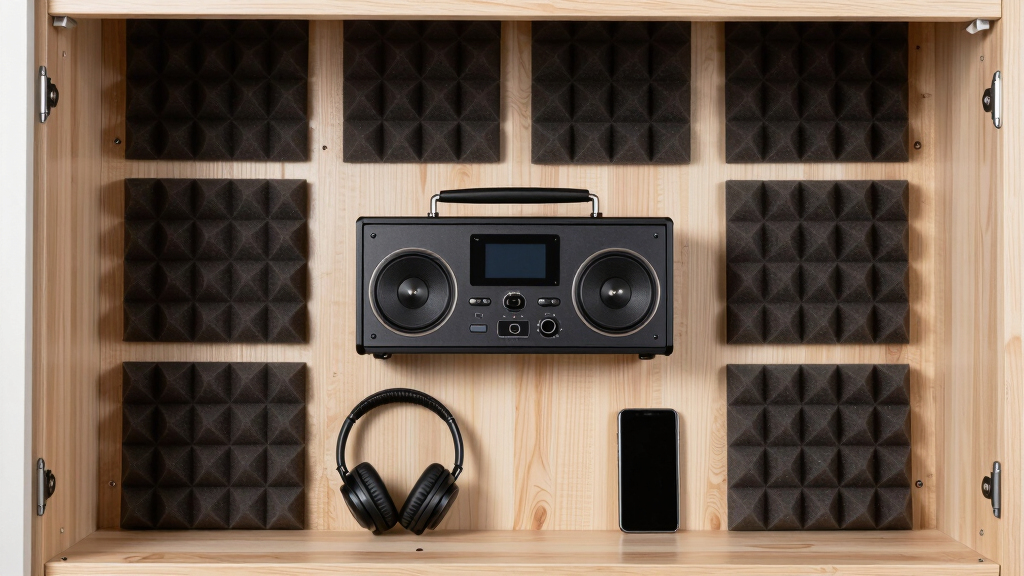
For setups where placement away from the user isn’t feasible, creating a ventilated, soundproof enclosure—often called a ‘cabinet’—can contain noise while dissipating heat. Proper airflow and temperature control are critical to prevent overheating and thermal throttling, which can cause fans to increase noise levels.
The article highlights that acoustic foam and barriers are less effective than strategic placement and ventilation, especially for airborne and structure-borne noise. Mechanical decoupling, such as rubber feet, can also reduce vibrations and hums.
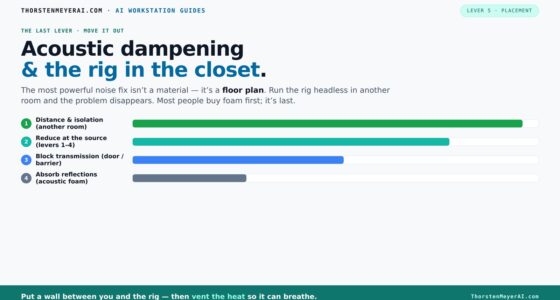
Acoustic dampening
& the rig in the closet.
The most powerful noise fix isn’t a material — it’s a floor plan. A rig you can’t hear because it’s in another room beats any amount of foam. Tap the approaches in Part 1 to see what actually works.
(another room)
(levers 1–4)
(door / barrier)
(acoustic foam)
Contain the noise, not the heat
Why Placement and Ventilation Are Critical for Quiet AI Workstations
Effective placement and ventilation strategies can dramatically improve workspace comfort and equipment longevity. By reducing noise at the source or isolating the rig, users can maintain a quieter environment without sacrificing performance. This approach is especially relevant for remote work, shared offices, or noise-sensitive environments.
Understanding the distinction between airborne and structure-borne noise helps in choosing the right mitigation techniques, making these strategies accessible and practical for a wide range of setups.
soundproof computer enclosure for high-power workstation
As an affiliate, we earn on qualifying purchases.
As an affiliate, we earn on qualifying purchases.
Background on Noise Reduction in High-Power AI Rigs
Traditional noise mitigation efforts focus on acoustic foam and barriers, which only address airborne sound within a room. Recent insights highlight that moving the rig into a separate room or closet can be more effective, especially given the high heat output of modern GPUs and CPUs. The concept of a 'rig in the closet' has gained popularity as a practical solution, provided adequate ventilation is maintained to prevent overheating.
Previous guidance often underestimated the importance of airflow and thermal management in enclosed spaces, leading to potential hardware damage or thermal throttling. Newer approaches combine soundproofing with active cooling systems, including ducted airflow and thermostat-controlled exhaust fans.
"Moving the rig into another room or closet is the most effective way to eliminate noise, as it isolates the sound source completely."
— Thorsten Meyer, AI workstation expert
acoustic dampening foam panels for PC
As an affiliate, we earn on qualifying purchases.
As an affiliate, we earn on qualifying purchases.
Remaining Questions About 'Rig in the Closet' Effectiveness
While the benefits of placing a rig in a closet are well-understood, the optimal ventilation setup, including fan placement and airflow paths, remains under discussion. The long-term impact on hardware lifespan due to heat retention in sealed spaces needs further study. Additionally, the cost and complexity of dedicated soundproof cabinets may limit accessibility for some users.
networked headless AI workstation setup
As an affiliate, we earn on qualifying purchases.
As an affiliate, we earn on qualifying purchases.
Next Steps for Implementing Quiet AI Workstation Setups
Users should evaluate their workspace for placement options, prioritizing room separation where possible. For enclosed setups, investing in purpose-built soundproof cabinets with integrated cooling is advisable. Ongoing developments include smarter ventilation solutions and more affordable soundproofing materials, which will further improve quiet operation.
Industry experts recommend testing different configurations, monitoring temperature and noise levels, and adjusting airflow to optimize performance and silence.
ventilated server cabinet for noise reduction
As an affiliate, we earn on qualifying purchases.
As an affiliate, we earn on qualifying purchases.
Key Questions
Is placing a rig in a closet safe for hardware?
Yes, if proper ventilation and temperature controls are implemented, placing a rig in a closet can be safe and effective. Ensuring airflow and cooling are critical to prevent overheating.
What are the best ways to ventilate a closet containing a high-power AI rig?
Using active exhaust fans, ducted airflow, and thermostat-controlled vents are recommended. Avoid fully sealing the space to allow heat to escape and prevent thermal buildup.
Can acoustic foam alone significantly reduce noise from a rig?
No, acoustic foam mainly absorbs reflections within a room and does not block airborne or structure-borne noise. Placement and ventilation are more effective for noise reduction.
How do I prevent my enclosed rig from overheating?
Ensure adequate airflow with exhaust fans, maintain proper ventilation paths, and consider using temperature-controlled cooling solutions like radiators or AIOs to dissipate heat efficiently.
Source: ThorstenMeyerAI.com
Fall Picks
fall essentials
As an affiliate, we earn on qualifying purchases.