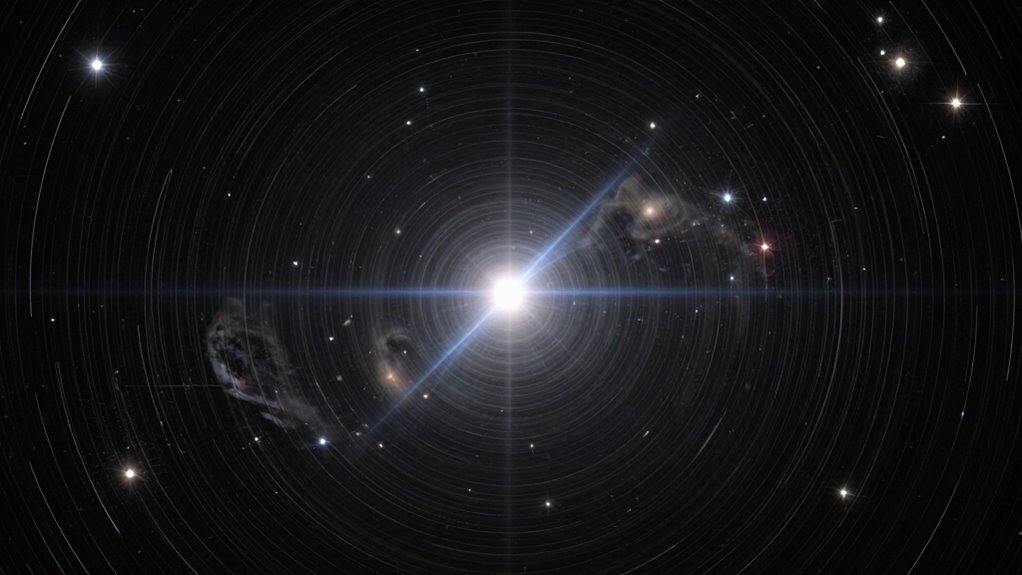

Pulsars are the universe’s fastest and most precise cosmic beacons, emitting regular pulses of electromagnetic radiation. They form when massive stars explode as supernovae, leaving behind ultra-dense neutron stars that spin rapidly thanks to conservation of angular momentum. Their strong magnetic fields channel particles toward magnetic poles, creating beams that sweep through space like lighthouse signals. These signals help scientists explore extreme physics. Keep exploring to discover how pulsars reveal the universe’s hidden forces and future scientific breakthroughs.

Prime made for students and young adults
- Fast, free delivery for dorm and study essentials
- Prime Video and Amazon Music included
- Member-only deals
Key Takeaways
- Pulsars are highly magnetized, rotating neutron stars emitting beams of electromagnetic radiation that sweep across space like cosmic lighthouses.
- They were discovered in the 1960s through their regular, precise radio pulses, confirming the existence of neutron stars.
- Pulsars spin rapidly due to core collapse during supernova explosions, with some rotating hundreds of times per second.
- Their magnetic fields channel charged particles, creating beams that produce the characteristic pulsating signals detected on Earth.
- Pulsars serve as natural cosmic clocks, aiding in gravitational wave detection, space navigation, and testing extreme physics.
radio telescope for astrophysics
As an affiliate, we earn on qualifying purchases.
As an affiliate, we earn on qualifying purchases.
What Are Pulsars and How Were They Discovered?
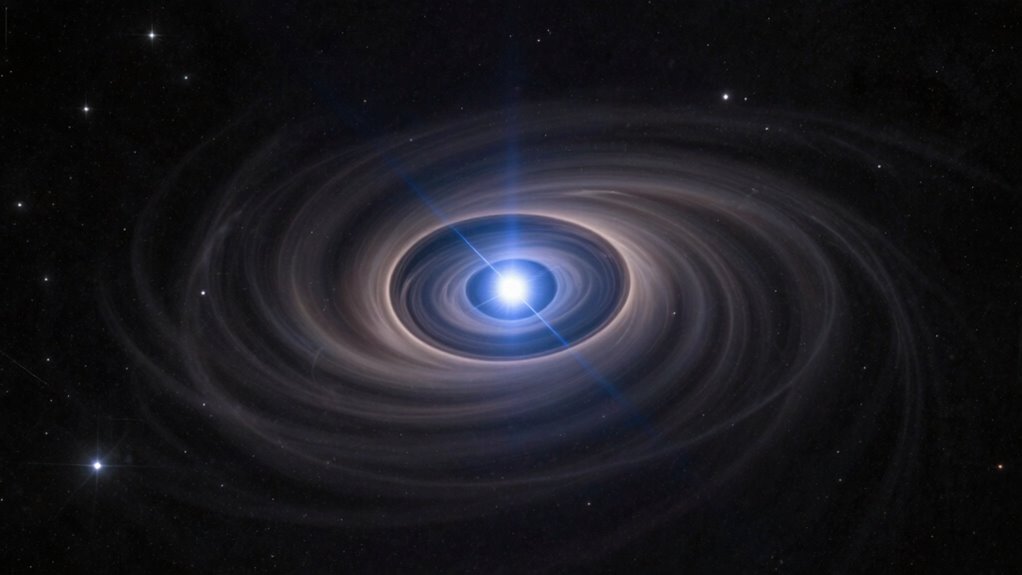
Pulsars are highly magnetized, rotating neutron stars that emit beams of electromagnetic radiation from their magnetic poles. These cosmic radio sources produce regular, pulsing signals that scientists first detected in the 1960s. When astronomers observed these periodic radio emissions, they realized they were witnessing something extraordinary. The signals appeared to pulse with incredible precision, almost like a cosmic lighthouse. The discovery of pulsars provided evidence for the existence of neutron stars and has been instrumental in advancing our understanding of extreme physics. Because neutron stars are incredibly dense remnants of massive stars that exploded as supernovae, their rapid rotation and intense magnetic fields create these focused beams. As the star spins, the beams sweep across space. If Earth happens to be in the path of these beams, we observe a pulse—hence the name “pulsar.” This discovery opened a new window into understanding extreme physics and the universe’s most energetic objects. Understanding neutron stars has been crucial to unraveling the physics behind pulsars, especially in studying their magnetic fields and emission mechanisms. Additionally, ongoing research into their precise timing allows scientists to test theories of gravity and search for gravitational waves.
As an affiliate, we earn on qualifying purchases.
How Do Pulsars Form From Supernova Explosions?
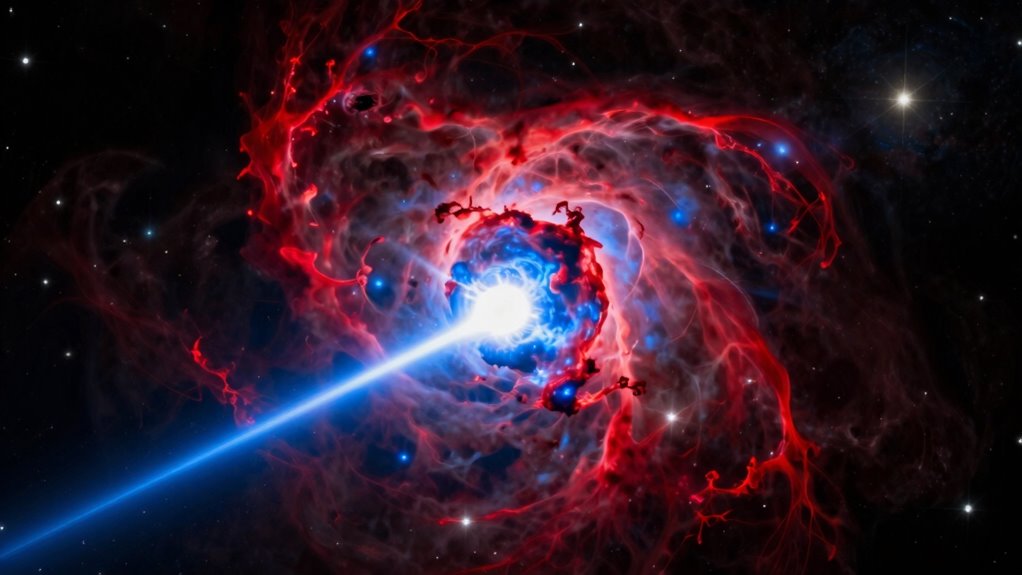
When a massive star exhausts its nuclear fuel, its core collapses under gravity, triggering a supernova explosion. This collapse compresses the stellar core so tightly that protons and electrons combine into neutrons, forming a neutron star—the dense remnant left behind. If the core’s mass is below a certain limit, it stabilizes as a neutron star, which can become a pulsar if it has an aligned magnetic field. The table below highlights key stages:
| Stage | Description |
|---|---|
| Core Collapse | Gravity causes the stellar core to implode |
| Neutron Star Formation | Core compresses into a dense neutron star |
| Pulsar Development | Magnetic field and rotation produce lighthouse beams |
This process explains how pulsars originate from supernova remnants. The magnetic field plays a crucial role in the emission of the characteristic beams observed in pulsars.
astronomy telescope for beginners
As an affiliate, we earn on qualifying purchases.
As an affiliate, we earn on qualifying purchases.
What Makes Pulsars Spin So Fast?
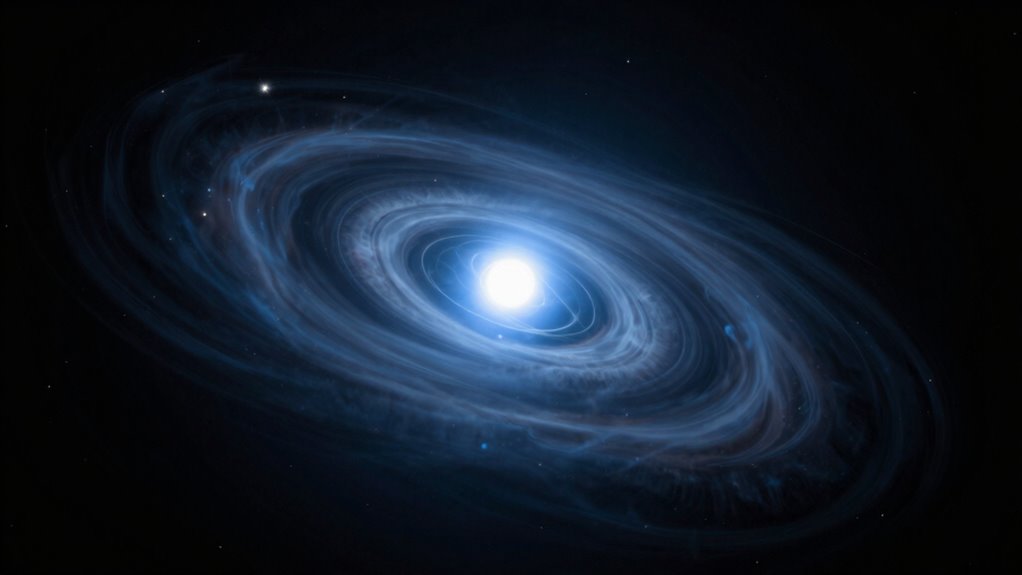
You might wonder why pulsars spin so rapidly, and it all comes down to conservation of angular momentum. When a star collapses, its rotation speeds up dramatically, much like a figure skater pulling in their arms. Additionally, strong magnetic fields can influence the pulsar’s rotation, helping it maintain its incredible speed.
Conservation of Angular Momentum
Have you ever wondered why pulsars rotate so incredibly fast? It all comes down to the conservation of angular momentum. When a massive star collapses into a dense neutron star, its rotational inertia decreases dramatically. Because angular momentum must stay constant, the star’s angular velocity skyrockets. Imagine spinning with your arms out, then pulling them in—you spin faster. Here’s a visual:
| Star Before Collapse | Star During Collapse | Pulsar After Collapse |
|---|---|---|
| Large radius | Reduced radius | Tiny, compact star |
| Slower spin | Faster spin | Extremely fast spin |
| Higher rotational inertia | Lower rotational inertia | Higher angular velocity |
This principle explains how a tiny remnant can achieve such rapid rotation speeds, making pulsars some of the universe’s fastest spinning objects. Additionally, the conservation of angular momentum principle is fundamental in understanding many other astrophysical phenomena. For instance, the process of stellar evolution illustrates how these physical laws influence various stages of a star’s life cycle. Moreover, understanding these principles helps astronomers interpret the observed behavior of pulsars and other celestial bodies.
Magnetic Field Influence
As the star collapses into a neutron star, its magnetic field becomes dramatically intensified. This powerful magnetic field influences the pulsar’s rapid rotation, acting like a lighthouse beacon. The magnetic alignment, where the magnetic axis isn’t aligned with the star’s rotational axis, causes beams of radio waves to sweep across space. As the neutron star spins, these beams periodically point toward Earth, creating the pulsar’s characteristic pulses. The magnetic field’s strength and orientation play a pivotal role in maintaining the star’s high spin rate. The intense magnetic forces also help channel charged particles along magnetic lines, fueling the pulsar’s emissions. Additionally, the magnetic field’s interaction with the star’s rotation can lead to phenomena like magnetic braking, which gradually slows the pulsar over time. Ultimately, this magnetic field influence helps explain why pulsars are some of the universe’s fastest and most precise cosmic clocks.
As an affiliate, we earn on qualifying purchases.
How Do Pulsar Beams Create Regular Pulses?
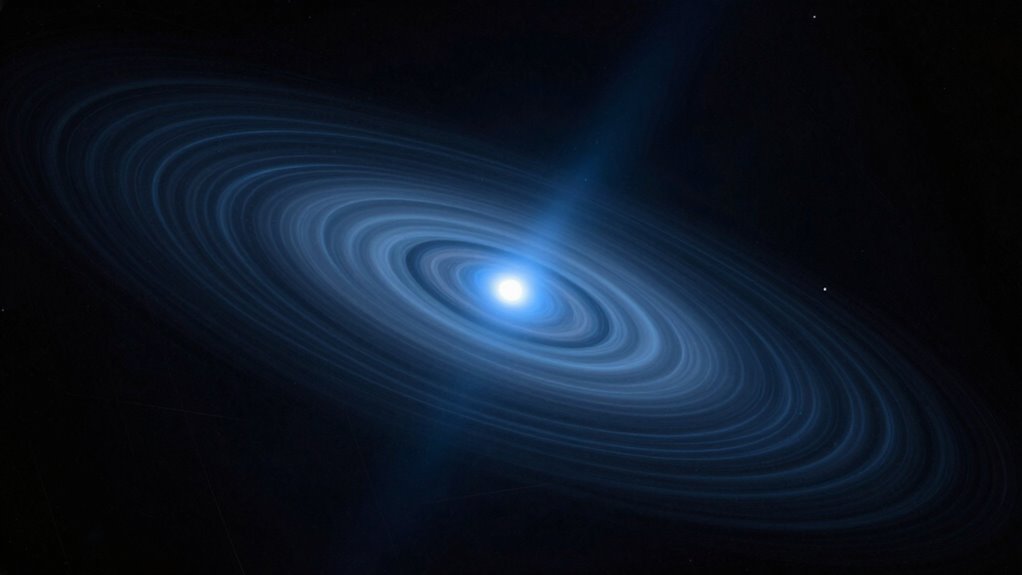
Pulsar beams create regular pulses because the neutron star’s strong magnetic field channels charged particles toward its magnetic poles, generating focused beams of radio waves. As the star spins, these beams sweep across space like lighthouse beams, creating the pulses we detect. The stability of these pulses depends on precise beam alignment, which remains steady over long periods. If the magnetic axis is well-aligned with the rotation axis, the pulses stay consistent. Any wobbling or misalignment can cause irregularities. To visualize, consider this table:
| Aspect | Effect on Pulses | Importance |
|---|---|---|
| Beam alignment | Maintains pulse stability | Ensures regular signals |
| Magnetic stability | Prevents pulse drift | Keeps signals consistent |
| Rotation rate | Affects pulse timing | Determines pulse frequency |
Additionally, the magnetic field plays a critical role in shaping the behavior of pulsars and their emission patterns. Moreover, the rotation rate of a pulsar can vary slightly over time due to internal processes, influencing its pulse pattern. Changes in the pulsar’s internal structure can also lead to timing irregularities, which are important for precise astrophysical measurements.
What Are the Different Types of Pulsars and Their Features?
You’ll find that millisecond pulsars spin incredibly fast, completing hundreds of rotations each second. On the other hand, magnetar pulsars emit intense bursts of energy that outshine typical pulsars. Understanding these differences helps you grasp the diverse features pulsars can exhibit.
Millisecond Pulsars’ Speed
Millisecond pulsars are remarkable for their incredible rotation speeds, often spinning hundreds of times per second. These rapid spins result from neutron star collisions and interactions in binary systems, which transfer angular momentum and spin them up. Their extreme speed makes them some of the universe’s most precise clocks. This precision helps scientists detect gravitational waves by observing tiny variations in their signals. Because of their stability and rapid rotation, millisecond pulsars serve as natural laboratories for testing physics under extreme conditions. Their speed offers clues about their formation and evolution, especially how they achieve such rapid spins after neutron star collisions. By studying millisecond pulsars, researchers gain insights into fundamental astrophysical processes and the universe’s gravitational landscape.
Magnetar Pulsars’ Intensity
Among the different types of pulsars, magnetar pulsars stand out because of their extraordinary magnetic fields and intense emissions. Their magnetic intensity is billions of times stronger than typical pulsars, resulting in powerful bursts of energy emission. This immense magnetic field fuels dramatic X-ray and gamma-ray outbursts, making magnetars some of the universe’s most energetic objects. The energy emission from these pulsars can be so intense that it temporarily outshines other cosmic sources. Unlike regular pulsars that emit steady radio waves, magnetars produce sporadic, high-energy flashes. Their remarkable magnetic strength directly influences their intensity, creating a fascinating cosmic spectacle. If you observe a magnetar, you’re witnessing an object with the most potent magnetic forces and energy emission in the pulsar family.
How Do Scientists Observe and Study Pulsars Today?
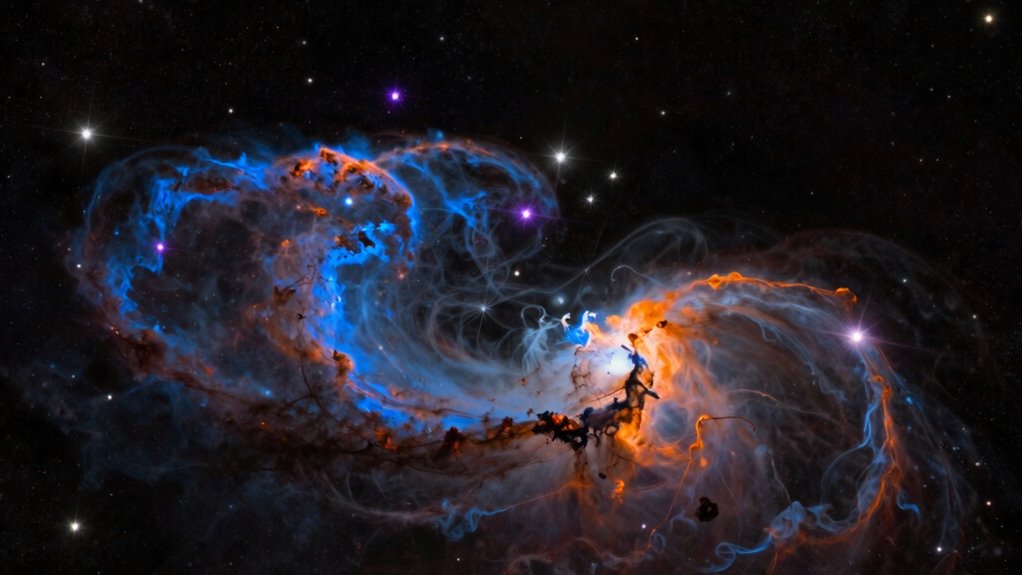
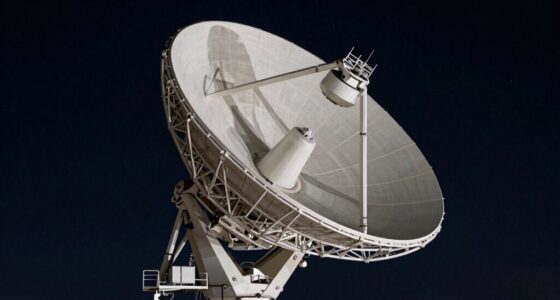
Scientists observe and study pulsars today primarily by using advanced radio telescopes that can detect their precise and regular radio signals. These telescopes capture faint signals from pulsars across vast distances, enabling detailed analysis. Once the signals are received, scientists perform data analysis to identify pulse patterns, measure rotation periods, and study any irregularities. This process helps reveal insights into the pulsar’s properties and behavior. Additionally, adaptive signal processing techniques are employed to filter out noise and enhance detection accuracy. Researchers also utilize interferometry to improve spatial resolution and gain more detailed observations of pulsar emissions. The development of high-sensitivity receivers further enhances the ability to detect weaker signals from distant pulsars, expanding our understanding of these fascinating objects. Furthermore, data analysis software plays a crucial role in interpreting the complex signals received from pulsars, enabling scientists to uncover subtle features and anomalies. Modern computational methods also assist in simulating pulsar environments, providing deeper insights into their mechanisms.
Recent Discoveries and the Future of Pulsar Research
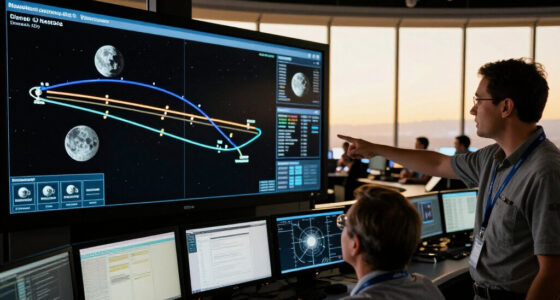
Recent discoveries in pulsar research have markedly expanded our understanding of these intriguing objects. Advances in observing neutron star interactions have revealed complex behaviors, such as glitch phenomena and binary system dynamics. Pulsar timing arrays are now key tools for detecting gravitational waves, opening a new window into the universe. These arrays use precise measurements of pulsar signals to identify ripples in spacetime caused by massive cosmic events. Ongoing technological innovations have significantly improved observational capabilities, enabling more detailed data collection. Future research aims to improve pulsar timing accuracy and discover more millisecond pulsars, enhancing our ability to probe fundamental physics. As technology advances, you can expect even more precise data that will deepen insights into neutron star interactions and the broader cosmos. Enhanced observational techniques are expected to significantly boost data quality, leading to groundbreaking discoveries in pulsar astronomy. This ongoing work promises exciting discoveries, shaping the future of pulsar astronomy.
Why Pulsars Matter: Their Role in Modern Astronomy
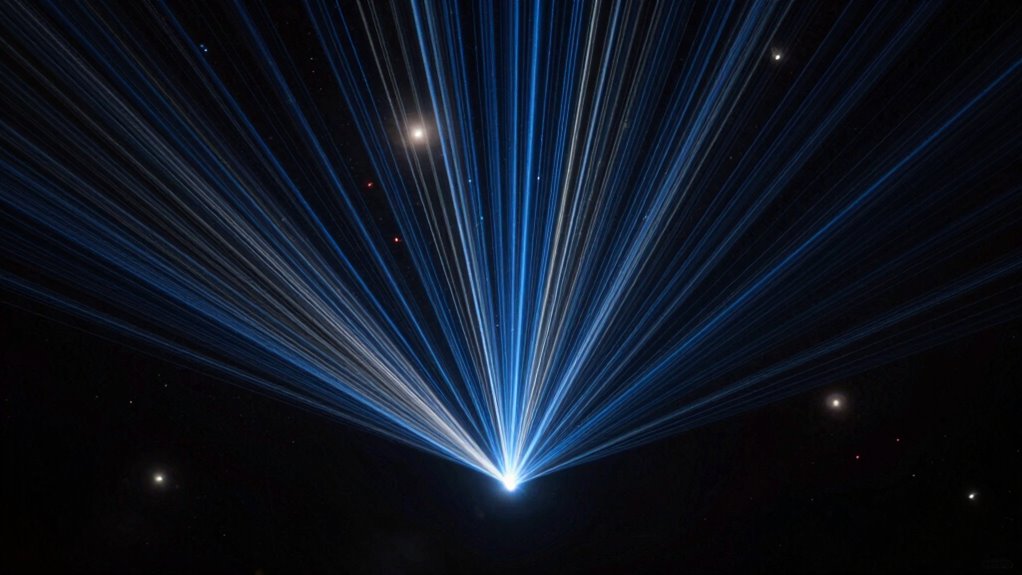
Pulsars are essential tools in modern astronomy because they serve as precise cosmic clocks and probes of fundamental physics. Their regular signals help you navigate the universe through cosmic navigation, similar to GPS but on a galactic scale. Scientists use pulsars to detect gravitational waves, ripples in spacetime caused by massive cosmic events. This makes pulsars invaluable for studying phenomena that are otherwise difficult to observe. Pulsars also act as natural laboratories, allowing you to test theories of gravity and matter under extreme conditions. Their predictable pulses enable high-precision timing experiments, advancing our understanding of the universe’s fabric. By leveraging pulsars, you gain a powerful method to explore the universe’s hidden forces and structure. They truly are the universe’s fastest, most reliable beacons.
Frequently Asked Questions
Can Pulsars Be Used for Navigation in Space?
Yes, pulsars can be used for spacecraft navigation through pulsar timing. You can rely on their precise, regular signals to determine your position in space, much like GPS works on Earth. By measuring the arrival times of pulsar signals, you can accurately calculate your location, making pulsar-based navigation a promising method for deep-space missions. It offers a reliable, autonomous way to navigate without depending on Earth-based systems.
How Do Pulsars Help Test Theories of Gravity?
Imagine a cosmic lighthouse, shining through the fabric of space-time; pulsars help test gravity theories by acting as precise clocks. When gravitational waves pass, they cause tiny shifts in pulsar signals, revealing relativistic effects. These observations allow you to verify Einstein’s predictions, detect gravitational waves directly, and refine your understanding of gravity’s true nature, turning pulsars into invaluable tools for probing the universe’s deepest mysteries.
Are There Any Known Planets Orbiting Pulsars?
Yes, there are known planets orbiting pulsars, called pulsar planets. You can detect these exoplanets through precise pulsar timing, which reveals tiny variations caused by orbiting bodies. These pulsar planets help expand your understanding of planet formation and demonstrate how exoplanet detection methods can identify planets in extreme environments. They’re rare but fascinating, showing that planets can exist even around the universe’s most extreme objects.
What Is the Fastest Rotation Rate Observed in a Pulsar?
You’re in for a surprise—PSR J1748-2446ad holds the record with a rotation speed of about 716 times per second. Its incredible magnetic field powers this rapid spin, making it one of the fastest pulsars known. The sheer speed pushes the limits of physics, showing how a dense neutron star can rotate so fast without breaking apart. It’s a prime example of nature’s extremes, pushing the boundaries of what’s possible.
How Do Scientists Differentiate Between Pulsars and Other Cosmic Objects?
You can tell pulsars apart from other cosmic objects by examining their spectral signatures and timing analysis. Pulsars emit highly regular signals with specific spectral features, unlike stars or galaxies. By analyzing the timing of their pulses, which are incredibly precise, scientists identify their unique rotational patterns. This combination of spectral signatures and consistent timing helps distinguish pulsars from other celestial bodies in the universe.
Conclusion
Pulsars are like celestial lighthouses, guiding scientists through the universe’s secrets. Their rapid spins and precise signals decipher mysteries of extreme physics and cosmic evolution. As you explore their fascinating nature, you realize they’re more than just stars—they’re cosmic timekeepers and testbeds for fundamental laws. By studying these cosmic beacons, you’re tuning into the universe’s heartbeat, revealing how it’s been shaping itself since the dawn of time.
Fall Picks
fall essentials
As an affiliate, we earn on qualifying purchases.