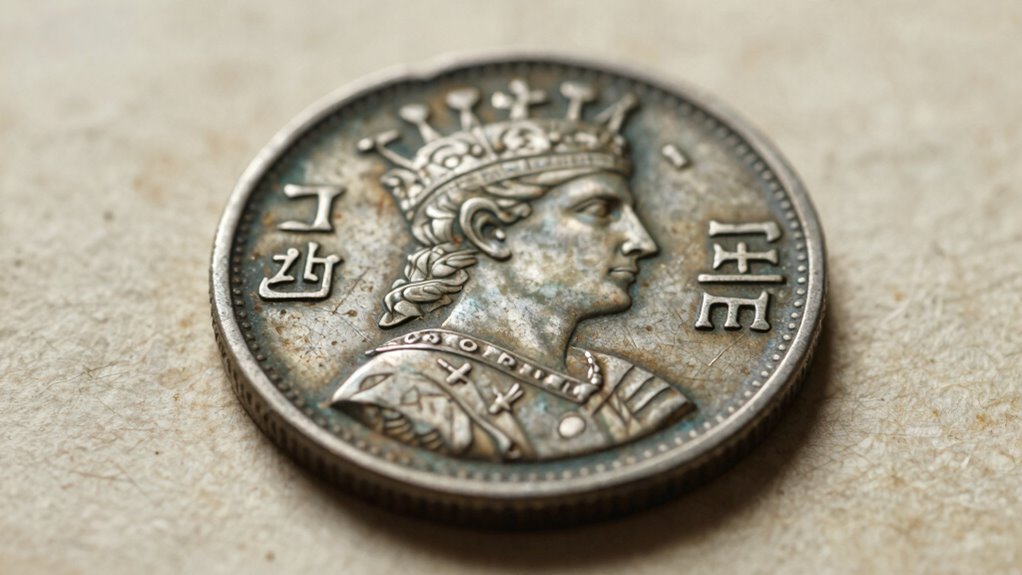

Old coins are powerful historical evidence because they capture moments of cultural identity, political power, and economic change, all through imagery, inscriptions, and symbols. They reveal societal values, religious beliefs, and technological advancements, while also illustrating trade networks and resource availability. Coins reflect shifts in governance and societal priorities over time. By examining these artifacts, you gain insight into past civilizations’ lives and ways of thinking—if you keep exploring, you’ll uncover even richer stories behind them.

Prime made for students and young adults
- Fast, free delivery for dorm and study essentials
- Prime Video and Amazon Music included
- Member-only deals
Key Takeaways
- Old coins reflect cultural values, political authority, and societal priorities through imagery, inscriptions, and symbols.
- They reveal technological advancements and craftsmanship quality, indicating a civilization’s technological progress.
- Coins serve as trade links, showing economic networks and resource exchange across regions and time periods.
- Variations in coin design and metal composition indicate political changes, stability, or societal upheaval.
- They provide archaeological context, offering insights into historical events, trade routes, and societal interactions.

Have you ever wondered what old coins can reveal about the past? These tiny artifacts are more than just metal discs; they’re snapshots of history, capturing moments of cultural identity, political power, and economic change. When you examine an ancient coin, you’re peering into a world long gone, understanding how societies expressed their values through their currency. Ancient minting techniques tell you about technological advancements, craftsmanship, and resource availability, offering insight into the skills and innovations of past civilizations. Coins produced with intricate designs and high-quality metal reflect a period of stability and prosperity, while rougher, more hurried minting hints at economic struggles or wartime chaos. The metal composition of coins can also reveal information about available resources and trade networks of ancient societies. One of the most compelling reasons old coins serve as powerful historical evidence is their role in conveying currency symbolism. Every emblem, inscription, and imagery on a coin is carefully chosen to communicate a message. Rulers often stamped their portraits or titles to assert authority, making coins a form of propaganda that reinforced their legitimacy. Deities, animals, or mythological figures frequently appeared on coins, representing religious beliefs or cultural ideals. These symbols help you understand what societies valued, feared, or revered. For example, a coin depicting a sun god might indicate a society’s religious focus, while one featuring a lion could symbolize strength and sovereignty. Additionally, analyzing minting techniques can provide insights into the technological capabilities of ancient civilizations and their level of craftsmanship. Ancient minting was a meticulous process, and the designs were often standardized to guarantee trust and acceptance. The consistency in coinage signifies organized governance and a centralized authority that maintained economic stability. If you analyze different coins from the same era, you can trace changes in political regimes, such as shifts in ruling dynasties or empires. Coins also traveled far beyond their place of origin through trade, revealing patterns of commerce and cultural exchange. They serve as tangible links connecting distant societies, showing how currency facilitated interaction and influence across regions. Furthermore, the archaeological context where coins are found can provide crucial information about the historical setting and trade routes. The metal analysis of coins further helps archaeologists understand the trade networks and resource procurement of ancient civilizations. Studying coin circulation over time can also shed light on economic stability, inflation, or monetary policies within a society.
In essence, old coins are compact records of history, packed with information about technological progress, political messages, religious beliefs, and economic networks. By studying these small artifacts, you gain a deeper understanding of how ancient societies viewed themselves and communicated their identities. Each coin you examine is a piece of a larger story—one that spans centuries and continents—making it a fascinating and invaluable window into the past.
As an affiliate, we earn on qualifying purchases.
Frequently Asked Questions
How Do Coin Designs Reflect Cultural Influences?
You see that coin designs reflect cultural influences through artistic motifs and religious symbols, which reveal the beliefs and values of the society that created them. By examining these elements, you can identify connections to local traditions, rulers, or religious practices. These designs serve as visual records, showing how culture, religion, and politics intertwined, giving you a deeper understanding of historical societies and their unique identities.
Can Coins Reveal Trade Routes and Economic Exchanges?
Coins are like tiny maps, revealing trade routes and economic exchanges through their circulation patterns. By studying ancient metallurgy, you see where metals were mined, crafted, and traded. As coins traveled across regions, they tell a story of interconnected economies. When you analyze circulation patterns, you uncover the flow of goods, wealth, and influence, turning small metal discs into grand tales of commerce that shaped civilizations.
What Methods Are Used to Date Ancient Coins?
You can date ancient coins by analyzing their metal composition and minting techniques. Examining the alloy helps identify the period, as certain metals were popular at specific times. Studying minting techniques, like die patterns and strike methods, reveals when coins were produced. Combining these methods, along with stylistic and historical context, allows you to accurately determine the age of ancient coins, offering invaluable insights into past civilizations.
How Do Coin Inscriptions Help Identify Historical Figures?
You see, about 85% of ancient coins feature inscriptions that help identify historical figures. Through inscription analysis, you can decipher names, titles, and dates, making them invaluable for historical research. Numismatic symbolism often complements this info, revealing the figure’s role or significance. These inscriptions serve as direct links to the past, allowing you to connect with the figures and events that shaped history, making coins genuine time capsules.
Are There Myths Associated With Certain Old Coins?
Yes, there are myths associated with certain old coins. You might encounter coins featuring mythical symbols or figures, which often reflect superstition beliefs or cultural stories of the time. People believed these symbols could bring good luck or ward off evil. Over centuries, these myths have grown, making such coins not only valuable historically but also rich in symbolic meaning, fueling fascination and legends surrounding their origins.
As an affiliate, we earn on qualifying purchases.
Conclusion
Think of old coins as tiny time travelers, carrying stories from eras long past. Just like a compass guides a traveler through unfamiliar lands, these coins steer you into history’s heart, revealing secrets of ancient economies, rulers, and cultures. When you hold a coin, you’re holding a piece of history’s puzzle—each one a small but powerful key revealing stories that shaped the world. Embrace them, and watch history come alive in your hands.
As an affiliate, we earn on qualifying purchases.
As an affiliate, we earn on qualifying purchases.
Halloween Picks
halloween
As an affiliate, we earn on qualifying purchases.