

If you need high magnification to view tiny details like cells or bacteria, a compound microscope is your best choice since it offers magnification from 40x to over 1000x. For examining larger, three-dimensional objects such as insects or circuit boards, a stereo microscope is ideal because it provides lower magnification and a wider field of view. Understanding the differences helps you pick the right tool for your specific task—discover more to make an informed decision.

Prime made for students and young adults
- Fast, free delivery for dorm and study essentials
- Prime Video and Amazon Music included
- Member-only deals
Key Takeaways
- Compound microscopes are ideal for viewing tiny, transparent structures like cells and bacteria at high magnification.
- Stereo microscopes are better suited for examining larger, three-dimensional objects and surface details.
- Compound microscopes require specimen preparation, such as slides and thin tissue slices, for detailed analysis.
- Stereo microscopes offer real-time, surface-level viewing without extensive sample preparation.
- Stereo microscopes are more portable and easier to handle for quick inspections and on-site tasks.
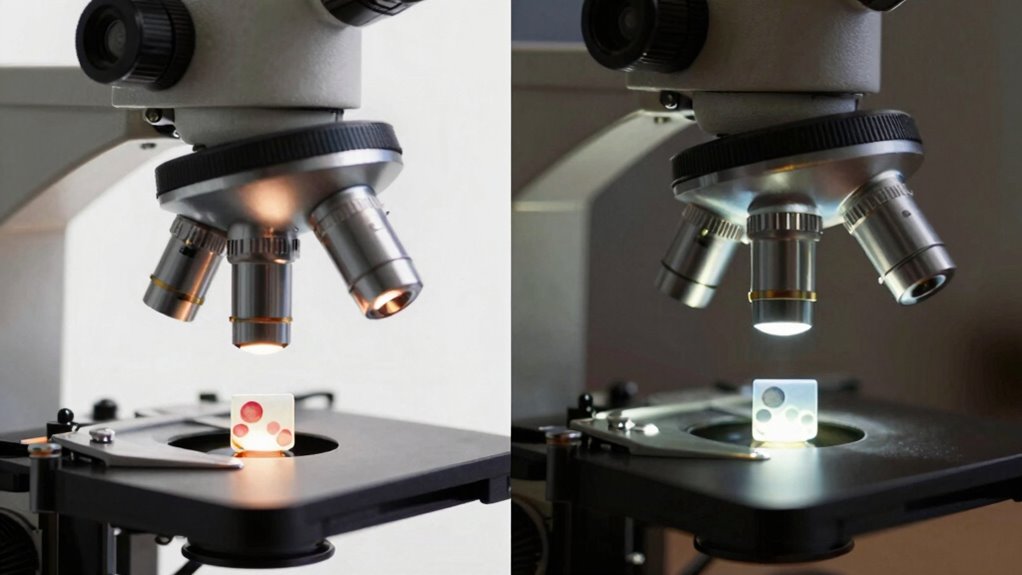
When choosing between a compound and stereo microscope, understanding their fundamental differences is essential. One of the key distinctions lies in their magnification differences. A compound microscope typically offers higher magnification, often ranging from 40x up to 1000x or more. This makes it ideal for viewing tiny details, such as cells, bacteria, or thin tissue slices. On the other hand, a stereo microscope provides lower magnification, usually between 10x and 50x. While this might seem limited, it’s perfectly suited for examining larger, three-dimensional objects with clarity and depth. Recognizing these differences helps you determine which microscope aligns with your specific needs, whether you’re analyzing microscopic structures or inspecting larger specimens. Additionally, the magnification capabilities of each microscope influence their suitability for different tasks. Application scenarios also play a significant role in choosing between the two microscopes. If your work involves biological research, microbiology, or laboratory analysis, a compound microscope is often the right choice. Its high magnification and ability to view thin sections or cells make it indispensable in scientific settings. Conversely, if your focus is on inspecting circuit boards, jewelry, or insects, a stereo microscope is more practical. Its wider field of view and three-dimensional visualization enable you to see the surface details and spatial relationships of larger objects without needing to prepare thin slices or slides. Additionally, understanding the optical systems of each microscope helps in selecting the appropriate instrument for your specific tasks. The optical quality of the lenses also plays a crucial role in achieving clear and accurate images. A good lighting system can further enhance image clarity and detail, especially in complex specimens. Moreover, the ease of use and portability of stereo microscopes make them an excellent choice for quick inspections or on-site work.
As an affiliate, we earn on qualifying purchases.
Frequently Asked Questions
Can Compound Microscopes View Living Specimens Effectively?
Yes, compound microscopes can view living specimens effectively, but with some limitations. Their magnification limits and the need for proper illumination techniques are essential. You should use brightfield or phase contrast illumination to observe live organisms without harming them. While they offer high magnification, you might need special techniques to enhance visibility and reduce damage, ensuring you get detailed views of your living specimens.
Are Stereo Microscopes Suitable for Detailed Cellular Analysis?
Stereo microscopes aren’t ideal for detailed cellular analysis because they lack the high magnification capabilities needed for viewing tiny cell structures. However, they excel in providing excellent depth perception, allowing you to observe larger specimens with a three-dimensional view. If your focus is on dissecting or examining larger objects, a stereo microscope is perfect. But for detailed cellular work, a compound microscope offers the higher magnification required.
What Is the Typical Price Range for Each Microscope Type?
Like the price of a fine wine, the cost varies for microscopes. Compound microscopes typically range from $100 to $3,000, offering higher magnification capabilities and advanced illumination methods, making them ideal for cellular detail. Stereo microscopes are generally more affordable, costing between $50 and $2,000, with simpler illumination and lower magnification, perfect for larger specimens. Your choice depends on your specific needs and budget.
How Portable Are Compound and Stereo Microscopes?
You’ll find that stereo microscopes are generally more portable, making them ideal for fieldwork, thanks to their compact design and robust build. Compound microscopes tend to be less portable due to their size and complexity. When considering portability, think about their magnification capabilities and illumination options, as stereo microscopes often feature adjustable lighting for different environments, while compound microscopes usually rely on built-in illumination suited for static lab settings.
Which Microscope Type Is Better for Educational Purposes?
For educational purposes, a compound microscope is better because of its high magnification capabilities and optical clarity, allowing students to observe tiny details in slides and specimens. You’ll find it ideal for biology and medical studies. A stereo microscope offers a broader view with lower magnification, suitable for larger objects or dissections. Choose based on whether students need detailed internal views or broader, three-dimensional perspectives.
As an affiliate, we earn on qualifying purchases.
Conclusion
In the grand symphony of microscopic exploration, choosing between a compound and stereo microscope is like selecting the right instrument for the melody. Each reveals a different universe—one with intricate, layered details, the other with a broader, three-dimensional vista. By understanding their unique voices, you’ll open the perfect harmony for your discovery, turning the tiny world into a masterpiece of clarity and depth. Let your curiosity be the conductor guiding your choice.
digital compound microscope with camera
As an affiliate, we earn on qualifying purchases.
As an affiliate, we earn on qualifying purchases.
portable stereo microscope for fieldwork
As an affiliate, we earn on qualifying purchases.
As an affiliate, we earn on qualifying purchases.
Halloween Picks
halloween
As an affiliate, we earn on qualifying purchases.