

Today, quantum computers can perform specialized calculations faster than classical ones, especially in areas like cryptography, optimization, and simulating quantum systems. They handle complex problems such as drug discovery and material design more efficiently by emulating quantum phenomena directly. While still limited by hardware and error correction challenges, these systems are already useful for niche, demanding tasks. If you’re curious about how these capabilities are evolving, there’s much more to explore.

Prime made for students and young adults
- Fast, free delivery for dorm and study essentials
- Prime Video and Amazon Music included
- Member-only deals
Key Takeaways
- Quantum computers are currently used for specialized tasks like quantum simulations and optimization problems.
- They can break certain cryptographic algorithms, prompting development of quantum-resistant encryption.
- Quantum systems help model complex chemical reactions and materials more accurately than classical computers.
- Existing quantum hardware allows for niche applications despite limited qubit count and coherence time.
- Quantum algorithms enable exploring multiple solutions simultaneously, improving problem-solving efficiency in specific fields.
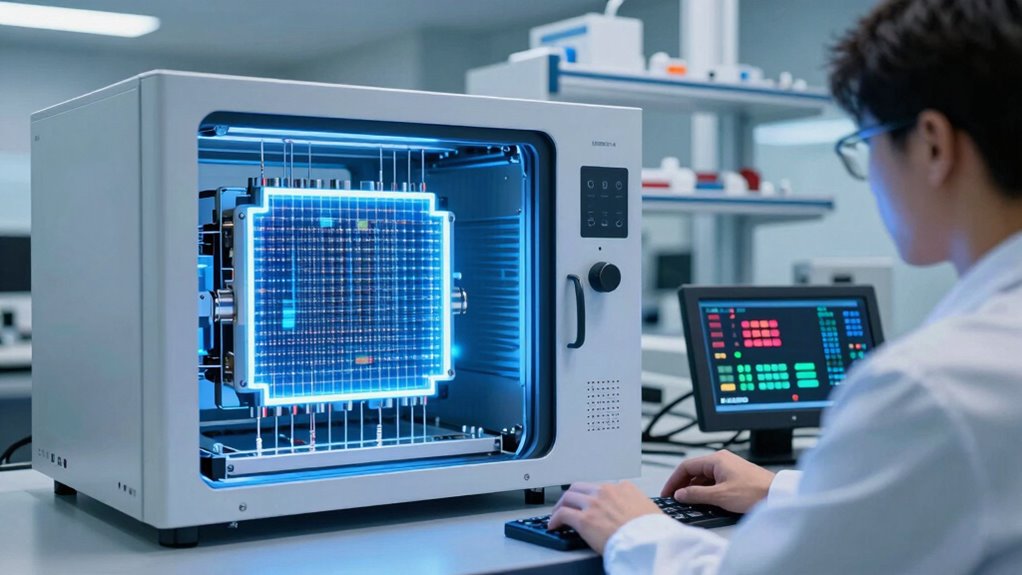
Quantum computing has advanced rapidly in recent years, transforming from a theoretical concept into a practical technology with real-world applications. Today, you can see its potential in fields like cryptography, optimization, and complex simulations. At the core of these breakthroughs lies quantum entanglement, a phenomenon where particles become interconnected so that the state of one instantly influences the state of another, regardless of distance. This unique property allows quantum computers to process vast amounts of information simultaneously, giving them an edge over classical computers in solving certain problems.
Quantum computing is rapidly evolving, unlocking new potential in cryptography, optimization, and complex simulations through entanglement.
However, working with quantum systems isn’t without challenges. Quantum bits, or qubits, are fragile and prone to errors caused by environmental noise and decoherence. That’s where error correction becomes critical. Unlike classical error correction, which relies on redundancy, quantum error correction involves encoding information across multiple entangled qubits. This way, if some qubits decohere or get corrupted, the overall information can still be recovered without disturbing the quantum state. Error correction techniques are continuously improving, making quantum computations more reliable and scalable, which directly impacts their practical applications.
Right now, you can leverage quantum computers for specific tasks that are extremely complex for classical systems. For example, in cryptography, quantum algorithms like Shor’s algorithm threaten to break widely used encryption methods, prompting the development of quantum-resistant cryptography. While widespread implementation is still a few years away, research labs are already testing these algorithms on real quantum hardware. In the domain of optimization, quantum computers excel at solving problems involving many variables and constraints, such as supply chain logistics or financial modeling. Their ability to explore multiple solutions simultaneously accelerates finding best or near-best solutions, which can markedly improve efficiency.
Simulating molecules and materials is another area where quantum computing is making tangible progress. Because quantum systems naturally emulate other quantum phenomena, you can use them to model complex chemical reactions or new materials more accurately than classical computers. This capability holds promise for drug discovery and developing new substances. Although current quantum hardware is still limited in qubit count and coherence time, ongoing advancements in error correction and quantum entanglement are steadily pushing the boundaries of what’s achievable. Additionally, quantum hardware development continues to improve, enabling larger and more stable quantum systems.
In essence, you’re witnessing a landscape where quantum computers are already useful for niche applications, thanks to fundamental properties like quantum entanglement and error correction. While they aren’t replacing classical computers yet, their unique strengths position them as powerful tools for tackling problems that are otherwise intractable, paving the way for breakthroughs across multiple industries.
As an affiliate, we earn on qualifying purchases.
Frequently Asked Questions
Can Quantum Computers Replace Classical Computers Entirely?
No, quantum computers can’t replace classical computers entirely. You’ll find quantum algorithms excel at specific tasks like factoring and optimization, but they still struggle with Qubit stability and error correction. Classical computers remain essential for everyday tasks because they’re reliable and well-developed. Quantum tech is evolving, but for now, it complements classical systems rather than replaces them. Expect hybrid solutions rather than full replacement in the near future.
How Secure Is Quantum Encryption Currently?
You might think quantum encryption is unbreakable, but there’s a twist—quantum vulnerability still exists, making its security not absolute. While encryption resilience has improved, experts warn that powerful quantum computers could eventually crack current protocols. So, your data’s security isn’t as airtight as it seems; it’s more like a high-tech bubble—impressive, but not invincible. Stay tuned; the quantum race is far from over.
What Industries Are Most Affected by Quantum Advancements?
You’ll find finance, pharmaceuticals, and cybersecurity most impacted by quantum advancements. Quantum algorithms are transforming these industries by enabling faster data analysis, complex simulations, and enhanced encryption. As quantum technology progresses, expect industry transformations that improve drug discovery, optimize financial models, and strengthen security measures. Staying informed about these developments helps you anticipate changes and leverage quantum innovations for competitive advantage in these sectors.
Are There Any Real-World Quantum Computing Applications Now?
Right now, there are real-world quantum computing applications, mainly in research and specialized fields. You can see quantum algorithms being used to optimize complex problems, like drug discovery and financial modeling, while quantum hardware is being developed to improve accuracy and stability. Though widespread use isn’t here yet, these advancements are paving the way for future breakthroughs, making quantum computing increasingly practical for industry and scientific challenges.
How Expensive Is Building and Maintaining a Quantum Computer?
Quantum costs and maintenance expenses make building and maintaining quantum computers incredibly costly. You’ll face hefty hardware costs, delicate cooling systems, and constant calibration efforts. These quantum quandaries mean only well-funded organizations can afford the advanced apparatus needed. The price tag can soar into millions, and ongoing upkeep demands significant resources. In short, quantum computing’s high costs limit widespread access, making it a premium investment rather than a casual or affordable venture.
As an affiliate, we earn on qualifying purchases.
Conclusion
Right now, quantum computing is like a promising seed, just beginning to break through the earth’s surface. It’s not yet a towering tree, but its roots are spreading, ready to reveal mysteries that once felt unreachable. With each breakthrough, you’re witnessing the dawn of a new era—one where the impossible dances on the edge of reality. Keep watching, because this isn’t just technology evolving; it’s the universe whispering its secrets, waiting for you to listen.
As an affiliate, we earn on qualifying purchases.
As an affiliate, we earn on qualifying purchases.
Halloween Picks
halloween
As an affiliate, we earn on qualifying purchases.